The Path of Surrender instead of Controlling the Breath

It begins with the breath. A small breath practice done consistently everyday is where it starts. A small practice grows through persistence, unrelenting devotion and enthusiasm. There is no way to willfully force your body into a big breath practice. The most valuable thing you can do for your life is to develop your breath. It absolutely will happen for you, if you apply yourself in the right way.

The path of Surrender is the easiest, quickest and surest path of developing the breath. There will be definite mile markers along the way (ie blood purifies, nitric oxide turns on, pain relievers released, breath slows down, mind gets concentrated.) You will come to experience these mile markers, but in a disinterested way.

The biggest failing of all the "Brain hacks" and "Breath hacking" Youtube videos is this fundamental misunderstanding what a breath practice is. You need to grow long term patience, a continuous, unrelenting immersion into this very next arising breath with a listening mind and an open heart. One Youtube guy teaches a "breath speed ball" that speeds you up and slows you down in 30 seconds. The goal is to achieve by force a slick momentary result. That is not going to change the trajectory of your life in any profound way.

Start with your breath practice each morning. Build it and don't stop. 21 days become 90 days, then a lifestyle starts to emerge. That is what this online course is about. Simple baby steps done repeatedly with a loving heart full of acceptance, gratitude and surrender is a path anyone can travel.

details tomgillette.com

This picture was taken is during Bapuji's 4 years of living in Sumenytown, PA. Photo credit Umesh Eric Baldwin

bapuji.flow.upward.jpg

Breath 7 Days a week is what's difficult

Most yogis don't understand the difference between a yoga aasana practice and a praanaayaama practice.

Americans often learn about yoga at their local studio. They sign up for classes and usually take 1, 2 or 3 classes a week, for 75-90 minutes long. Gentle yogis go less often than hardcore hot yogis. I have years of Mindbody data on this. The hardcore group, often younger in age, will go 4, 5 and 6 days a week for 90 minutes of hot flow vinyasa, Bikram, or Ashtanga.

You are supposed to take days off from yogaasana to let your body rest. It is part of the practice. Women have "Moon Days," in the Ashtanga practice. You are supposed to not practice Ashtanga on those days. This mindset of taking days off is how "yoga practice" is viewed in America.

Praanaayaama doesn't work that way. Praanaayaama is 7 days a week. It is only 25 minutes long. Even though breath practice is physically easy and not strenuous to do, 7 days a week, without fail is a real burn. It is difficult to do that at first. The initial struggle is in the unwavering consistency of applying yourself in baby steps without interruption. That is a massive challenge at first.

Once you get the habit going, it is easy. You start a new habit after 21 days. At 40 days, you might get "momentum" going where the practice effortlessly carries itself. After 90 days, you start moving into a lifestyle choice that takes you on a remarkable journey. You cannot know about what is going to happen ahead of time. While aasana is obvious, praanaayaama is subtle at first.

Once you are firmly established in an everyday practice, mile markers start showing up (ie blood purifies, capillaries expand, clean blood goes to the brain, nitric oxide turns on and initiates neuroplasticity, development the brain and intellect, cellular respiration becomes magnificently efficient, breath slows down, mediation becomes easy, with laser like focus.) You start living inside each breath all day long.

When I was first introduced to yoga at Kripalu Ashram in the 1980's, the practice was mainly praanaayaama. Aasana was considered not as important. Every morning for 3 years during my early ashram days, I only missed 5 days of 4am praanaayaama because of travel. It was a rock solid lifestyle habit. I loved how powerfully amazing the the breath was each morning. There iss this sense of physical development with spiritual forward movement. It is hard to describe. Over the years, I forgot about my starting place with yoga. I later got lost in decades of yoga postures because I had an athletic gymnastic body.

In 1995, I recorded the first "Kripalu Vinyasa" flow and it was distributed by KYTA, the Kripalu Yoga Teacher Association. In 1996, I went to Mysore and got super ripped with Patthabhi Jois and Sharath. In the Kripalu Main Chapel with a crowd of 125 or so, I did my awesome yogi show, all these cool rad arm balances strung together like pearls. Everyone was suitably impressed, except my roommate Gitananand Grey Ward. He came up afterwards and said, "when are you going to stop fooling around with aasana and get back to your real practice?" He nailed me.

The answer is "about 21 years later."

Three years ago, with my body and life falling apart, I went back to my ashram praanaayama practice. I knew how to do it intellectually, but I was nowhere near the stage of momentum or making it a lifestyle. I had to start easy, from the beginning, taking one little step forward at a time. I started recording these steps. I cried a lot.

This Next Breath 1 started out as 7 days of practice. Students who joined early on, claimed it was nowhere near enough. The course expanded to 40 days of practice, each day the same practice but with a different theme and focus point. We all need variety. We need regularity with some novelty added in to keep practice fresh.

This Next Breath 1 became This Next Breath 2 (Advanced.) TNB2 is similar to Bapjui's (Swami Kripalu's) practice, something the world has not been fully introduced to. Even devotees of Bapuji don't do his breath practice which is weird. They like the devotional part, but not the practice. If you want to know the man, you do his practice. Swami Kripalu taught a path of Surrender to the Breath, don't control the breath. It is a path of listening, responding and over flowing love. It is a practice of Non-Doing while showing up every morning. All the insights will happen quite naturally in their own time.

I am positive the approach will work for you. It has worked for anyone who has sincerely put their focus on it. You must log your time for real, not just in your mind. 25 minutes of this specific breath practice done everyday will change your life in a remarkable way. It is not just any breath practice. You need to know what to focus on, what is important and what is not important. Yes, you will develop your ability to inhale and exhale, but more importantly, your nervous system, brain and internal cellular respiration will change. It has brought me to my knees, in a state of loving wonder, surrennding into life, every breath.


.
#kripalu, #kripalulove, #thisnextbreath, #breath, #pranayama, #prana, #meditation, #mindfulness, #yoga, #yogalove,

82427496_10215050547833662_4394048231558873088_o.jpg

Ahimsaa "Non-violence"


Ahimsaa - “Non violence”

“All you need is Love,” sang the Beatles. And it is true. “Love is our essence” is also true. “Love lies at the core of our being” is a true saying.

The problem is that “Love” is a messy word. There is brotherly love, motherly love, romantic love, sexual love, Platonic love, sentimental love, manipulative love and many other kinds of love. “Love” is very lovely, but it is a confusing, ambiguous word.

Instead of using the word “Love,” Patanjali, the codifier of Classical Yoga established the first principle of yoga as Ahimsaa, “Non-violence.” It is definition by negation. You don’t say what it is, but there is no error. There is no vague entanglement with alternative meanings. Just cease being violent in its many forms. Classical Yoga starts there.

Most people do not see themselves as “violent.” It doesn’t fit in with their good self image of themselves. Ask most people if they are violent and they are probably going to adamantly reply “I am not a violent person.”

Stop what violence? We are conditioned to think of violence as an outer activity. There is violence outside our bodies and there is violence inside our minds. Violence happens on many levels. It is not just outward acts of hurting each other. All outward acts of aggression begin from a painful suffering thoughts. Before any outward hostility starts, the mind has to generate a lot of violent thoughts beforehand.

The subtler type of violence include self rejection, self loathing, gossip, slander, cynicism, sarcasm, (guilty) complaining, blaming, making excuses and passing judgment on another person are all different forms of subtler violence. At some point in our lives, we all have done some of these. They all involve defending the ego.

What causes the violence? The separative and territorial principle known as “Ahamkara,” the ego. The ego is interested in its own survival. Its first directive is to survive and most of all, it fears its inevitable death. Non-violence involves dissolving, transcending or going beyond the ego, which is possible for everyone, even if it is just temporary.

Human beings, especially men, are violent by design. The history of homo sapiens has a long legacy of continuous wars and humans doing horrible things to other humans, animals and nature. Being encased in this ego, this fundamental ignorance separates us from “the world out there,” In the year 2020, we stand at the threshold of our collective annihilation, turning our Garden of Eden into a toxic wasteland of destruction. Stupidity, greed and war have a good chance of wiping out homo sapiens once and for all.

The english word “kindness” does work better. It is a good positive word. It is where most people like to hang their hat. We simple people people need simple directions and “kindness” is a helpful creed to live by. It is easy to remember the word kindness. This is a much longer discussion, but there still is the potential problem stating things in the positive form of “kindness.” It too can fall into Hallmark sentimentality, ambivalence and a fuzzy focus, a feel good generalization that makes everyone dull and happy. “Killing me with Kindness” “Competitive Kindness,” “Disingenuous Kindness” “Kindness that has something to prove” are all very real things done by humans to protect the ego or make it look good. We humans have an infinite capacity to fool ourselves. Patanjali chose the instructive “practice non-violence.” The starting place of Classical Yoga is to withdraw from violence in its many forms.

Affirmation: Today I release all sarcasm, cynicism and judgment of others. No exceptions.

"Why do most yoga classes in America completely skip praanaayaama?"

"Why do most yoga classes in America completely skip praanaayaama?"


Give it time. Yoga is still very new in America and we are still in the very compelling, exercise phase. For most people, yoga is about getting a workout.

Collectively, American yoga is still on "Aasana" the third limb of Classical Yoga. "Vinyaasa," by far the most prevalent form of yoga in the country, started in 1994. "Vinyaasa" did not appear as a class offering before that. The free form, free flowing vinyaasa most teachers teach is a very new thing.


A shift is going to happen in the next 5 - 10 years. As the population of American yoga teachers ages, and their bodies breakdown, yoga teachers are going to find out more about praanaayaama, the fourth limb of Classical Yoga.

"Praanaayaama is the soul of yoga. It is yoga itself." Swaamee Kripalu

75388273_10214600883432333_8384062902398615552_n.jpg

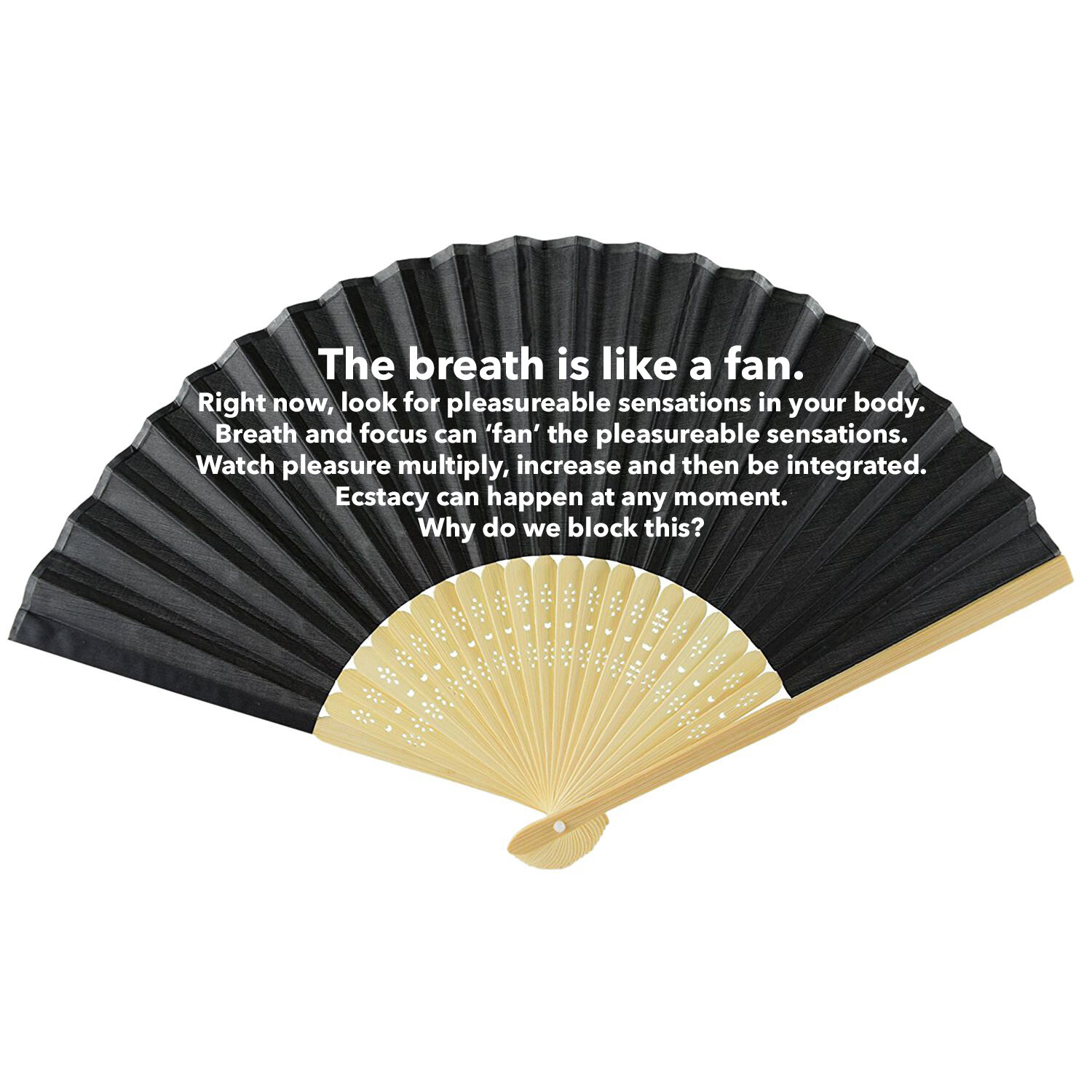
The Breath is like a fan.

If you look for them, you will find our bodies may have painful sensations, but there also are very pleasureable sensations of warmth, spaciousness, tender places and things that have no names. Keep looking and you find rivers of pleasant feelings flowing all the time. Focus on the pleasurable sensations. Look for them. They are there. 

You can 'fan' these pleasurable sensations with your breath-attention and they multiply. When we focus on this delight in our body, and fan them with the breath, the mind dissolves. 

Our mind purposely blocks and avoids too many ecstatic sensations. It is for survival. Pleasurable sensations are constantly rolling in our bodies but our mind turns away from the enormity of it all. At some point, the mind is unable to handle it and still function. If we relaxed too much and let these delightful sensations loose, it would leave us as a dysfunctional mystic, utterly unable to do anything in the external world.

Except Facebook posts. You would still be able to do that.

78581730_10214727481597208_3159678208396230656_o.jpg

"Controlling the breath" is the problem

"Controlling the breath" is the problem. This oft repeated phrase has been leading yogis astray for millennia.

"Who controls the breath?" Usually the brainstem does it automatically. The well meaning yoga teacher starts inflicting breath ratios and breath "holdings" on their poor unsuspecting students. The spiritual ego then gives it a good try, finds that breath ratios do work for a few breaths (there's an app for that) but it soon becomes a miserable nightmare after 10 minutes. Yes you can willfully calm yourself down with a few intentional breaths. But that is where the mistake is made: the willful ego is in charge.

The real gold is in surrendering to the breath. Let go of "I me and mine" and just keep alternating the nostrils for insane amounts of time.


The other problem is no one practices anywhere near enough. The norm for Anuloma Viloma is 5 to 10 minutes, which is a great start and it is where everyone starts, but you will need an easy to follow path that will build your practice into an "every breath practice." That is what This Next Breath 1 & 2 training leads to: All day breath centered awareness. How do you do insane amounts of time, without getting bored? Ahhh. That is what the second part is about.

What happens when you practice massive amounts of Anuloma Viloma? The breath naturally slows down and physiology leads the way. The spiritual ego is not in charge of the Breath. The Breath is in charge. When the breath organically goes slow, meditation is easy. The mind is quiet and focused. The later stages of yoga unfold naturally. This was the method taught to me by Gray Ward and given to him by Swami Kripalu.

I would recommend you begin this training which later becomes a living breath lifestyle.
#prana,##pranayama, #meditation, #mindfulness, #kripalu, #yoga, #yogaeveryday

me.controlling.jpg

What temperature is ideal for practice?

Question:My yoga room was cold today so I jumped out of my reclining pose and put a sweater on.. i decided this morning as long as you are comfortable (sweater) without distraction (cold) worked bit it did make me wonder if there is a specific temperature that is best for the practice?

Answer: “ Great question!

Everyone is going to do what they do. When you first start out, do whatever you want, whatever you need to get your practice going and get to the stage of Momentum.

As far as temperature, being warm and cozy is not recommended.

In general, practice in a cold room, without clothing, or as little clothing as possible. Don't have anything touching your skin. There are about 5 good reasons why the yogis practice this way.

Cold water, cold showers, cold baths are powerful and positively affect praanaayaama. It drives the blood from the extremities and into the central axis and into the center of the brain. The praana pulls inward. When the later stages of praanaayaama really start to take off, the body gets super hot, from the concentration and the pauses of the breath. Another reason for going cold is that the aura around the skin becomes very active. Clothing is disruptive to the changes going on around the skin. You want skin to air. It is better with no cotton, wool or synthetics covering the body. The cold temperature keeps you very alert. The cold helps you transcend reactivity to sensation.

The Himaalayan yogis recommend bathing in freezing cold water. Some practice in the nude with charcoal ashes covering their bodies. The charcoal closes the pores of their skin and keeps them warm a little bit. The charcoal has a detoxifying effect, is readily available and it's free.

And now, everyone will go do, what they want to do.”

613aeb58efed7315fa3e664016b2a16e.jpg

Anxiety is a breathing irregularity

As your mind ruminates about your pocket full of problems today, as your mind starts getting anxious when you "read the news today, oh boy," offer your fears into the sacrificial fire of your breath practice. Burn them up. Put every fearful thought into the fire of your breath.


This actually works.


Almost everyone I meet is suffering from anxiety. Anxiety is a breathing irregularity which leads to a mental state. Change the breath pattern and you change the mental state.


Disaster after disaster, recent world events evidently are spinning out of control. Almost everyone, no matter who you are in 2019, is flipping out. When we look outside, the future picture looks bleak. Engaging with the problems outside of us is a worthy endeavor.


Breathing practices are about handling the situation on the inside. It is not about activity outside our bodies. All we really have is this next breath.


The breath can run away into anxious irregularity or it can lead us back to the calm still moment, and that is all there is.


"There is nothing good or bad, but thinking makes it so." Shakespeare Hamlet 2:2


"Problems don't exist in reality. The only reason you have a problem is because your mind decided something is a problem." Mickey Singer, The Untethered Soul

kaminoff.fire.jpg

How do bacteria, viruses and mold enter the body?

How do bacteria, viruses, and mold enter the body? 98% enter through the mouth.

The yogis called the body the city with 9 gates: 2 eyes, 2 ears, 2 nostrils, one mouth, one anus and one ureter. I am calling the mouth the "drawbridge." Most people leave the drawbridge wide open all day and night for the bacteria, viruses, and mold to walk right in.

There are two vehicles for the bacteria, viruses and mold. They are transported into the castle by Food and Breath.

The food goes down the esophagus and then goes through an acid bath. 80% of our immune system is concentrated in the gut. Our body tries to discern who is an invader and who is helpful.

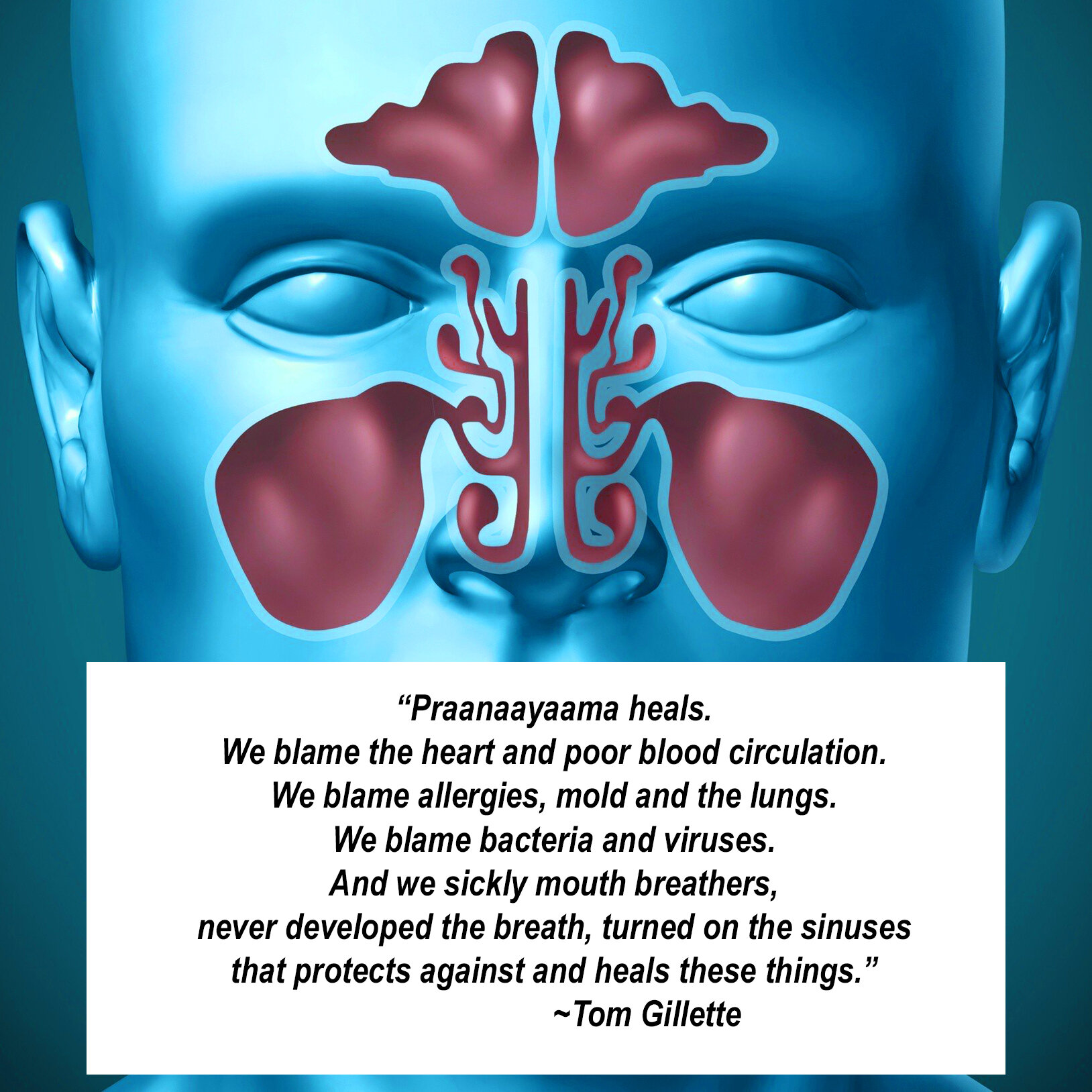
We breathe in 1 million bacteria a day. Most of it harmless. If we breathe in through the nostrils, and the sinuses are working at full efficiency, the Nitric Oxide kills 100% of the bacteria, viruses, mold and parasites. The Nitric Oxide cleans and repairs the blood, arteries and veins. From the aorta, the newly oxygenated blood goes through the carotid artery into the brain. 

If we breathe in through the mouth, the bacteria goes into the lungs. The lungs are not as well protected. There are not many soldiers down there. The bacteria, viruses and mold can more easily enter our blood stream. The dirty blood is distributed to the brain and all the organs of the body. Now the immune system has to fight off the invaders all over the body, because they were let in the front gate.

Most people are mouth breathers. Most people believe they are victims of viruses, allergies, the flu, mold and bacteria. They leave the drawbridge open.

If you close the drawbridge, breathe only through the nostrils, the sinuses become more active, alive and efficient. If you avoid breathing through the nostrils, because your sinuses are clogged and inflamed, it gets worse. They become more inflamed. Diseases arise and get a foot hold in our gut or our lungs.

Close the mouth. Breathe through the sinuses. Practice silence! And if you really want to heal the body.... fast. Nobody enters the front gate. Fortress secure.

The spiritual practices of silence and fasting have a powerful physiological basis.

castle.nine.gates.jpg

Praana body is the door to intelligence

Focus on the breath and the praana body awakens. An infinite source of intelligence becomes available. 

What is important about this quote is the shift from an intellectual understanding of what these words mean to a direct experience. 

I am immensely grateful to this man Gurudev. This meme has been a central teaching of his over many decades. Many thousands of people have lived in his many ashrams. Most now look back on those days as some of the brightest days of our lives.

gurudev.pranabody.jpg

"I can't meditate"

"I can't meditate." 

"If I watch my breath, I get anxious!" are two of the most common reactions people have when they start out with meditation or mindfulness practices. This Next Breath is especially for those people.

I was talking to my friend who is a super successful, wealthy lawyer and he was in misery. He said his mind just races and he can't stop it. His job involves "arguing all day long." At night, he can't get his mind to turn off. The voices keep going about who is right and wrong. He confided in me, while panting and breathing through his mouth, he thought he was going to go insane. The stress is killing him. He tried Mindfulness training and hated it. Mindfulness, observing his breath in a detached way, telling his mind to be still, made his situation worse. He gets more stressed when he meditates.

I told him I could help him. Work actively with the breath first! The quickest way to change the mind is to change the breath. That is what the yogis did! Breath is so much easier, than working with something as subtle and elusive as the layers of mind and emotion, and something as mercurial as thoughts.

An indicator of poor health is rapid breathing while sitting. Rapid breathing will also induce inhaling through the mouth which then compounds the disease patterns and makes everything worse.

An indicator of deep meditation is slowing the breath down. But how to slow down the breath? 

Your ego, your willfulness is not in charge of your breath. The body tightly controls metabolic rates in the body. Forcing your breath into artificial breath ratios, is doomed to failure and it doesn't work for very long. Okay, you can do it for a couple of minutes, but the body rebels. Breath ratios pretty much suck, and no one like to do them, even BKS Iyengar.

Most Praanaayaaama fails because people are trying to control the breath. There is a better way, an alternate school of breath practices, first outlined by Swaamee Kripalu. Free up the breath. Don't enslave it.

This Next Breath can help you with this. From my own experience of slowing down the breath to one breath per minute and then down to 9 breaths over a 10 minute period, I can show you, step by step how to calm the body and breath down... later the mind will calm down too. Work with your Breath First. Your meditation practice will thank you.

There is a catch. Anyone can do this. You don't have to be smart. You don't have to be flexible. You need daily dogged persistence, support and inspiration.

Breath.rate.per.minute.jpg

We blame the heart and never develop the lungs

We tend to blame the heart, because we never developed the lungs. When the ribcage is freed up, the lungs can pump the blood through the body and then the heart can just be an easy going valve.

(When I use the word “ lungs”, of course, this includes the primary and secondary respiratory musculature and the entire rib cage and spinal mobility.) 

The word “lungs” is used because that is the POV, the point of view, The lungs are the place where the attention rests. Where we place attention matters. We do these kinds of awareness experiments in the workshops.

lungs.pump.jpg

Seeing Newness

Alternate Nostril Breath inspires me every morning. 
Yes, you clear your head and become very awake. 
Yes, you fill the body with praana. 
Yes, you feel balanced and more in touch with yourself.
Yes, you turn on the Nitric Oxide and the far reaching effects of that. 
Yes, you integrate your nervous system and activate the Corpus Callosum. 
Another great gift is ..... "newness." 

Anuloma Viloma is the number one Creativity practice. You see things in a new way everyday.

bapuji.newness.jpg

"Breath is not spiritual," some guy said.

I got feedback on one of my posts on a different site. The commenter said he didn't agree with my fundamental viewpoint that "Breath is Spirit." He said "Breath is not spiritual. Breath is nothing special. It is just oxygen and that is all there is to it. It just is. Move on."

Hard core scientific materialism blinds us to the breath.

Most people are completely stuck in the idea that breath is only about the transfer of oxygen and CO2.... and that is ALL breath is about. Scientific Materialism posits that only atoms exist. We live in this cold, unthinking universe and these egos are illusory, passive victims of molecules bumping into each other. There is no purpose or meaning to life. It is just atoms. Scientific materialism is a grim philosophy. Everything else, like beauty, music and enjoyment is not really real. The things we care about most in our day to day experience do not really matter. Our awareness, our experience do not matter as they are deluded fictions and have no validity.

"How do you get consciousness out of six pounds of neurons?" This is called the "Hard Question" in neuroscience that doesn't have an answer in materialistic Newtonian terms. Either consciousness is relegated to a “ghost like delusion” or “consciousness becomes everything” like (the yogis,) some quantum physicists and the “Biocentrists” like Robert Lanza claim. Follow this link for great stuff: (https://www.robertlanza.com)

The quality of our awareness is tied to the breath. This becomes so apparent when you are committed to everyday early morning breath practice.

The Ancient Greeks, Romans, Christians, Jews, Taoists, Buddhists, Jains, Native Americans, Egyptians and many other wisdom traditions, and the Yogis have claimed that Breath is Spirit. Our Breath is connected to Spirit. Jesus Christ mysteriously blew the Holy Spirit into his disciples. Our innermost essence, who we think we are, is tied to the breath. Our moment to moment experience is tied to the breath. That is what really matters to us.

If you want to change your moment to moment experience, change your breath.

The flow of energy, praana, chi through our bodies, is flowing with the flow of breath. The moment to moment miracle of breath and its relationship to being conscious is left out of scientific materialism. 

We get to chose what paradigm we live in. We either examine our thoughts and beliefs and how we came to these conclusions, or we don't and we accept what was given to us.

breath.as.oxygen.jpg

"I am losing my mind" and I don't even own it

A friend exclaimed "I think I am losing my mind!"


How is that possible? She doesn't even own it! You can't lose something if you don't own it.


The mind owns us. The mind runs us most of the time. It is pretty much doing its thing. We can influence it a little bit, at best.


From an evolutionary standpoint, the development of language, abstract thinking and the mind gave humans a huge advantage. It was a pivotal moment that allowed early humans an ability to manipulate the world around us in ways that instinct alone could not.


The mind's first job was to keep the organism safe. The mind constantly scans the environment to detect threats to the organism. The mind's second job was to figure out ways to avoid pain and increase pleasure. Its job description is pretty simple. We cling to the mind's voices for safety. We usually rely on the mind to tell us everything, who we are and what to do. We do so willingly.


Thoughts are as impermanent as changing clouds in the sky. They have no essential permanence to them. They have no power, unless we give them power.


As Mickey Singer, author of "The Untethered Soul" has said, "Don't blame the mind. It is just doing the job you gave it. It is trying to keep you safe." "The mind just lives rent free in your head."


There are many practices for going beyond the mind.


There are the practices labeled "Mindfulness" or "The Witness" or from modern psychology "The Self observing Self." These ancient practices are like using a "thorn to remove a thorn." One sits "behind the thoughts and listens to what the thoughts are." One "watches thoughts like people walking down the street." One "sits in the audience and watches the thoughts, drama and characters on the screen like a movie." There are many more metaphors for understanding this powerful technique.


The yogis used another method that is related, but distinct from Mindfulness, called Praanaayaama. Praanaayaama is about physiologically slowing down the breath. One cannot just decide with the mind to slow down the breath for very long. Sure, you can hold your breath. You can force it, but that doesn't feel good, it kinda sucks and it doesn't really get you anywhere, so far as the mind is concerned.


However, the body and breath can be slowed down through daily habits. The body has enormous resources that are scarcely known. There is a day by day process outlined in This Next Breath and This Next Breath II where over time the efficiency of blood circulation increases, lung volume increases, nervous system slows down and the metabolic need for breath slows down.


When the breath naturally slows down, the character of the mind changes. The difference is like your mind being a sailboat on a stormy sea full of desires and plans and a to-do list. Then, a time comes, when your boat is becalmed, sitting on a glassy lake and there is no wind.


When the breath slows down to 3 breaths per minute, 2 breaths per minute, one breath per minute or lower, the mind is becalmed. It becomes clear. It happens quite organically. It doesn't happen because the mind was telling the breath to slow down. The mind's activity is biologically dependent on what is happening in the organism.


Classical Yoga uses both methods of Praanaayaama and Meditation. They are distinct and yet they are related. Slow down the breath and the functions of the body first, then move on to meditation. It works better.


It makes sense.

mind.owns.you.jpg