
This website and page is under construction. It is not pretty or finished. If you are interested in breath practices, watch this site.
One day, this will seem self-evident.
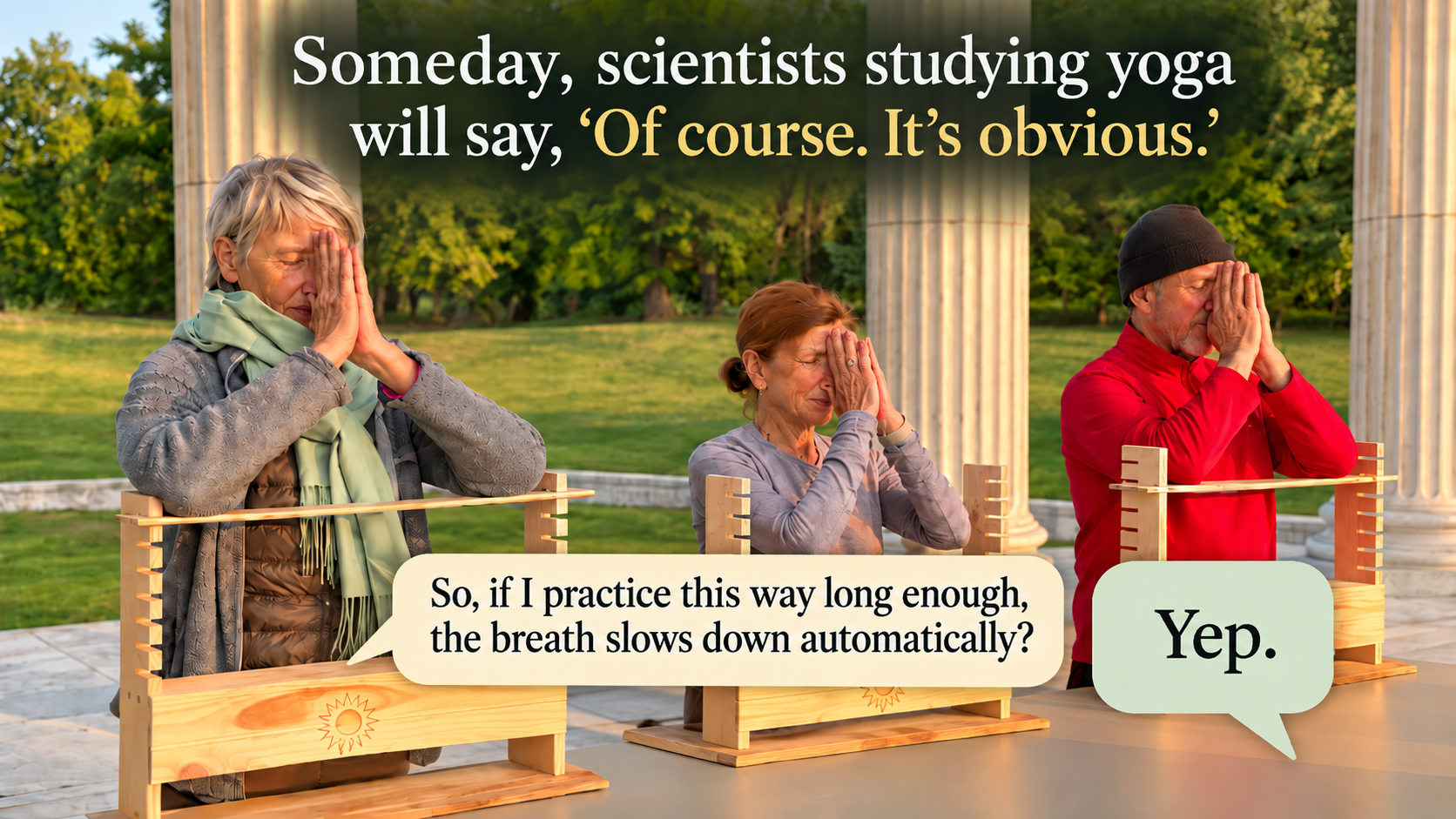
Alternate the airflow through the left and right nasal cavities enough times, and the breath slows down naturally, automatically.
It's the power of habit over time.
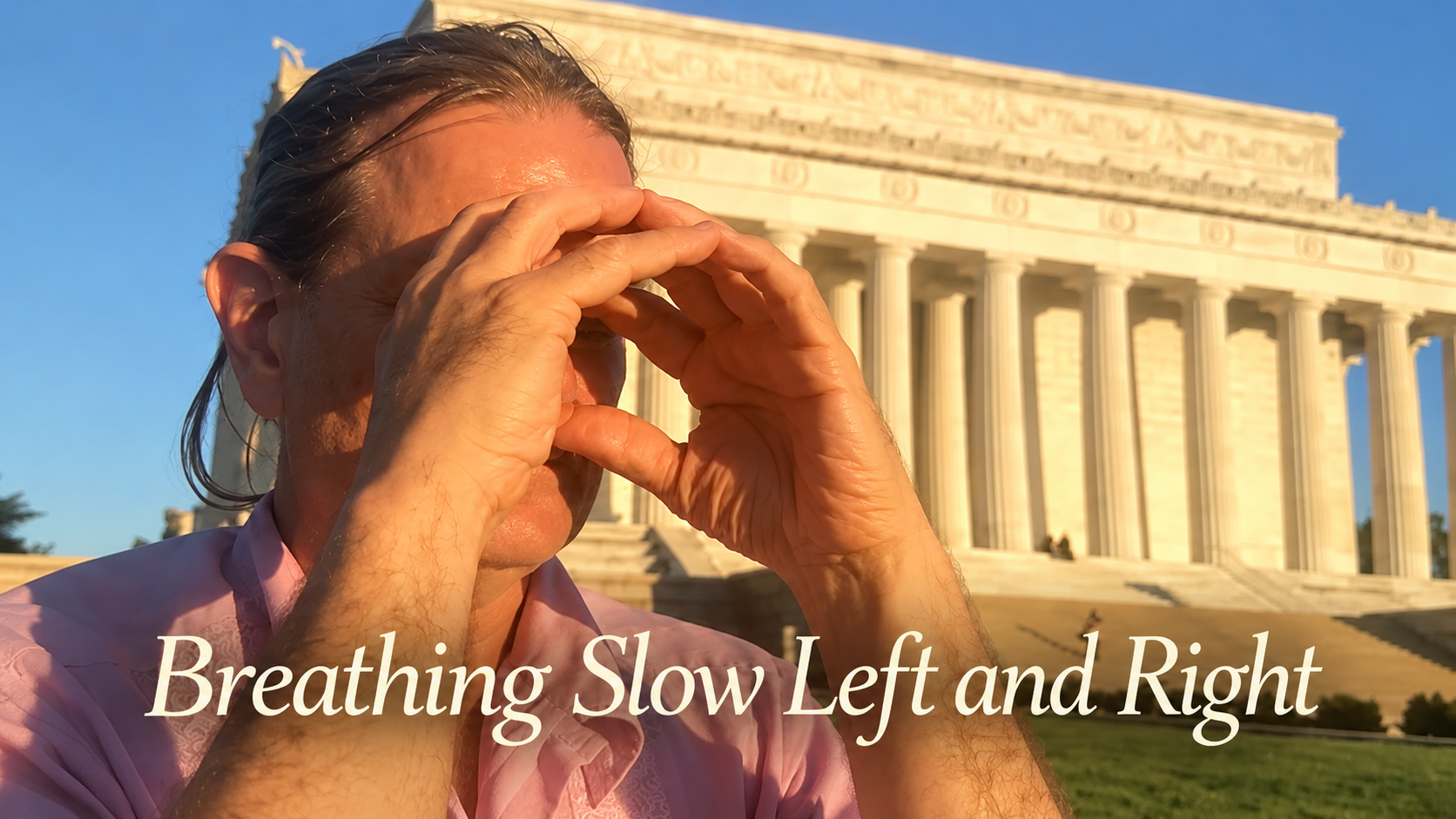
Slowing down the breath is possible.
No hyperventilation. No breath holds. No prescribed breath ratios. No fuss.
This simple ancient yogic practice is repeated every day. Alternate the breath slowly through the left and right nasal cavities, using your thumbs to guide the airflow.
Breathe Left and right. Left and right. Simple will work.
“I don’t get it?”
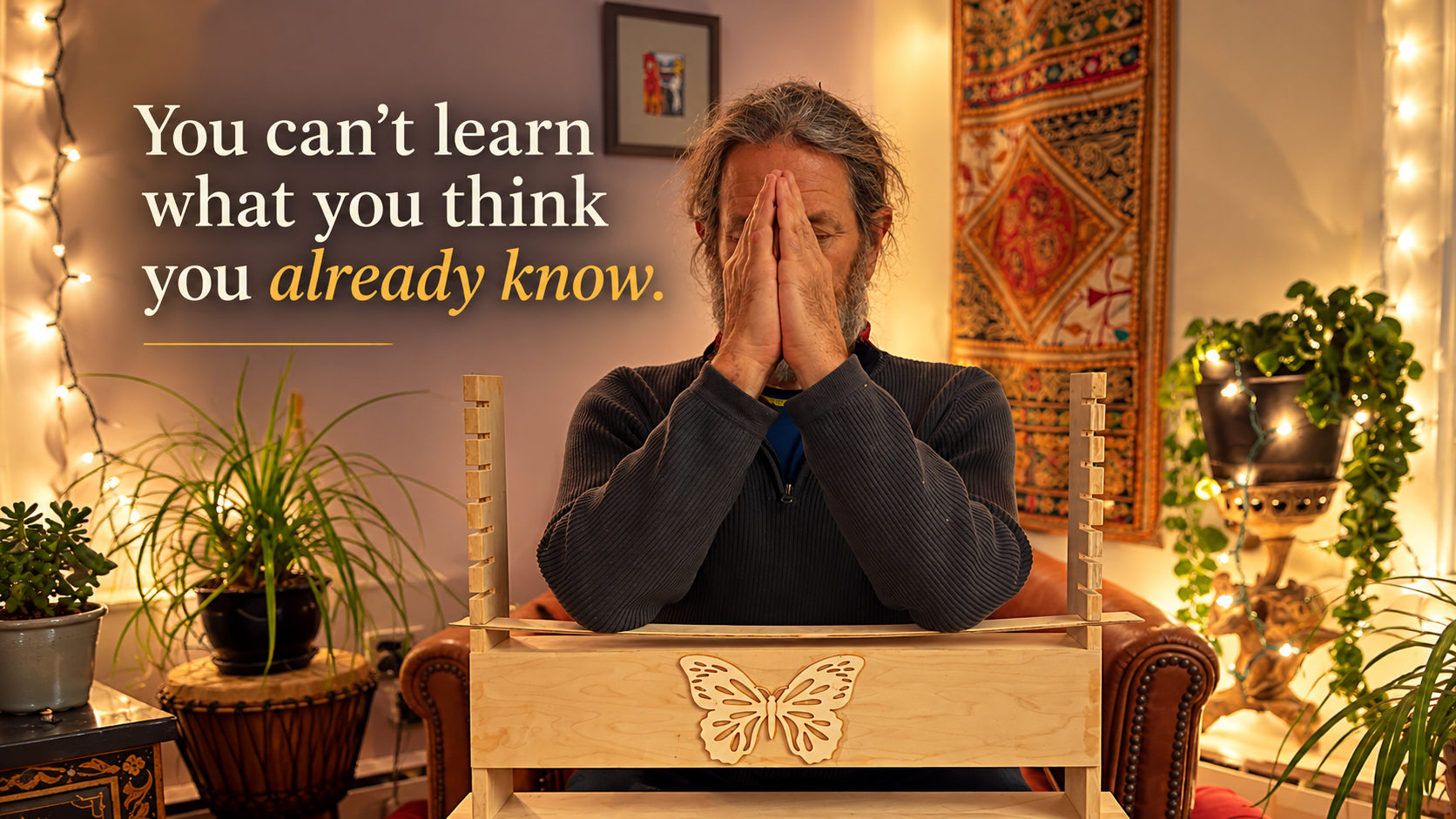
Everybody “knows” about alternate nostril breath.
Alternate Nostril Research, meta-analysis and most people’s common experience has abundantly shown: ”15 minutes reduces anxiety and lowers blood pressure.” Now move on.
Not so fast. Very few modern yogis have experienced where this practice goes. 15 minutes is usually where the practice stops for the majority of people. Why?
The position is really uncomfortable for starters.
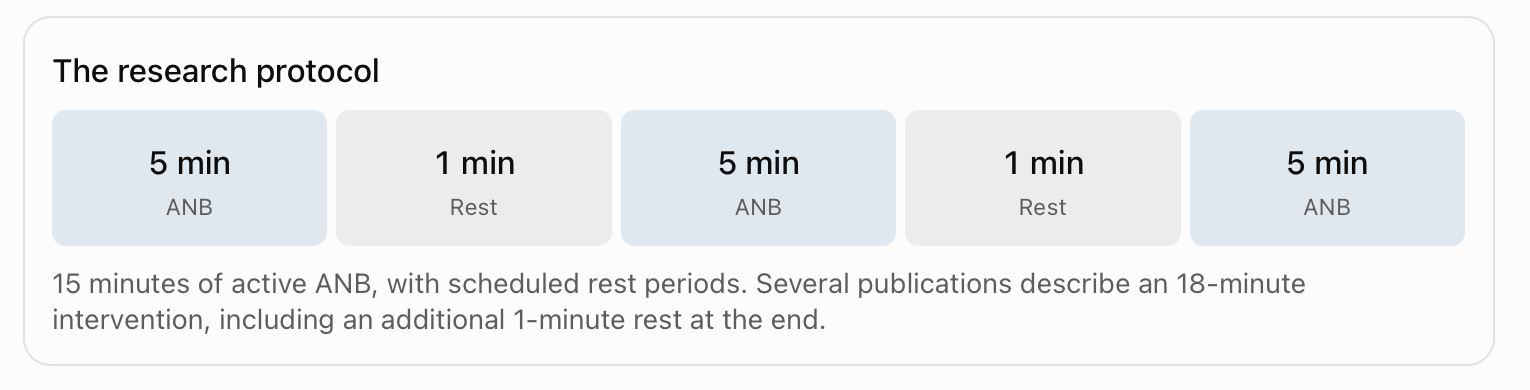
In many authoritative and quality research studies, they measured the effects on dozens of experienced pranayama participants. This is what they did: they practiced Left and Right Breathing for 5 minutes sitting on the floor and floating the arm. Then they rested their arm and shoulder. Then they practiced for 5 more minutes. And then they rested the arm for another minute, and then they practiced for another 5 minutes in order to complete a full 15 minutes. Here, here and here.
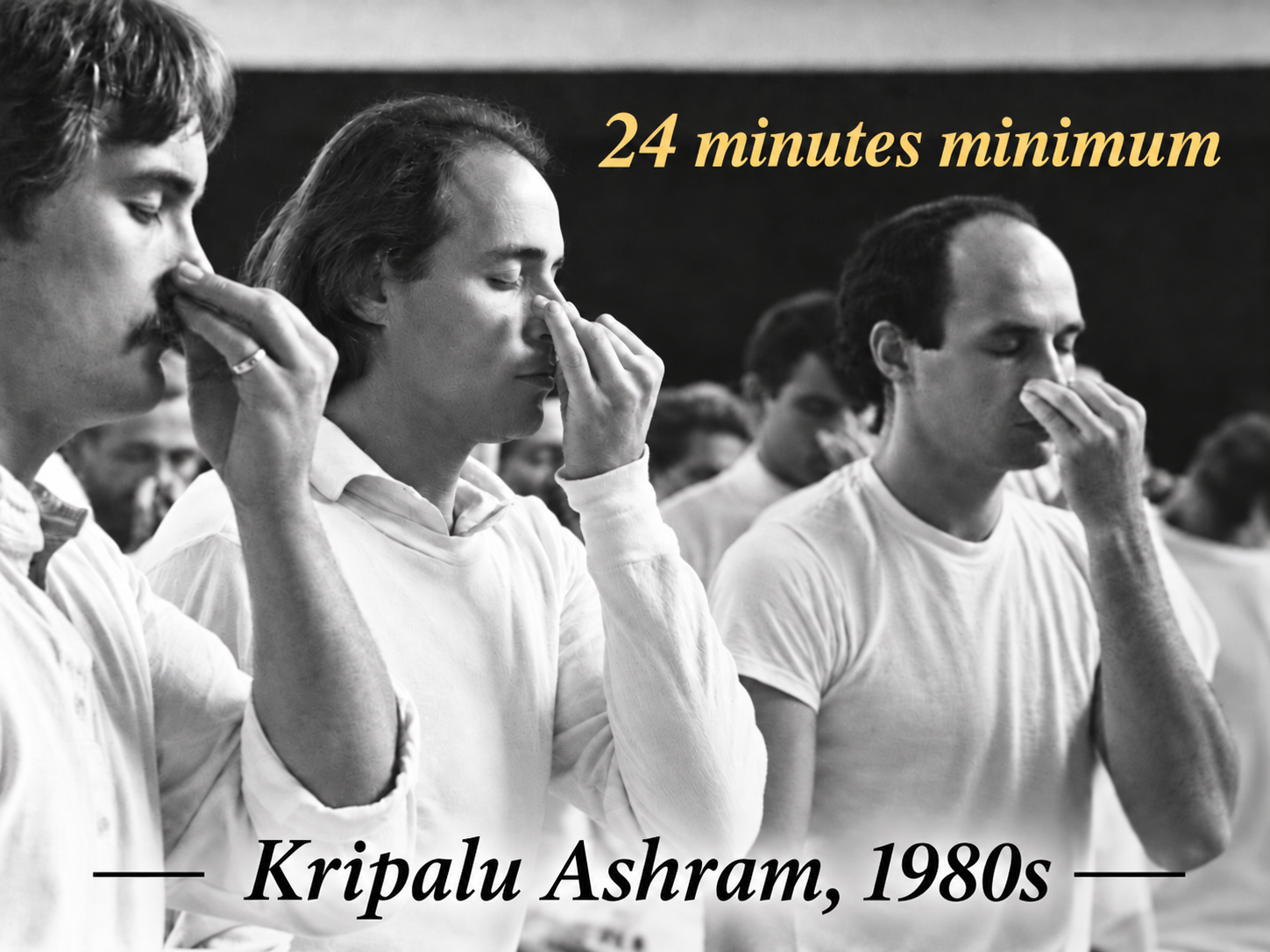
What happened at the Ashram? Did people stay with the continuous 24 minute practice? Why did this practice go for many years and then stop? (24 minutes is 1/60th of a day, a yogic measure of time)
Let’s face it. Sitting in that position and floating the arm, for 24 minutes is brutal. After attending 4am practice everyday for years, I felt like I learned something useful from the Ashram 24 minute experience.
Decades later, we changed the physical position, made it much easier, and kept the length of practice the same. When you stand up and support the elbows, 24 minutes is no big deal, even for beginners. So what happens?
Dosage Matters
What happens when you double the dosage and you do it everyday….. over months and years? What are the long term effects if you practice everyday and quadruple the 15 minute dosage to 60 minutes? Is there a group of people who are currently doing 24 minutes, 60 minutes, the painless way? yes.
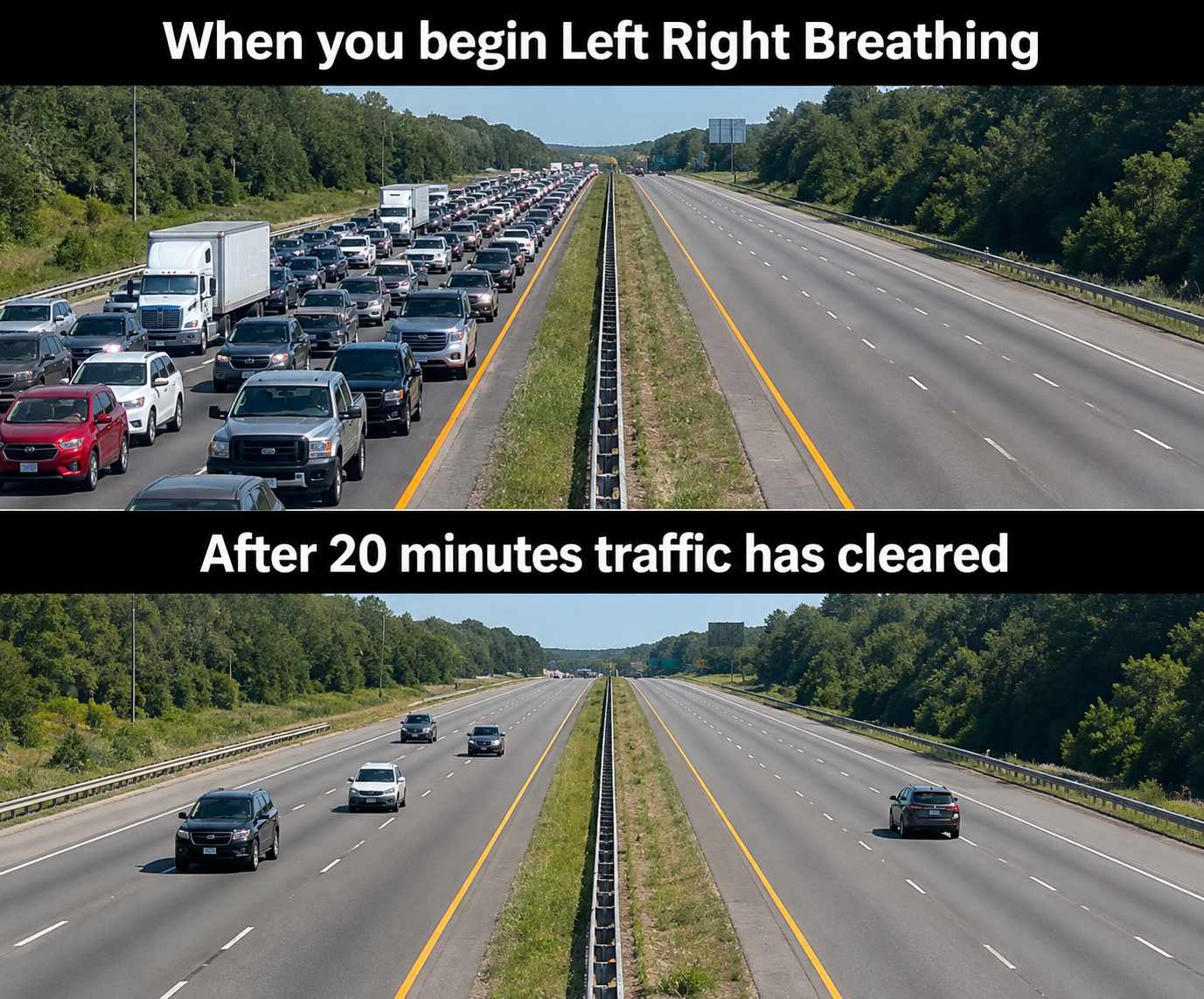
If you only practice for 15 minutes, this is what you might experience.
The top photo is when you wake up and you might find mucus in one nasal cavity from sleeping on your side.
You alternate the breath and persevere. After some practice, the mucus clears out and you will discover your nasal cycle. One side will naturally be slightly more restricted than the other. 20 minutes is only the beginning of the practice. It gets better.
Almost all the quality scientific research on this is 15 minutes or less. Researchers have only done the most preliminary investigations. And the results are significant even in these tiny amounts. Lowering blood pressure, reducing anxiety, simple things like that.
What happens when the breath changes?
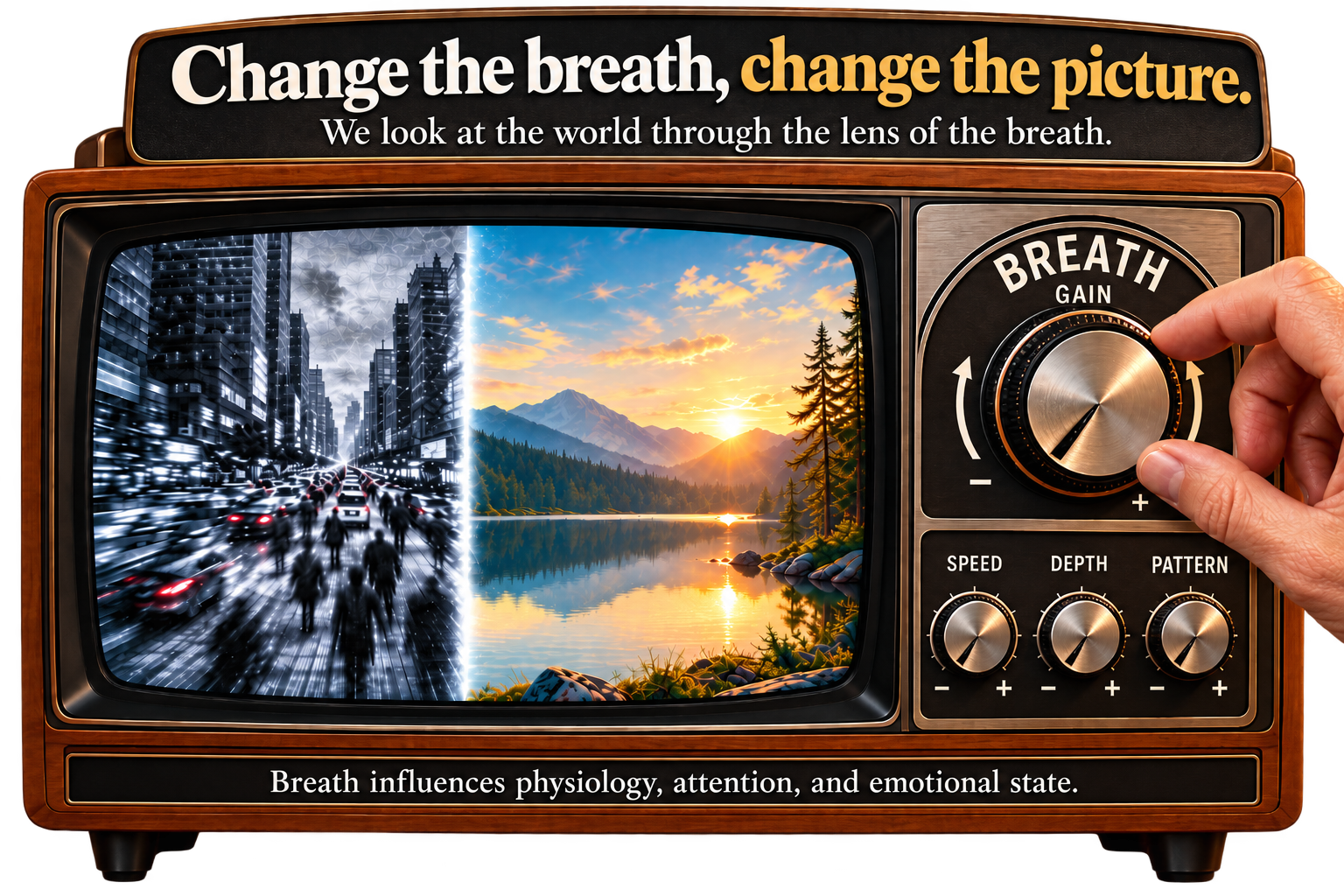
Don't control the breath.
No hyperventilation. No breath holds. No prescribed breath ratios. No fuss.
This simple ancient yogic practice is repeated every day. Alternate the breath slowly through the left and right nasal cavities, using your thumbs to guide the airflow.
Left and right. Left and right. The secret isn't a complicated variation.
It's the power of habit over time.
Practice at the beginning of every day. Return to it throughout the day. Continue for months, years.
At Kripalu Ashram in the 1980s, we were taught that 24 minutes was the minimum daily practice. Forty-eight minutes came later.
It was never intended to be a five-minute breath hack.
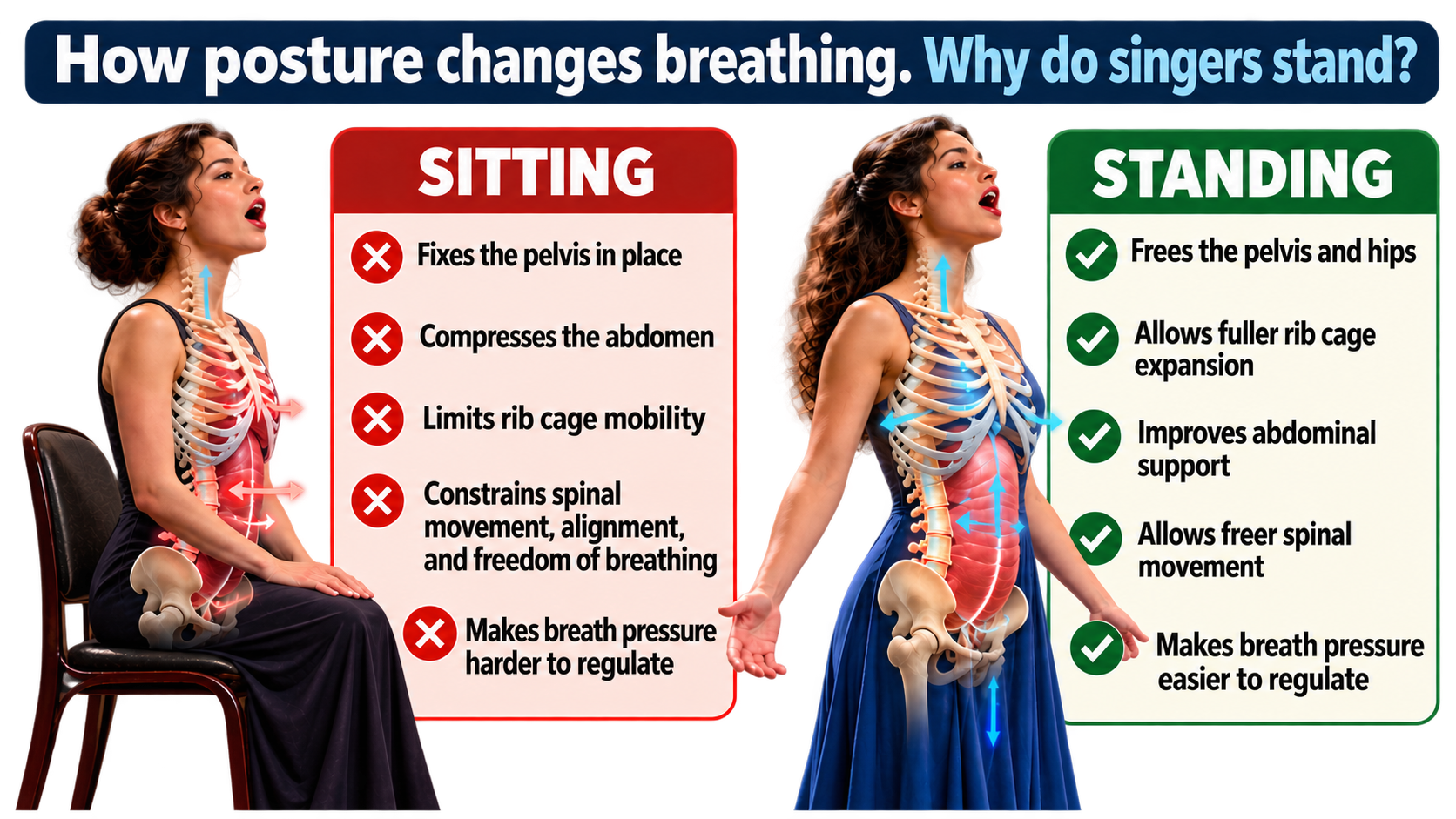
And it doesn't have to be unnecessarily difficult. Stand up, support your elbows, and practice.
It is easy and it doesn’t take that long.
Don’t control the breath.
It is unnecessary to control the breath.
Who is the one who thinks they are in control?
(Hint: ego, your personality. This turns out to be a problem.)
Breathing Slow Left and Right needs to become a lifestyle habit,
and your resting breath slows down automatically in time.
A group of us have been doing this long enough.
And so many other things change….
What happens when the breath slows down?
Nostril Dominance
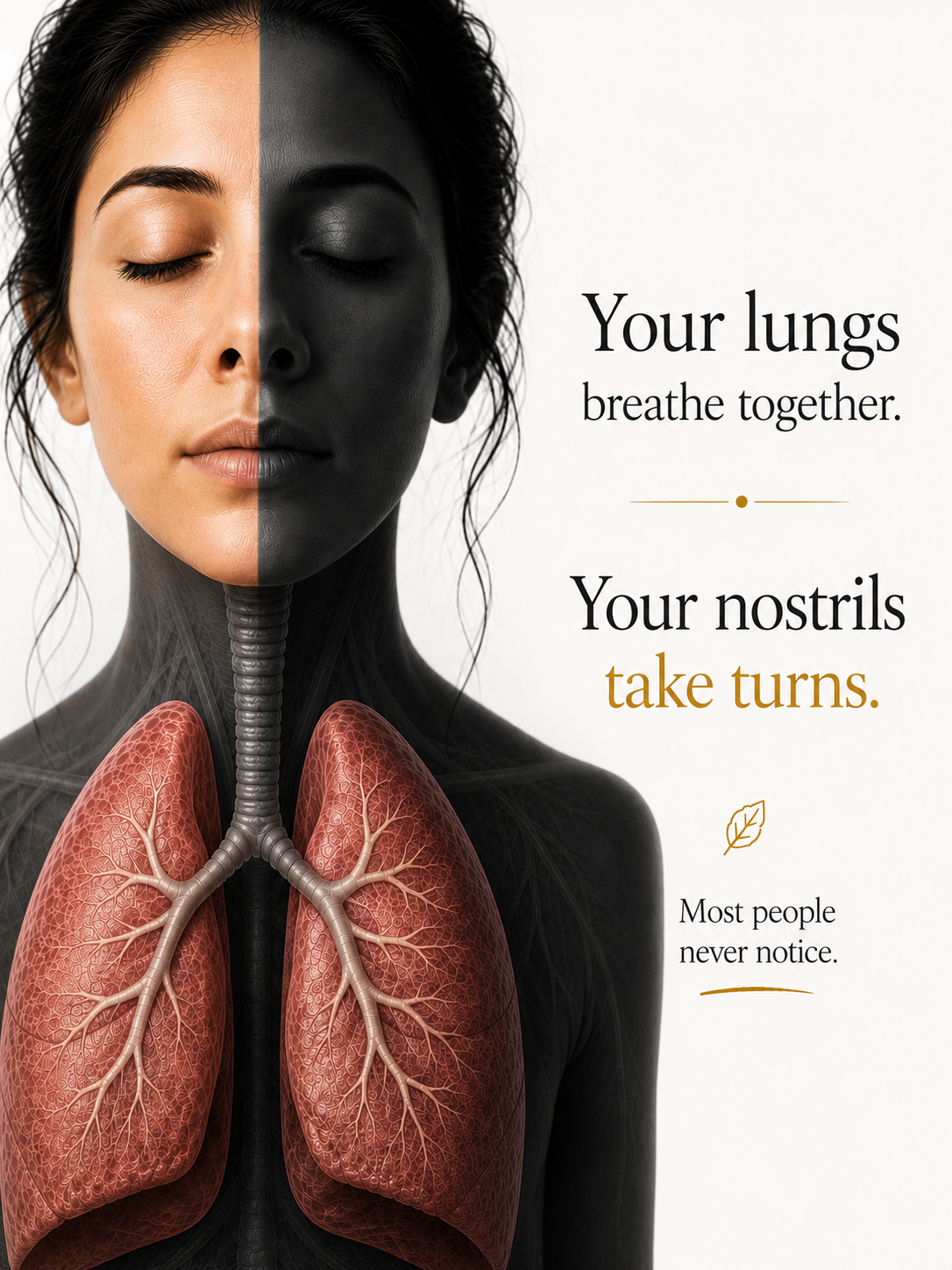
There is an evolutionary circadian rhythm that switches nostril dominance every 2- 7 hours. The lower turbinate of one nostril swells up and restricts air flow slightly and most people are unaware of this imbalance happening. This alternation of the nostrils is called the Nasal Cycle.
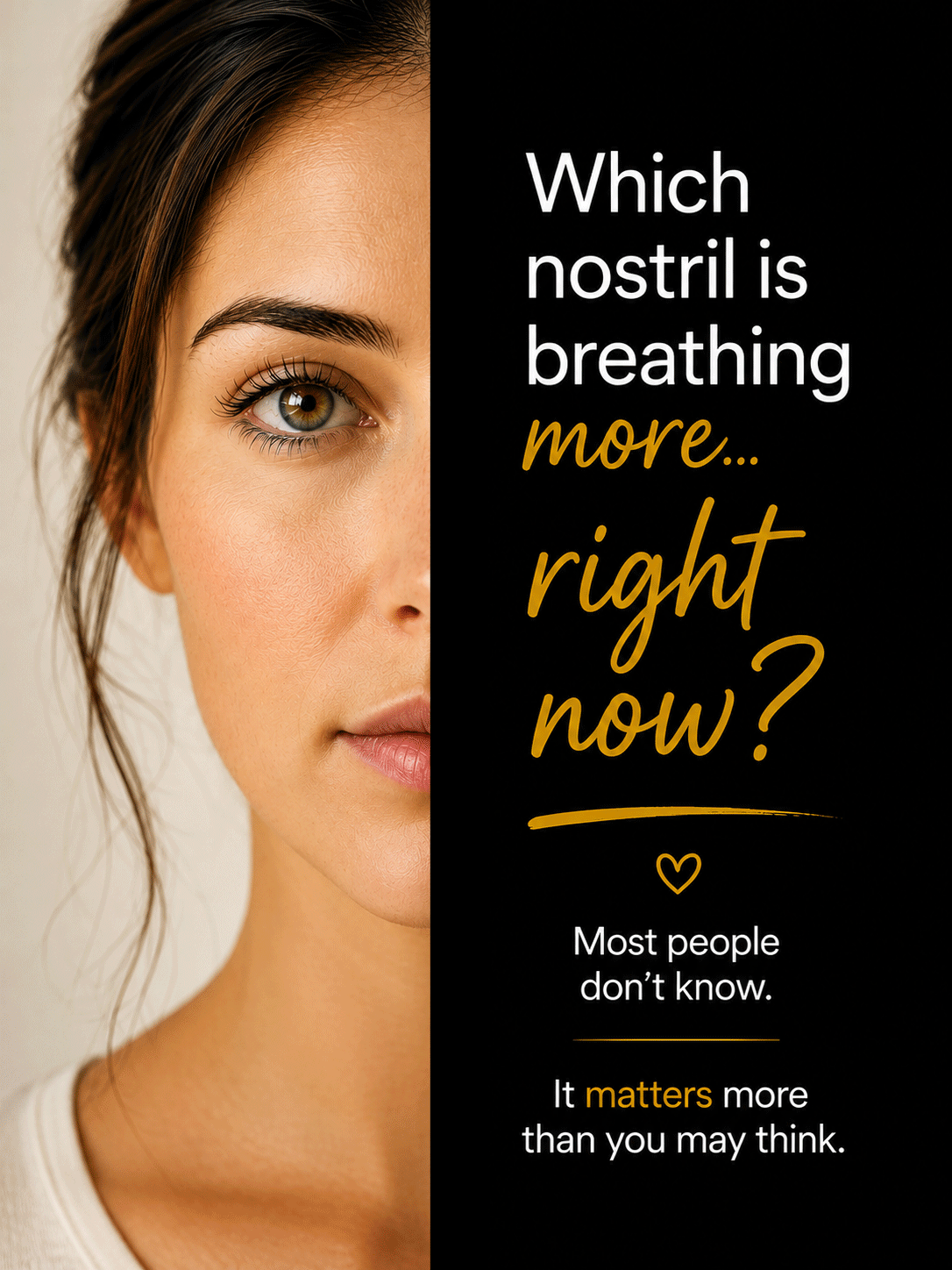
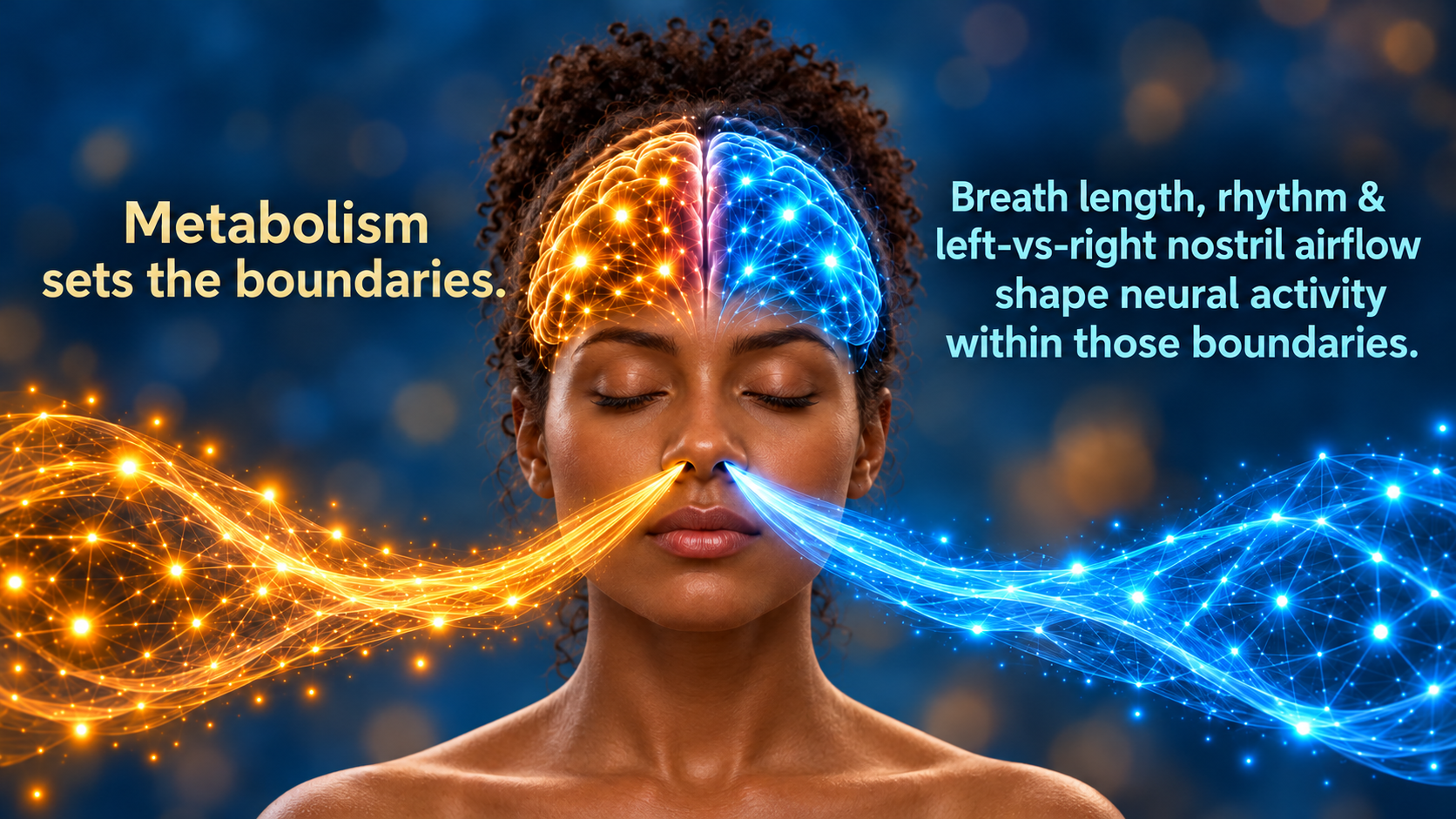
Nasal breathing provides unusually direct access to brain systems involved in emotion and memory, including the amygdala and hippocampus. Changing which nostril carries the airflow can alter patterns of brain activity—but scientists are still working out exactly how right- versus left-nostril breathing interacts with these lateralized networks.
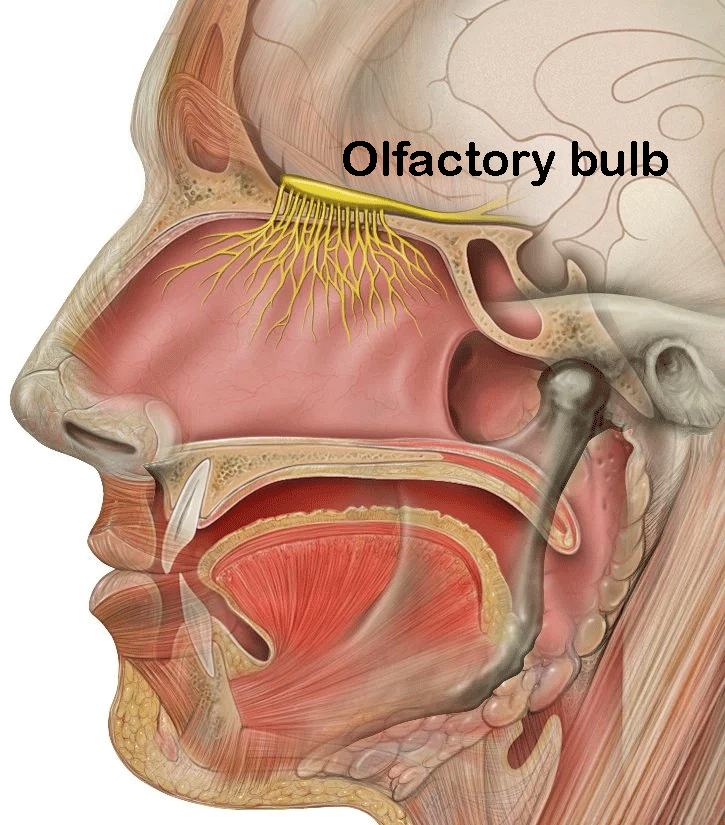
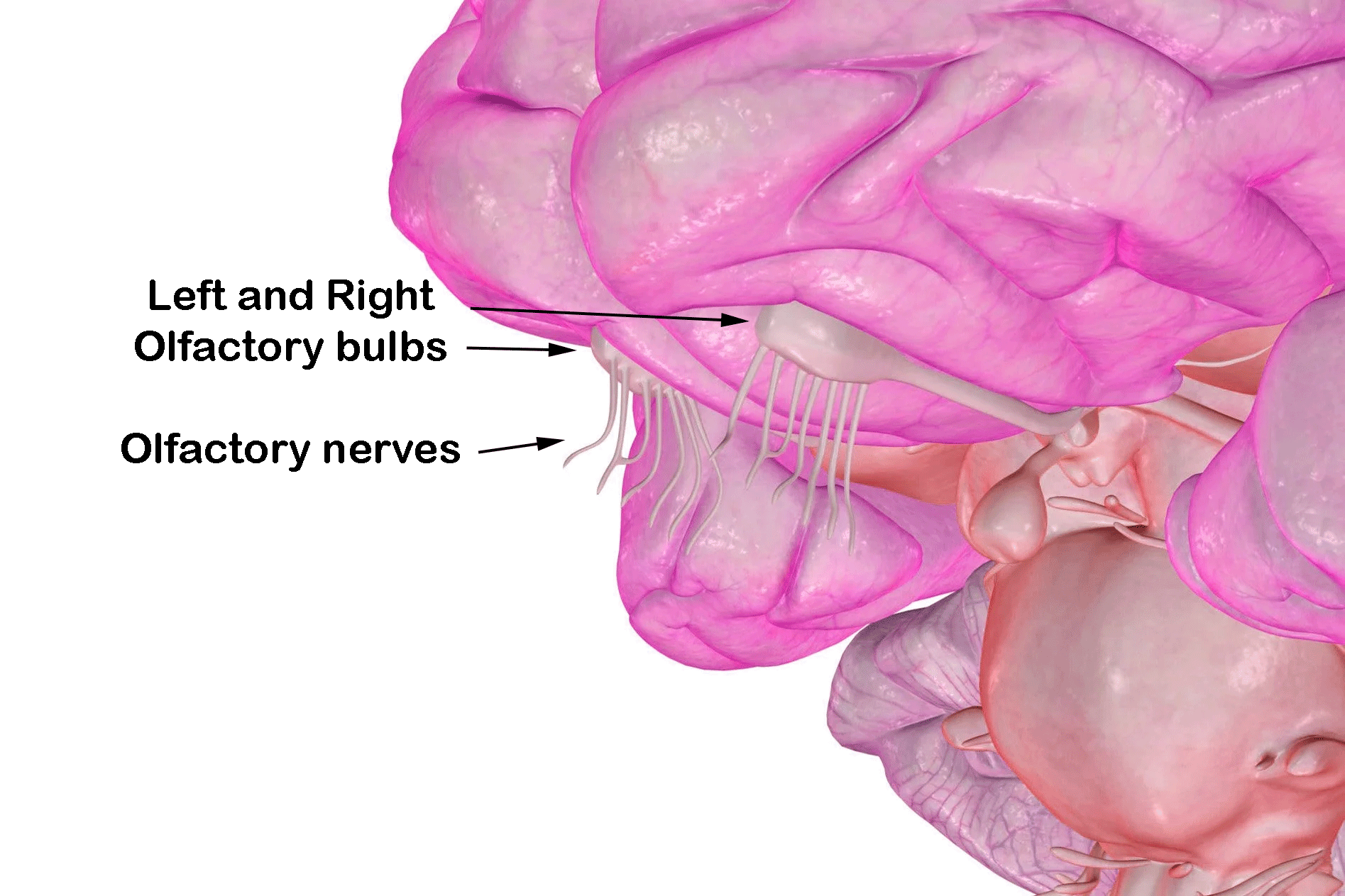
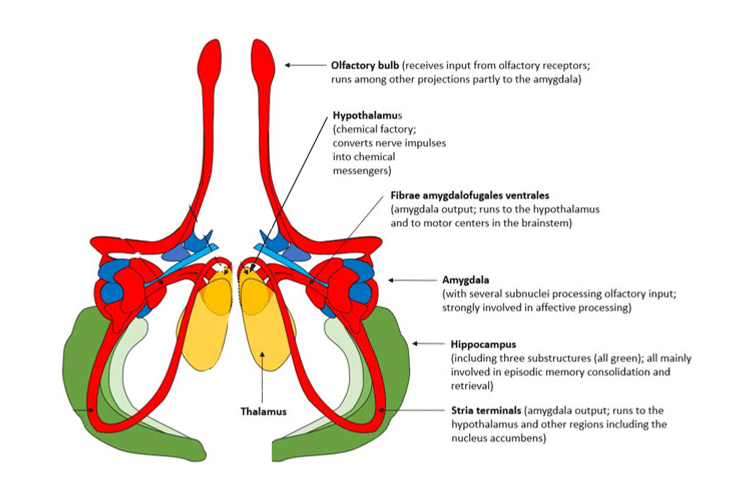
The olfactory bulbs and the exposed nerves that go through the skull and are exposed to the outside air, signal the twin left and right amygdala and the hippocampal structures, that are involved in threat detection, laying down memories and many other things..
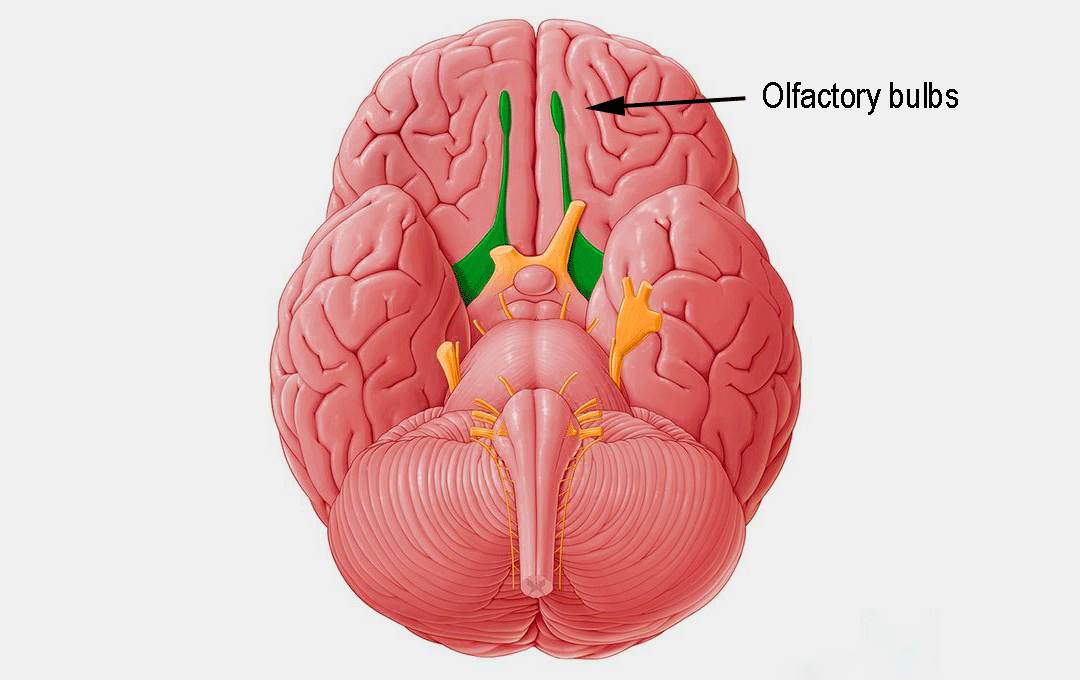
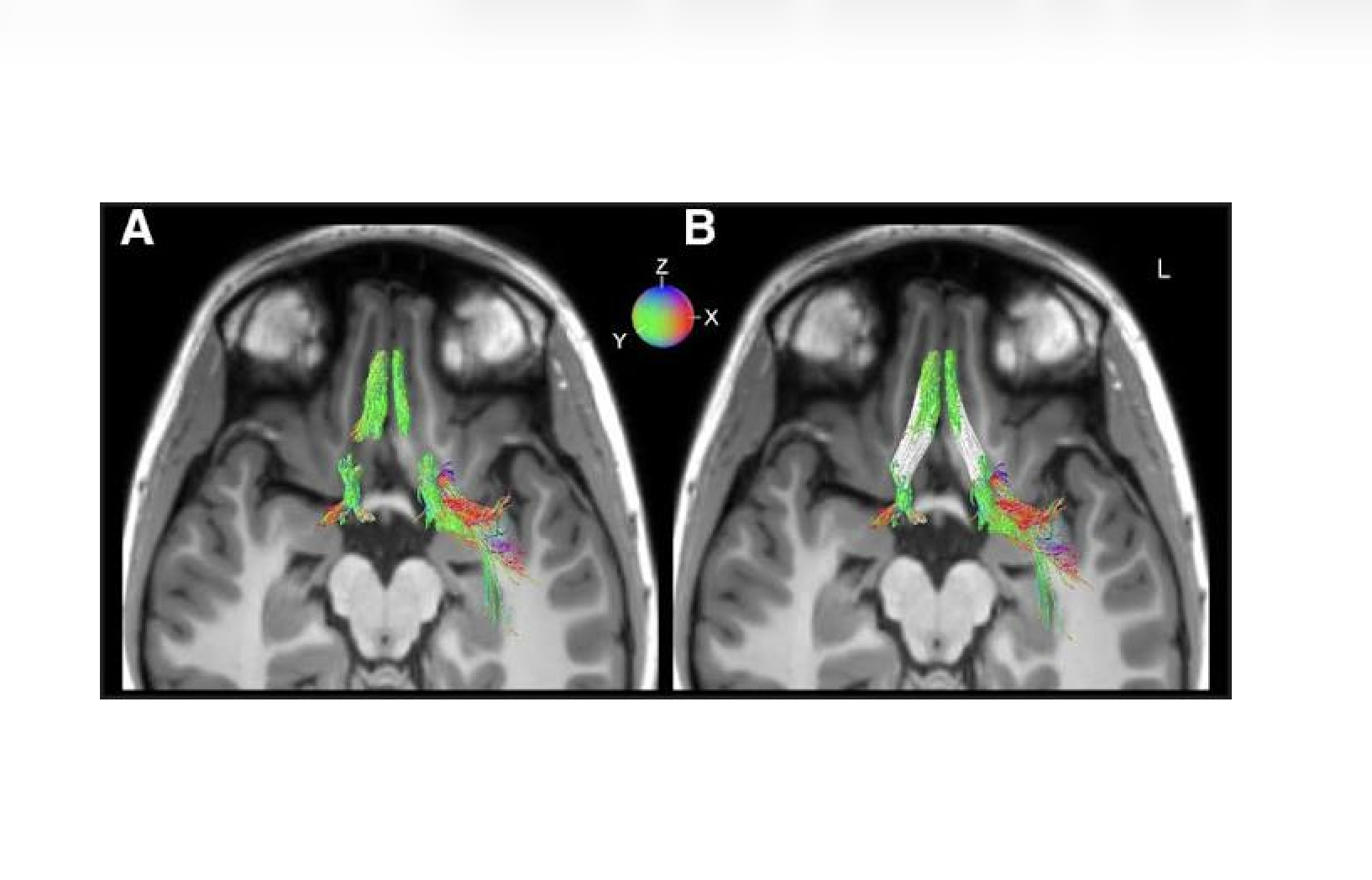
The left olfactory bulb stimulates the left amygdala. The right olfactory bulb stimulates the right amygdala. And so the dance begins.
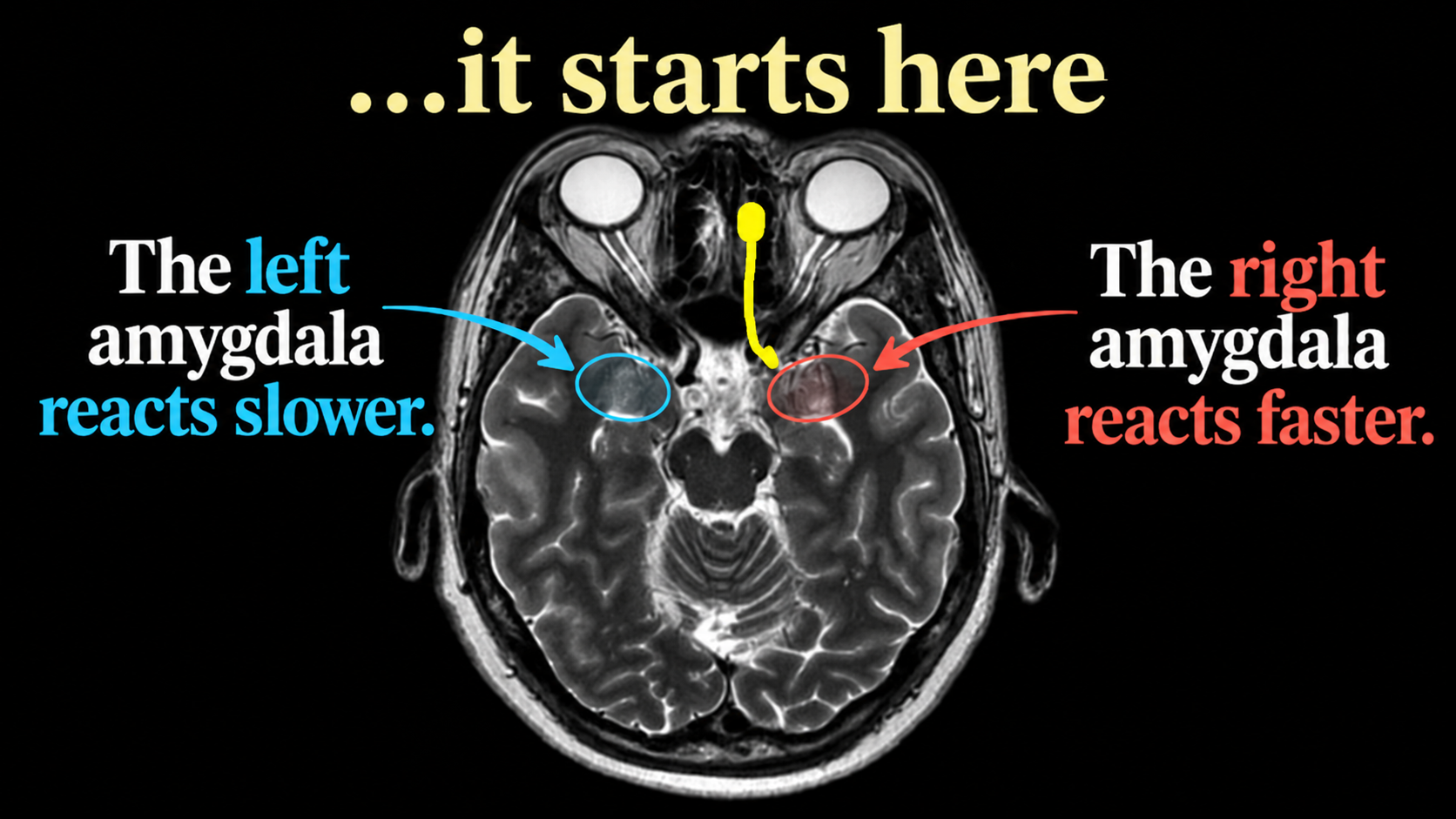
When you inhale through the right nostril, it sends a direct signal to the right amygdala (red circle) . Even though left and right communicate quickly, the temporal order matters.
The right and left amygdala are not identical in what they do and how they process information. The right amygdala appears particularly important for rapid, automatic detection and expression of emotionally significant information—including potential threats. The left amygdala is more involved in sustained, detailed and cognitive processing of emotional information. But even these divisions will always have overlap, exceptions and variations.
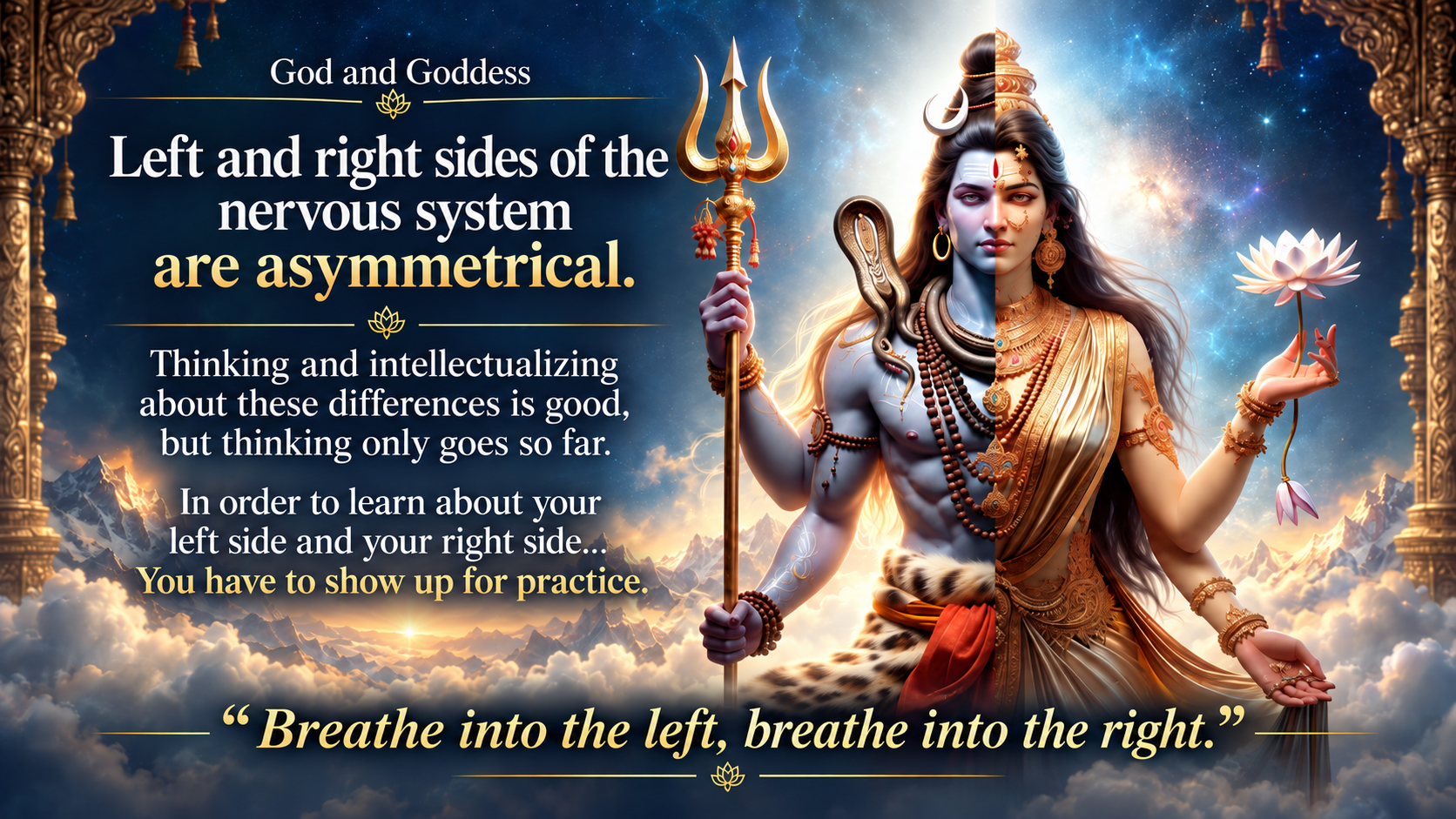
The Yogis discovered an Intervention.
Balance the two sides
and a very wide range of beneficial effects follow.
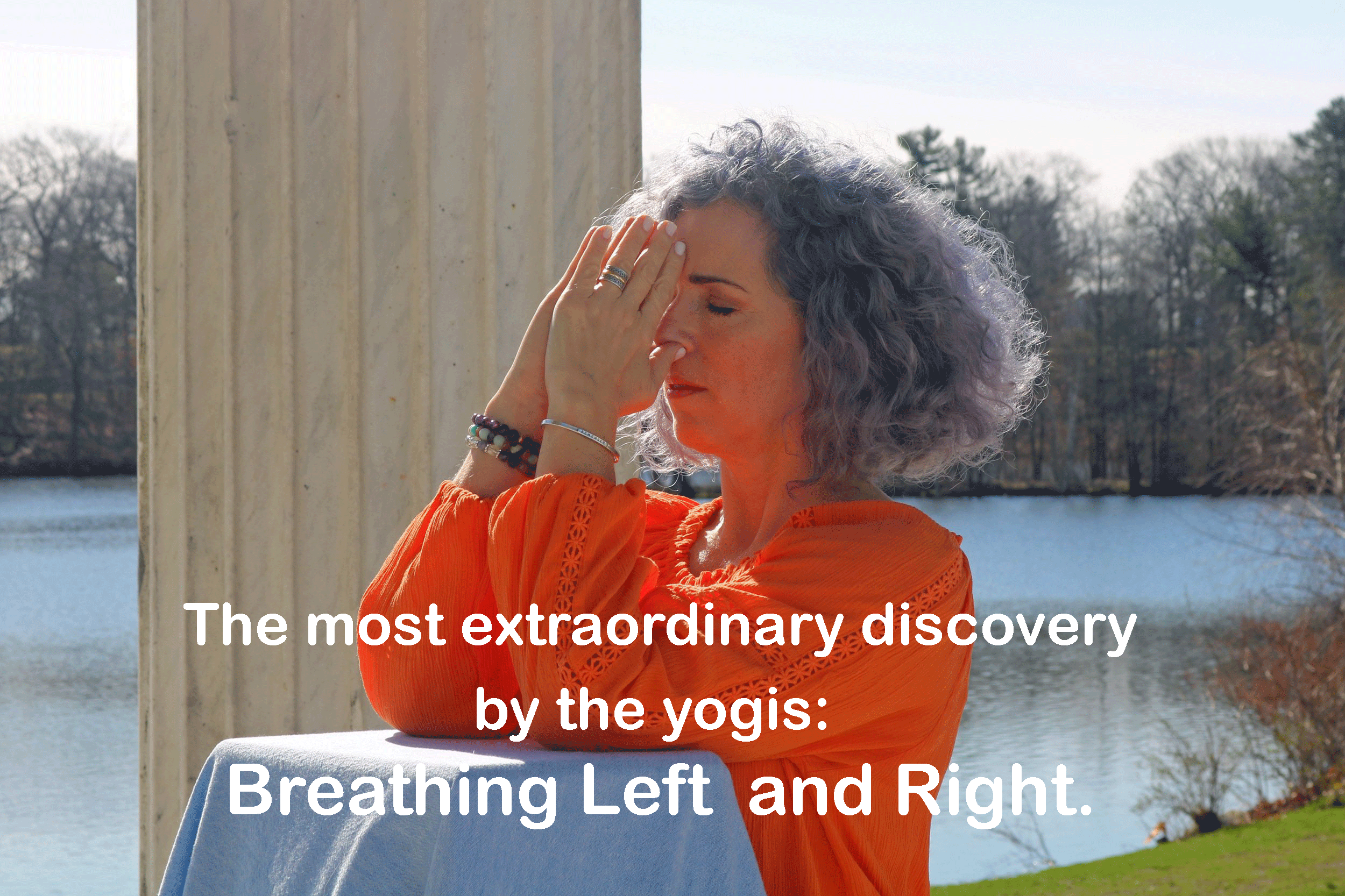
No one really knew what would happen.
So they sat in meditation and floated one arm, thinking that was a good approach.
They had preset ideas about what it would look like. (sit like a Shiva, Buddha)
And nobody questioned these premises for thousands of years.
The method they used, made it unnecessarily difficult, and the practice itself is really simple.
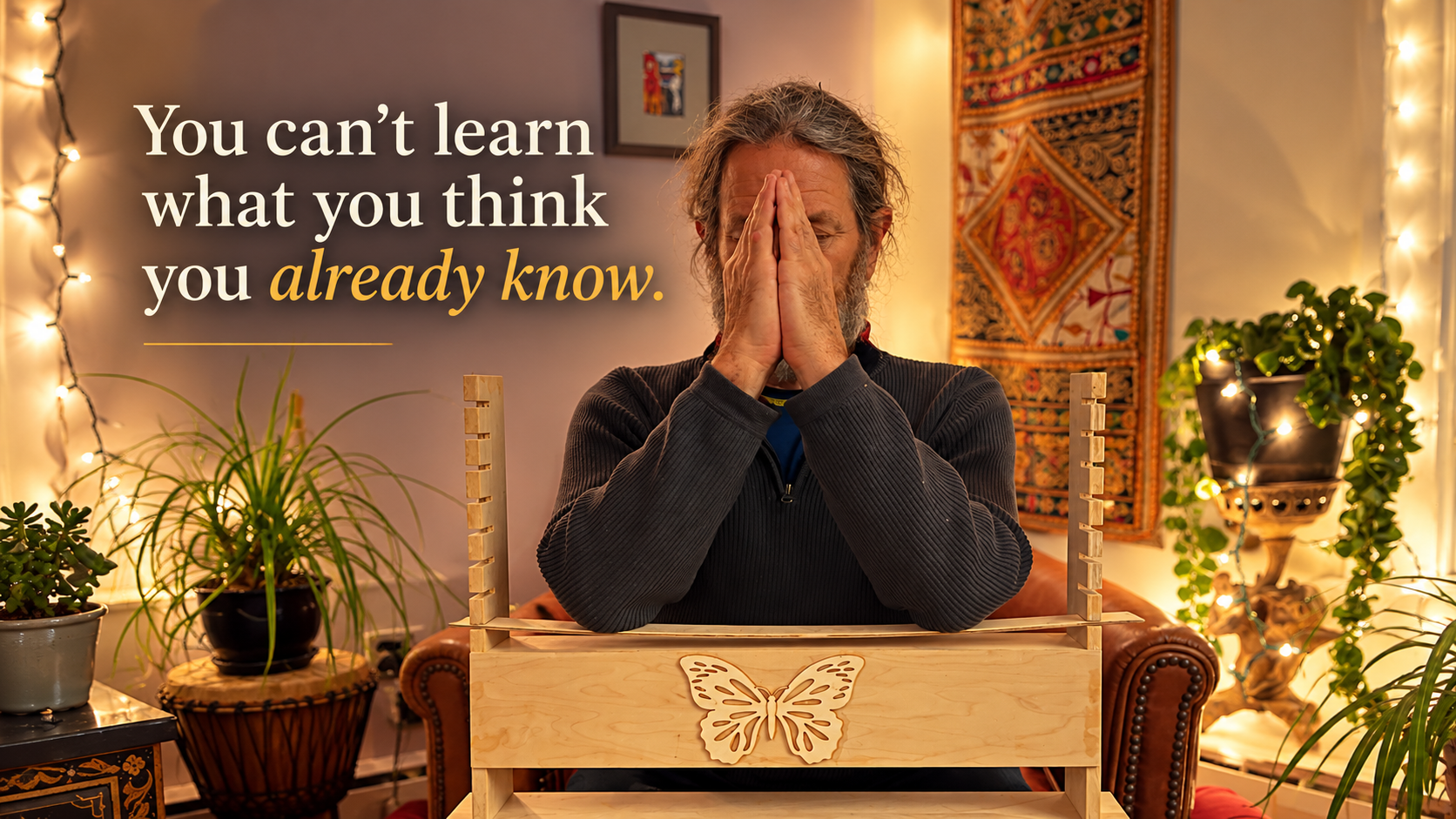
The teaching most commonly taught is that 10-15 minutes is enough!
The most common teaching is this:
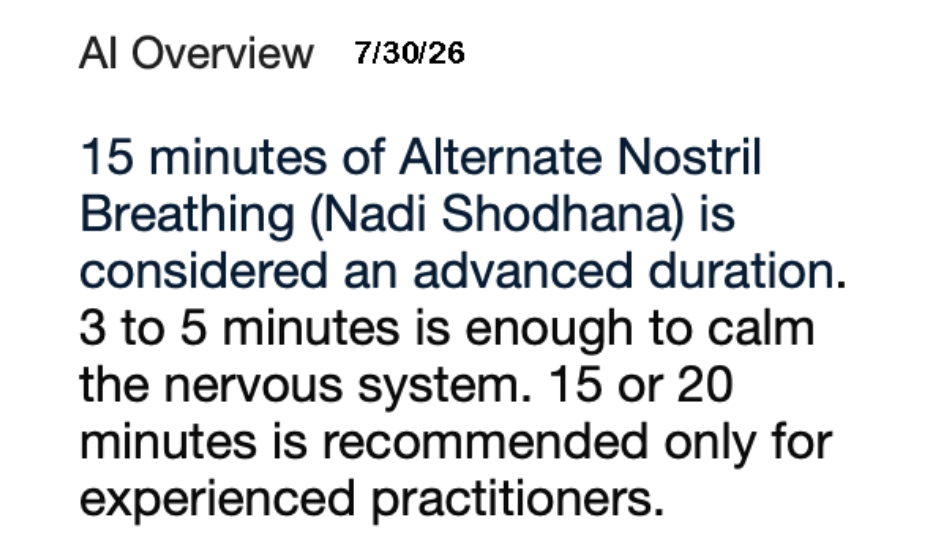
This typically is the opinion of someone who has not really experienced this practice fully yet. AI only knows what it is told.
This is a case of what is called in science:
“Confounding variables”.
There is a surprising number of confounding variables in this next slide.
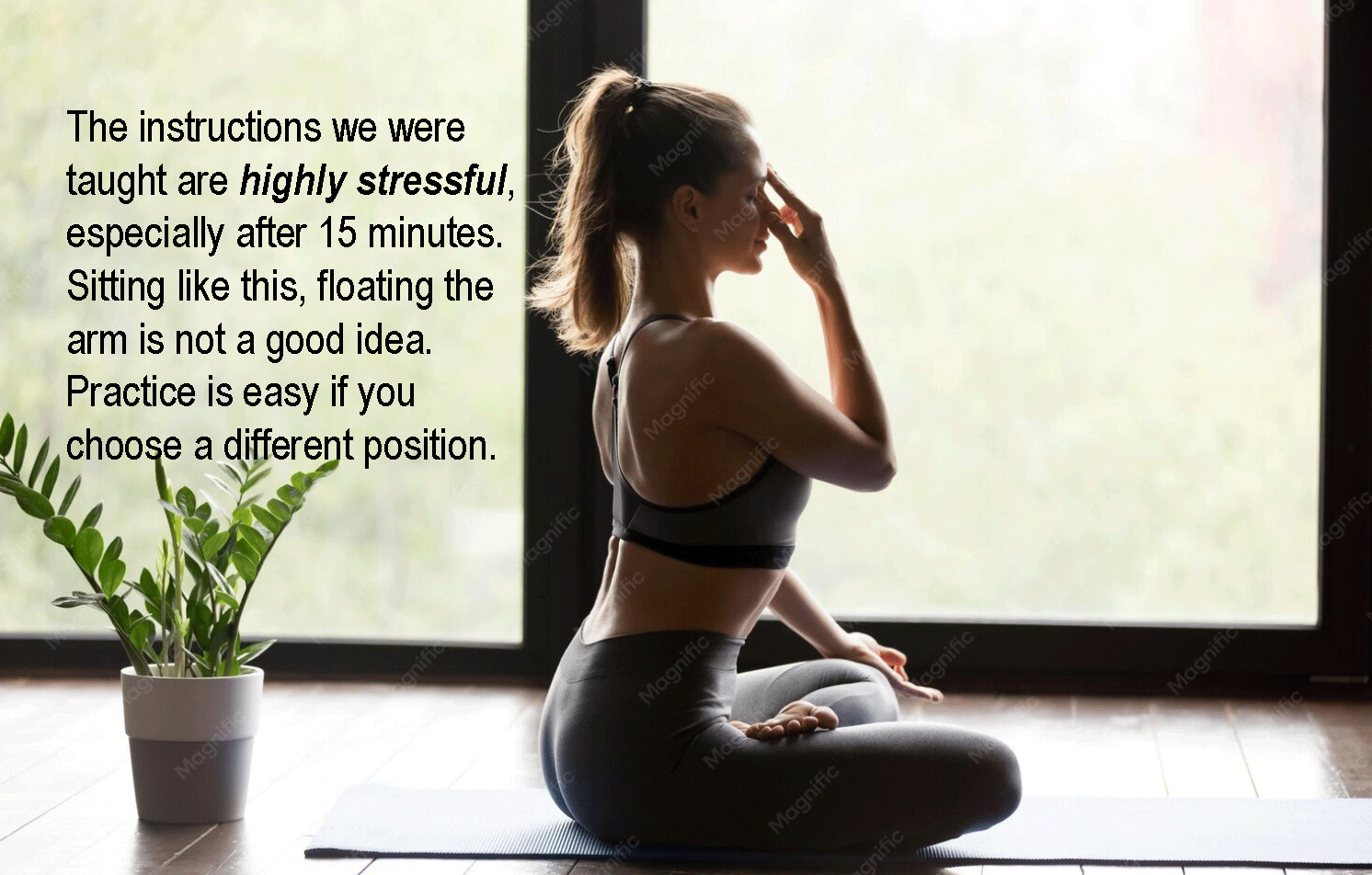
The traditional way we were taught
“Alternate Nostril Breath”
was full of questionable,
not so helpful choices.
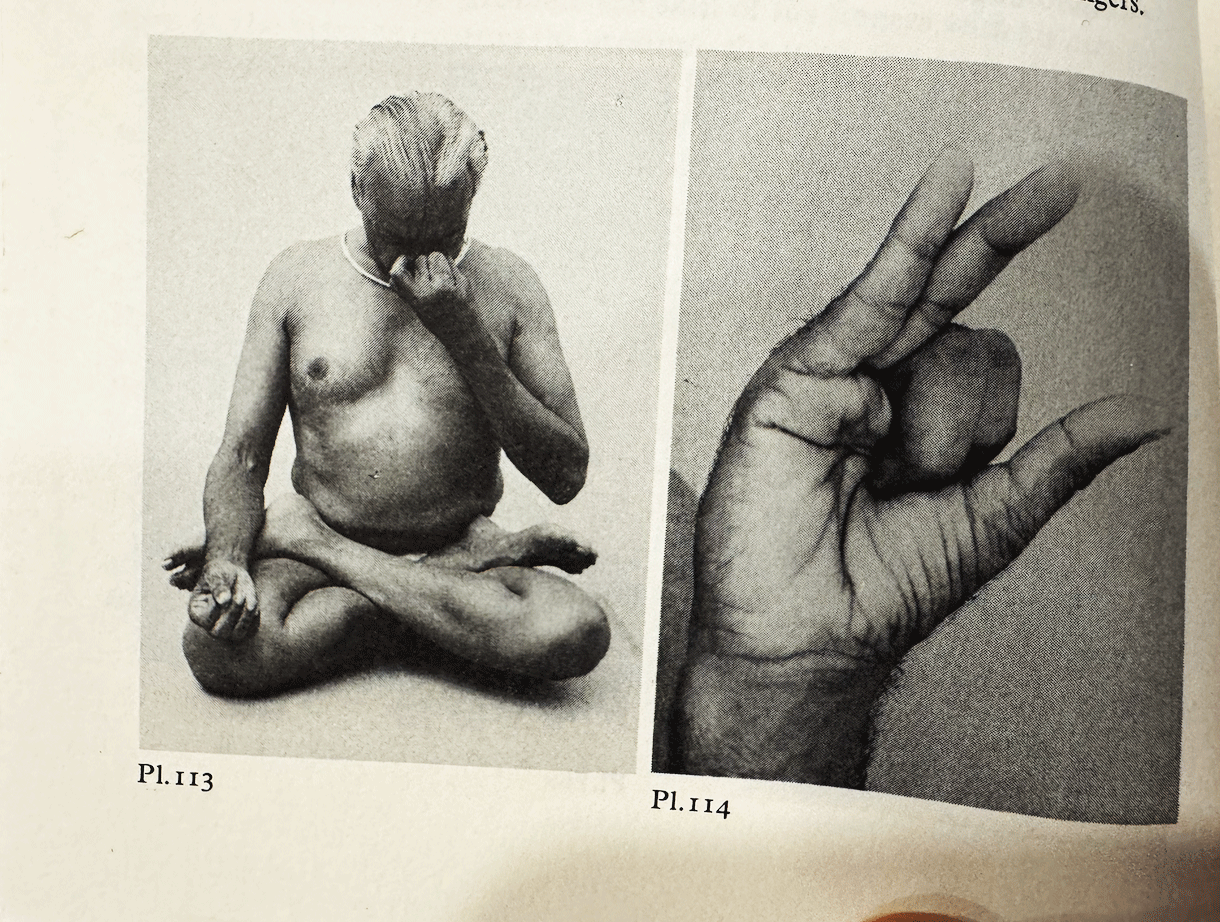
unnecessarily stressful. not ideal..
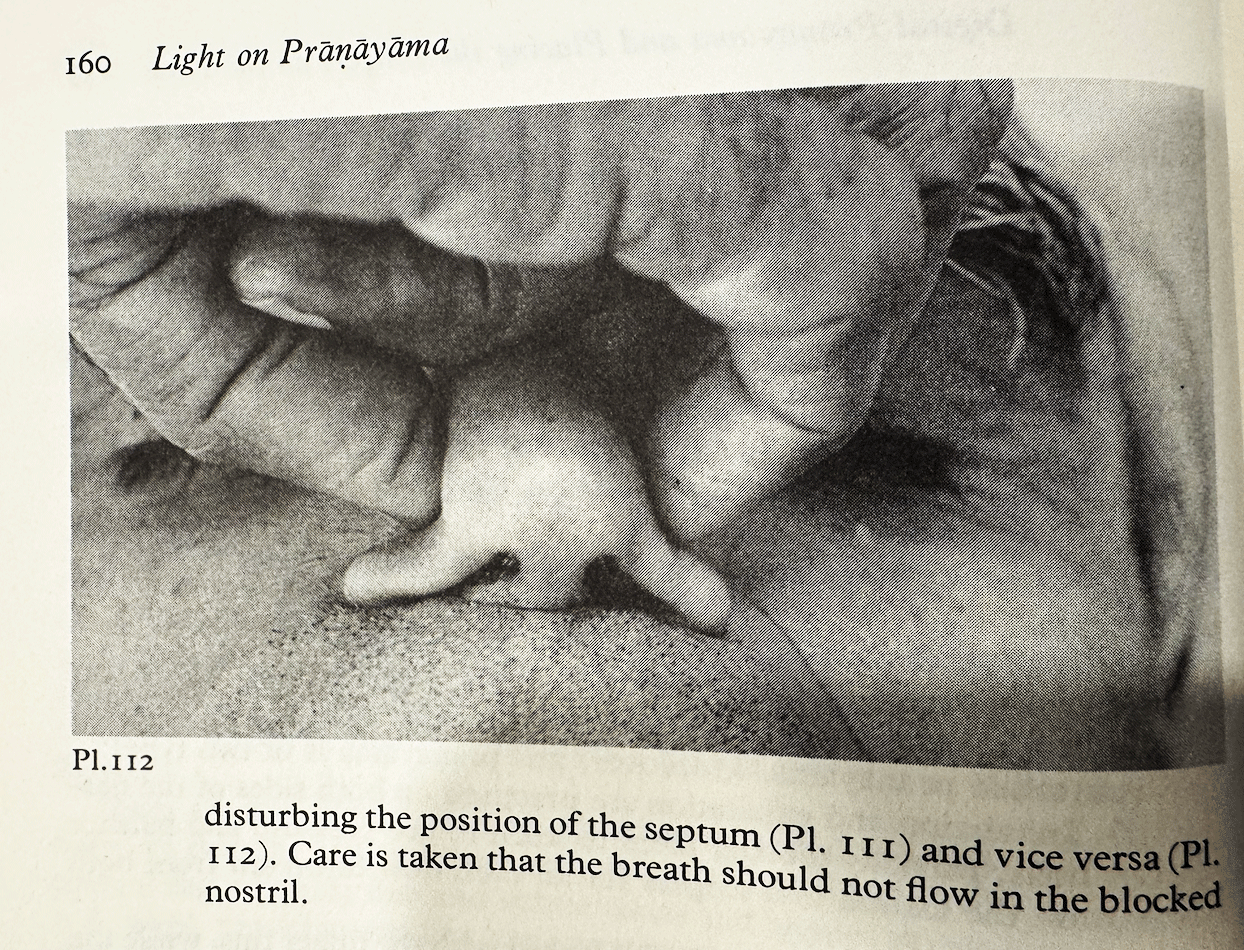
Squishing the nose, pushing the sidewalls of nostrils towards the septum, is not recommended for a longer practice. The blood vessels in the nose get damaged in the long run. In time, most everyone develops an over sensitivity to the nose being pushed around.
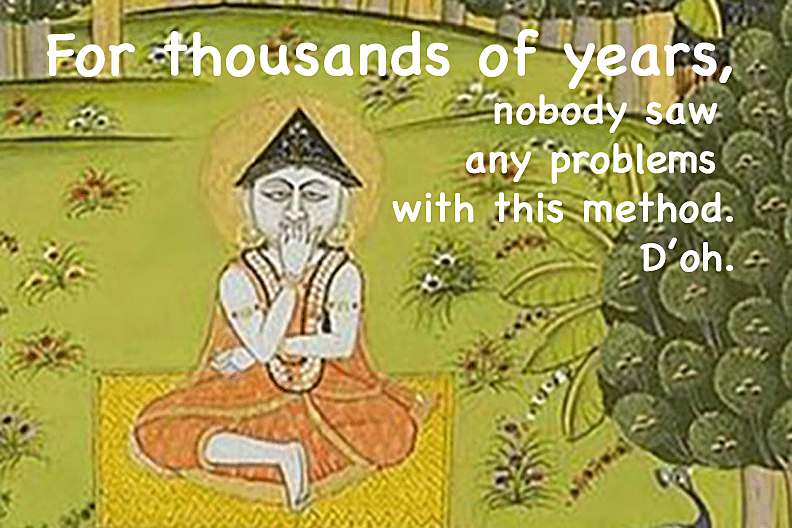
We have been blinded by tradition.
There is a better way.
For ordinary people to get extraordinary results.
And it doesn’t cost anything. It’s free.
There is a better way. Ssshh. It is still a secret club.
Stand up.
Support the elbows.
Two thumbs under the nose!
Tom Gillette (bio) has been a yoga teacher for 36 years and a yoga consultant for 5 published Yoga research studies with Brown University/Butler Hospital. You are welcome to contact him by Text. 401-499-4942

For people with sensitive noses, this changes everything. Your attention will grow sharp and clear with a delicate touch. The nose barely moves. And we go for really long voyages.
The nose doesn’t like to be mangled. For people who do a long practice, squishing the sidewalls of the nose will eventually create an over sensitivity problem. It is just a matter of time. Leave the nose squishing alone and work on your delicate touch skills. Delicate touch will heighten your attention.
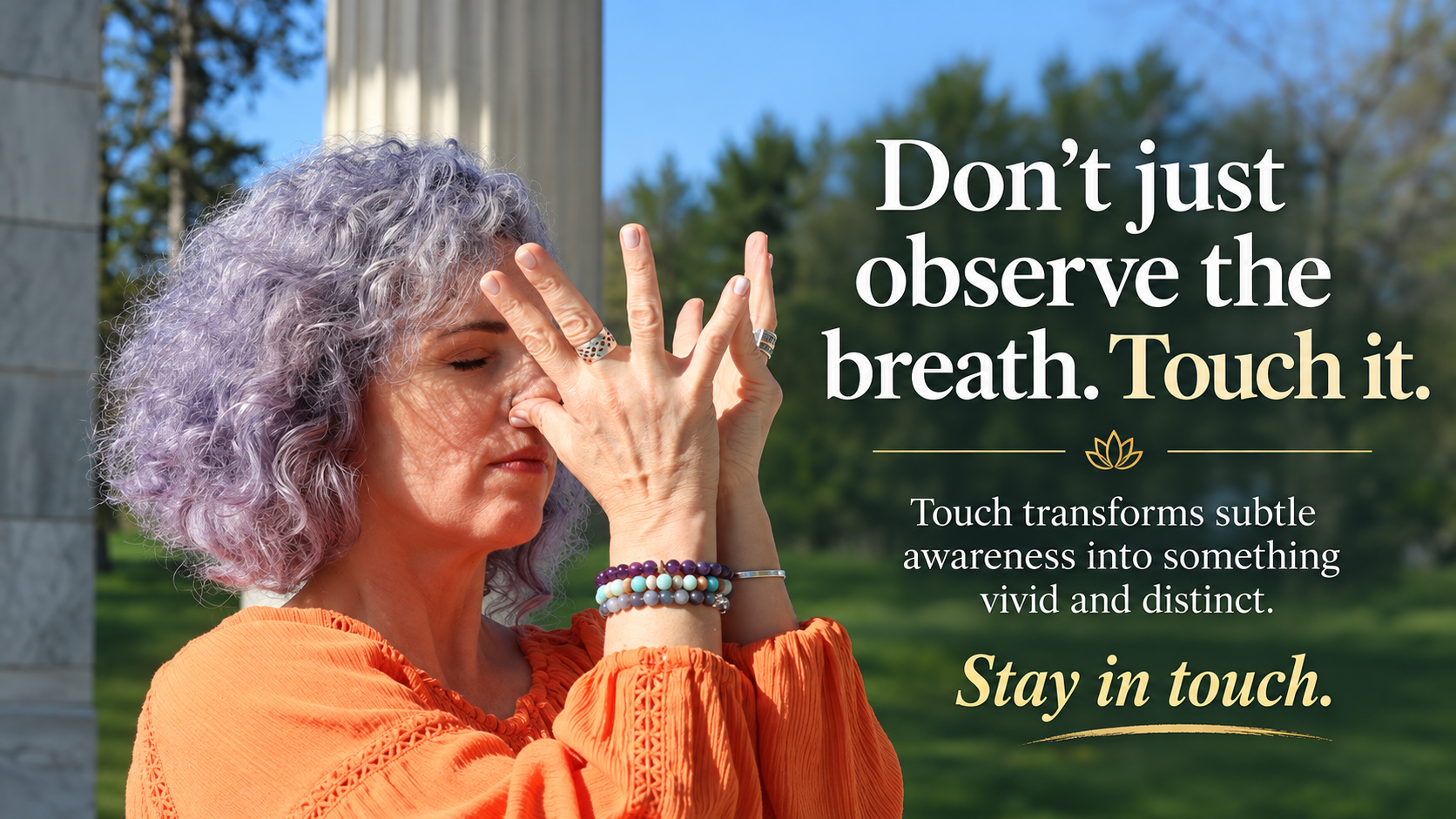
Mindfulness is important. Staying in touch, helps.
What happens when the breath slows?
Calms the nervous system — reduces stress and anxiety.
Lowers blood pressure — improve the body's regulation of blood pressure.
Increase heart-rate variability — improve cardiovascular regulation.
Change brain activity — influence attention, awareness, and emotional state.
Cultivate mental stillness — support relaxation and alertness together.
We begin the Journey at 24 minutes, and its no big deal.
What happens when you work up to 60 minutes a day of Left and Right and sustain that everyday?
Anecdotally,
in simple terms, we found that we got an abundance of energy. We found interoception soared, our internal sense of awareness of what is going on inside our bodies and minds. Memory will greatly improve, and we can prove it. Your blood chemistry balances. There is this profound sense of being whole again.
Swami Kripalu said that over years of practice of Anuloma Viloma, Breathing Slow Left Right, one’s character changes and becomes harmonious, equanimous and “sattvic.” Keep following the breath, repeating this simple alternation of focus from side to side, over and over again.
It turns out to be true.
Ordinary people, extraordinary results.
There is a big discussion to be had about Nitric Oxide and its potential role in the transformation. We create a trickle charge of Nitric Oxide that goes to the brain, not the gut. The delivery method is important in this case. Nasal breathing only. Nitric Oxide is certainly one of the variables that is a part of what happens.
Then there is the mind and how it changes.
Try this right now.
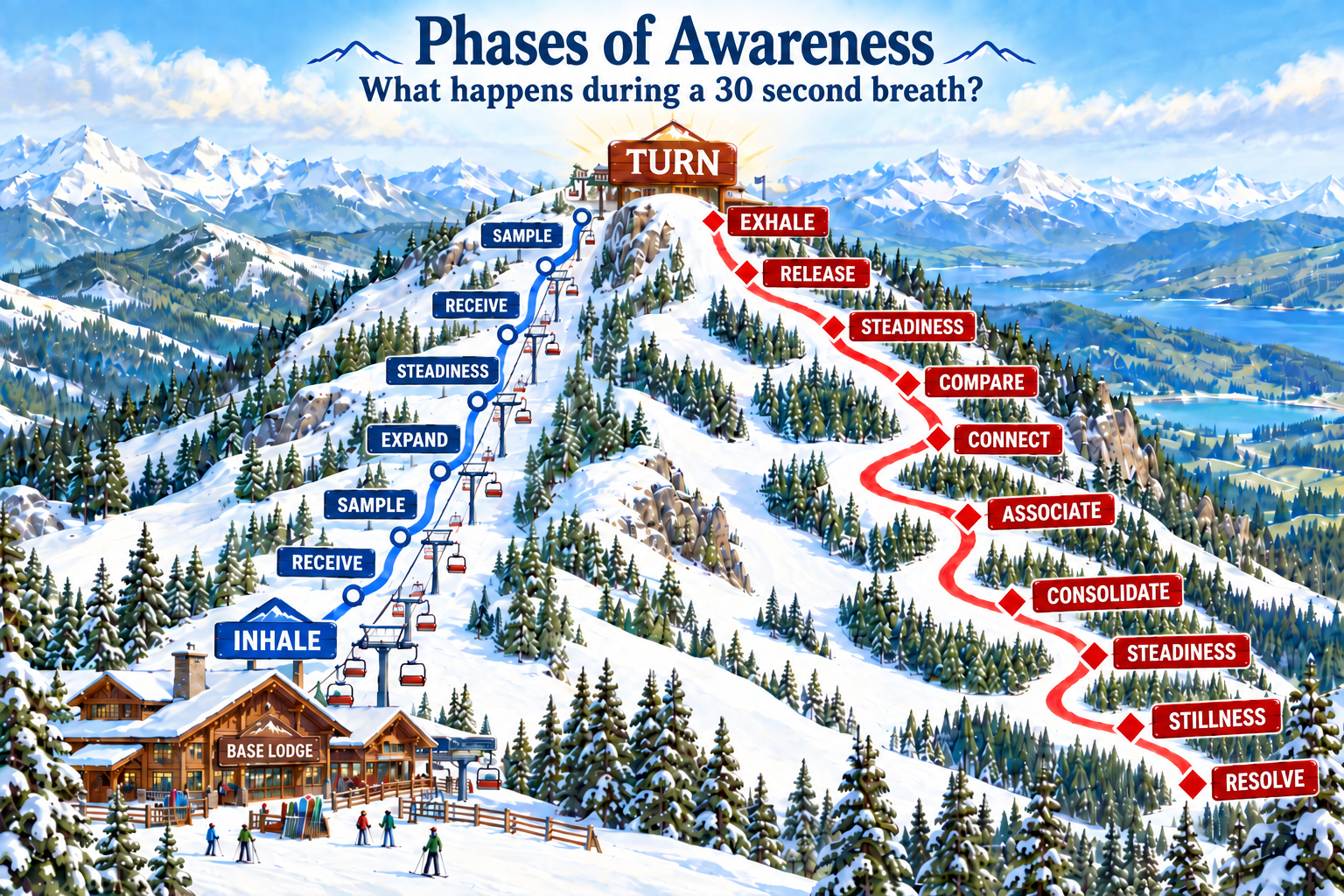
Read these instructions, look at the picture below of the ski slope.
Do an exhale, then go for your biggest, longest breath possible, right now.
As you are inhaling through the nose only, recite silently “receive, sample, expand, steadiness, receive, sample - Turn!” Then, “exhale, release, steadiness, compare, connect, associate, consolidate, steadiness, stillness, resolve.”
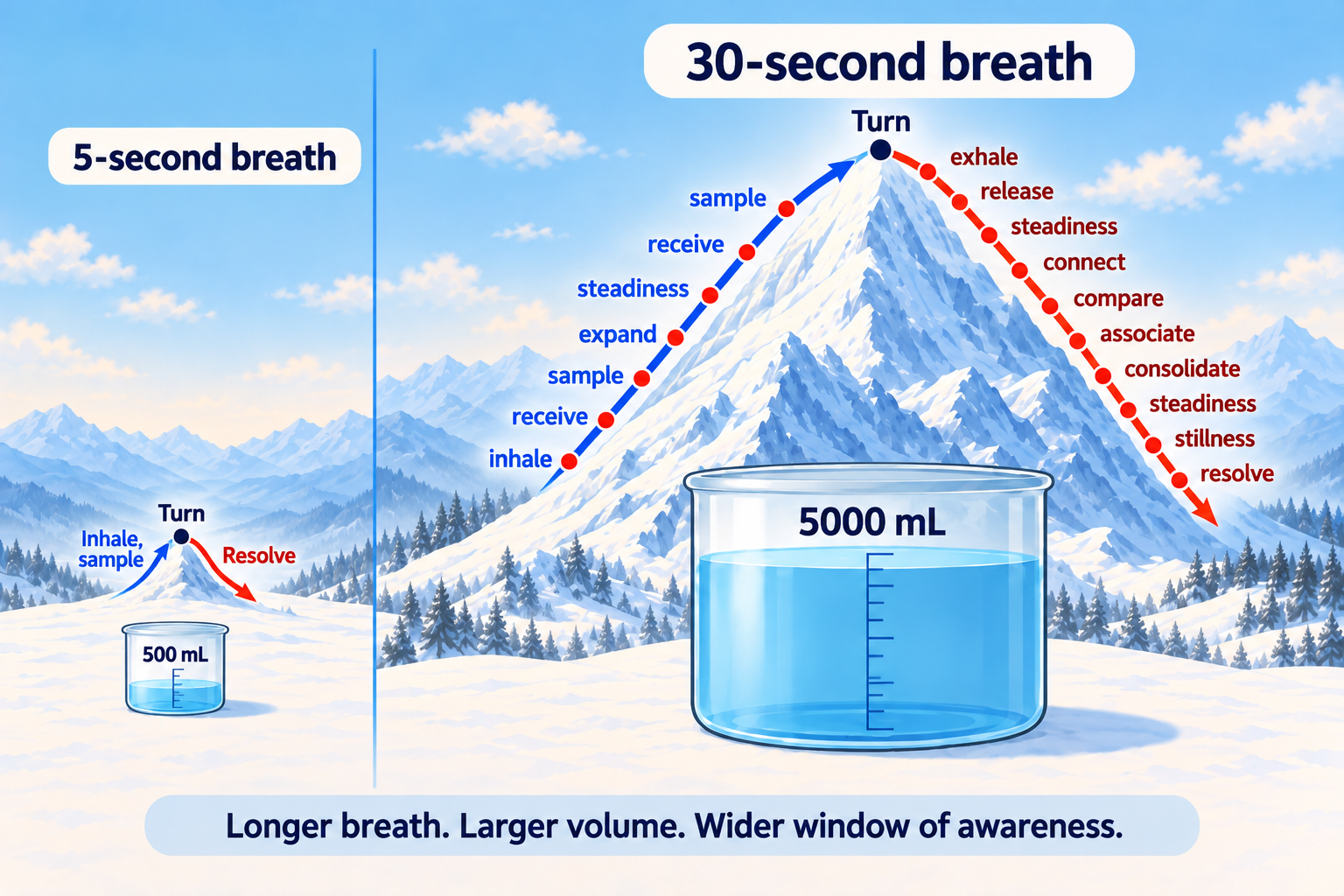
In that seemingly strange vacuous space of long inhales and exhales, the mind is processing, connecting, consolidating and interpreting in ways that are very different than a more typical 5 second breath.
You may have to play with this a few times, watching your mind’s temporal window stretch out.
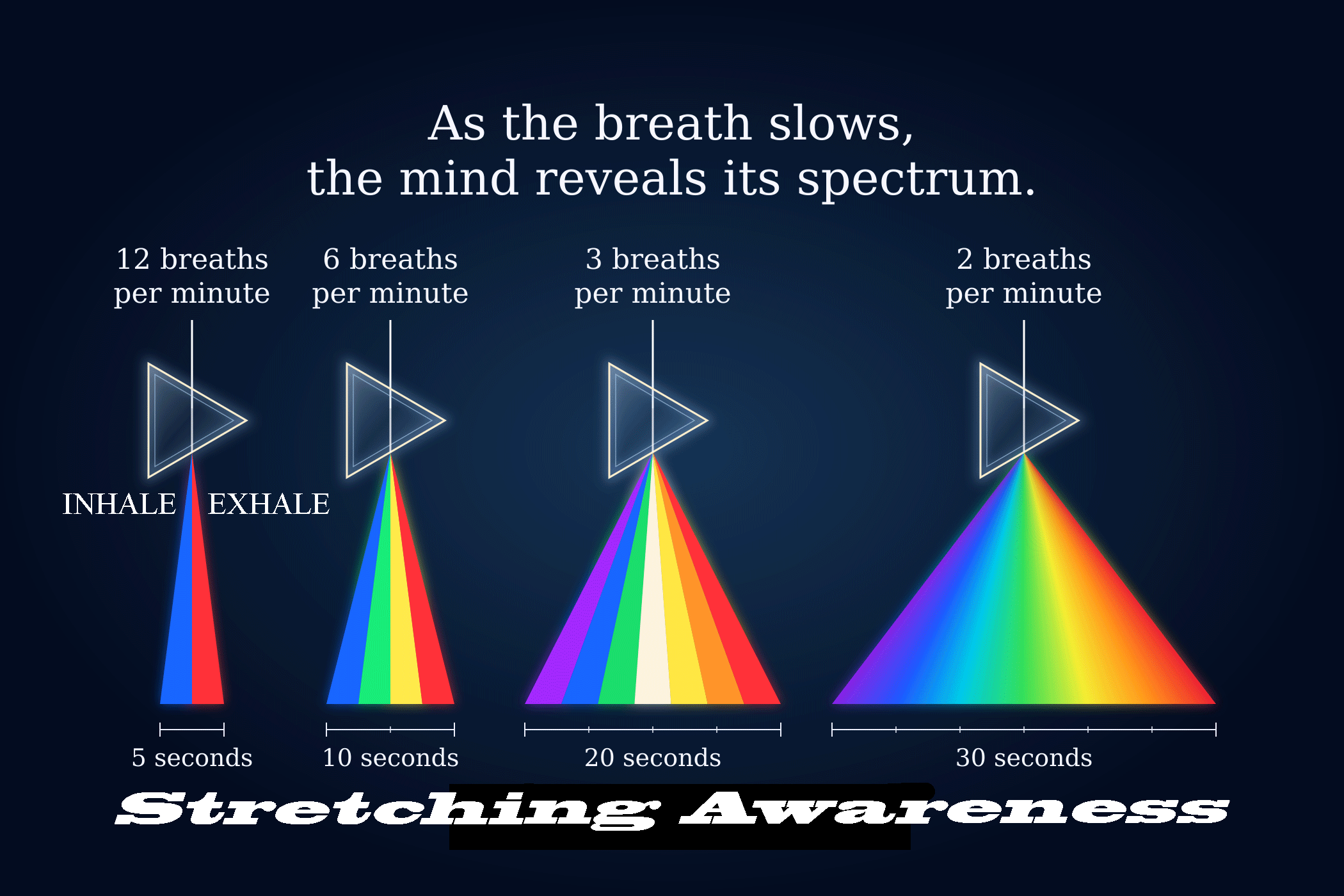
“The Self-Observing Self”
The Witness quite naturally arises, without a lot of fuss.
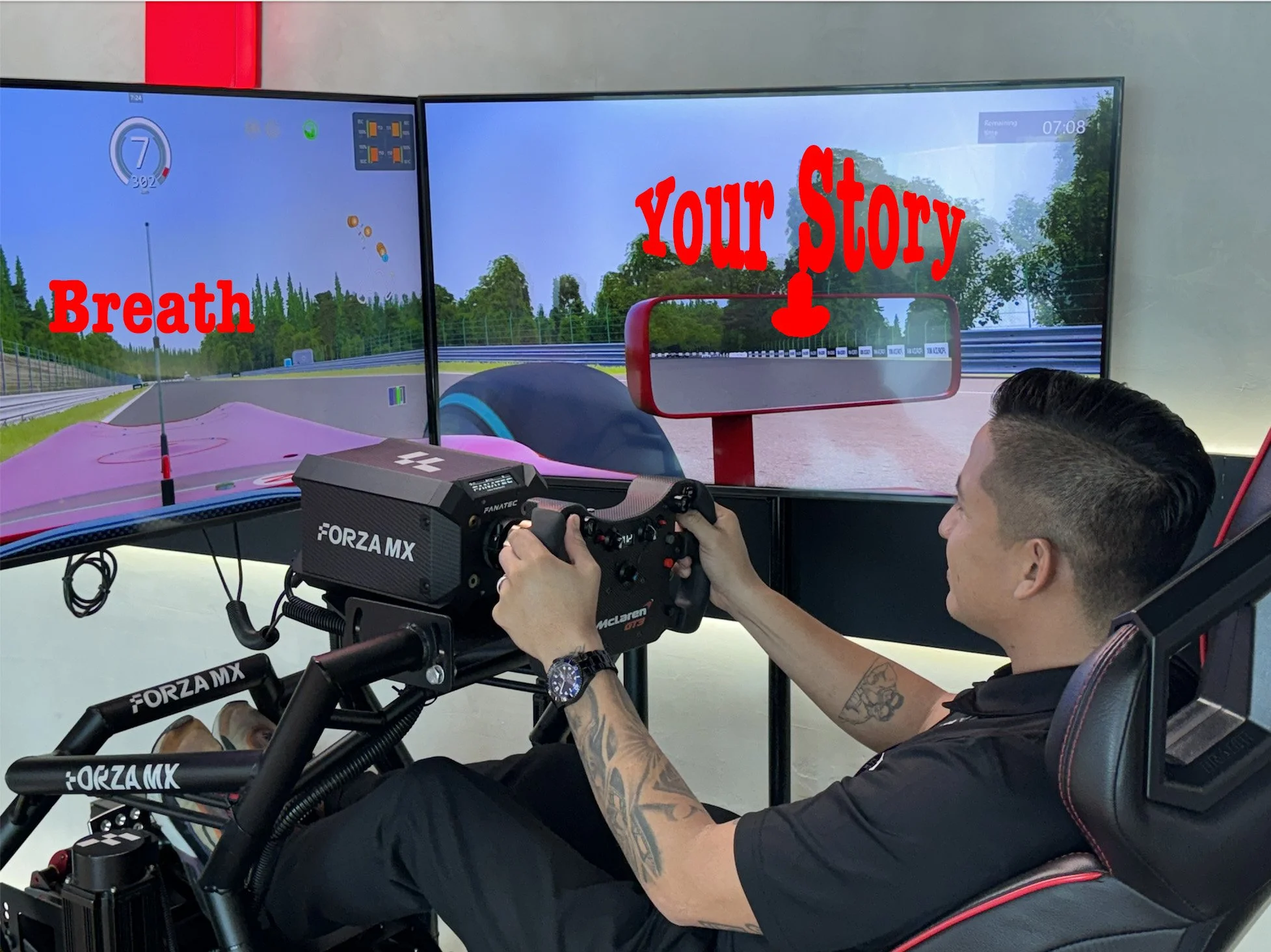
We explore a much longer 24 minute to 48+ minute practice, everyday. EASILY. A whole new world of unexpected benefits arise in standing position. Benefits: Attention, Grounding of the feet. Larger unrestricted lung volume, Vestibular safety: 4 points of contact: 2 feet, 2 elbows, Full body participation. Inversions of lungs!!! )
Left Right Breath is easier …. than Mindfulness Breath practices. Using the thumbs to focus on the breath has a big advantage, neurologically speaking. There are so many explorations that can be done in the standing position. Do other postures or practices you like before the broadcast at 6am., Some people follow the broadcast with a period of silent meditation or whatever moves you,
Do your own practices before or after the 6am broadcast. Come to these “mini workshop classes” when you want to. We have been doing daily experiments for many years… We have learned so much.
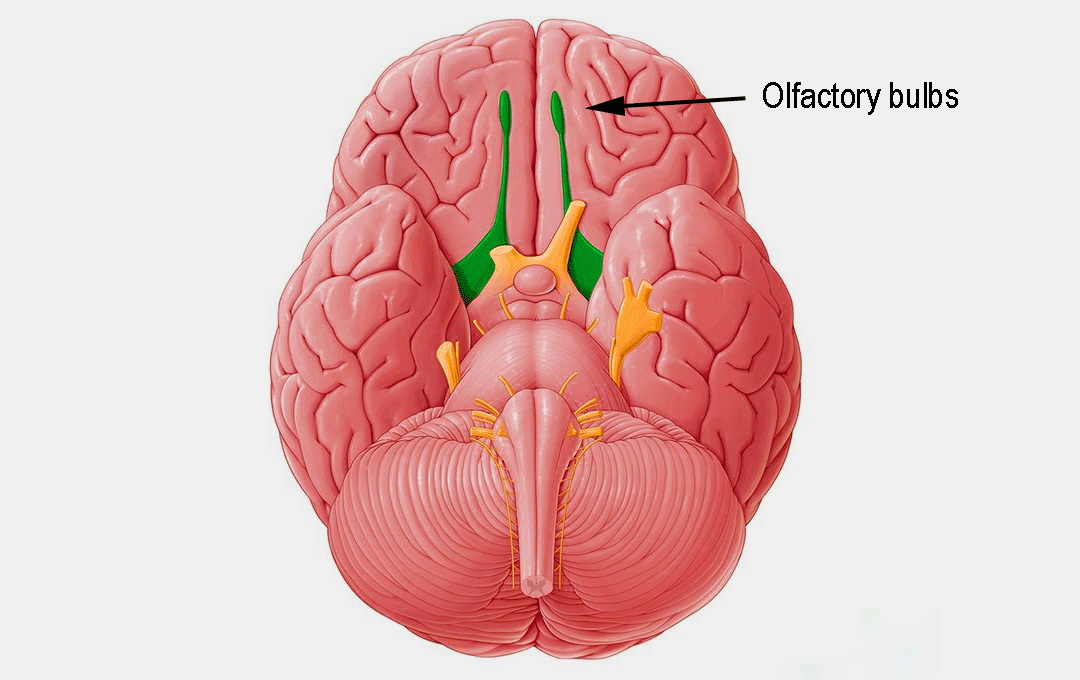
underneath side of brain - Alternate stimulation of olfactory bulbs, alternate hemispheric stimulation.
We become our habits….
Don’t “Seize the Day”. Seize the morning! It is the only time you can reliably count on. Start your day with the breath.
Developing a “Breath and Gratitude” practice habit at the beginning of each day is an excellent life choice. Your future self will thank you…. today. ~24 minutes everyday is a good starting place. There are levels to this.
~24 minutes is easy for a beginner when you do it this way. For the long term physiological results to show up, the absolute minimum dosage is around 24 minutes everyday (30 minutes total.) 24 minutes is easy (even if you are a parent with children) when a person stands and supports the elbows. 10 - 15 minutes of Nadi Shodhana is below the threshold where the significant physiological, neurological changes happen.
“10 minutes of practice” can too often be a form of self deception. Without depth, there is less reward, and without reward, habit formation is less likely. The more significant results of this astounding practice never happens at that dosage. Sitting and floating the arm get in the way.
“It is not about the nostrils.” It is about connecting the two sides of the body using focused attention and sometimes humming tapping, palpating, stillness and a wide range of other associated practices. The way we use our attention starts wiring neurons together.
“The neurons that fire together, wire together.” It is called Neuroplasticity. Repeated attention left and right, begins to strengthen the bridges (Anterior Commissure, the Corpus Callosum and others) between the left and right sides of the brain. As we use our attention, the associations grow stronger. When that is built into this breath being one’s daily habit, over a short amount of time, many levels of extraordinary health benefits accrue.
We feel each morning into our body, stilling the attention here and there, breathing into these places until we become those places.
Language matters. Language influences our experience. We don’t “hold the breath” or “control the breath.” That language, that mindset is a problem. We follow the breath. There is a big difference for you to discover with this language shift if you haven’t already.
Interoception and Hyper Mindfulness
Over months and years of daily practice, the “goal” is to be internally aware of the Left Right sides of the body all day long.
Interoception, our “8th sense” is our ability to sense inside ourselves, to know what is going on. It includes emotional regulation of our stress reactions and anxious mind states. Interoception is our most critical sense ot develop over time for long term health and well well being. We strengthen our interoceptive ability everyday. It grows. It gets stronger. It is cumulative.
We become aware of changing nostril dominance as it shifts through the day. We come to know which side of us is in charge.
Which meditative seat are we sitting on? the right nostril or the left nostril? They are two different viewpoints when you examine them closely.
We learn about the qualities and characteristics of the left side of the body, our “left side personality.“ And then we learn about the “right side personality.” Male and female, sun and moon are the common metaphors of the 2 sides of our personality. They are very different from each other. They react differently and behave differently and have different tendencies. Most people have little or no interoceptive awareness of left and right side differences.
Nasal Breathing only, especially at night.
Left Right Breathing is about re-learning to breathe through the nose only. Avoid mouth breathing at all costs. The lifelong disasters of mouth breathing are well covered by the Butyeko teachers, notably Patrick McKeown, and his book “The Oxygen Advantage” and others.
We don’t recommend “Breathwork” practices that encourage open mouth hyperventilation and over breathing. Hyperventilation and overbreathing is associated with anxiety and chronic disease patterns, like heart disease, cancer, diabetes. The goal of some Breathwork practices is about getting high, a “really deep yoga experience” or having a “transformational therapeutic breath experience.“ Physiologically, hypoxia is a disaster, especially if one keeps repeating overbreathing habits and makes it a lifelong pattern. Another danger of daily, “circular breathing” hyperventilation style Breathwork… is sterility. Hypoxia and sterility are well known dangers for fighter jet pilots.
“Breath ratios” are for short term practice, only. Breath ratios can be helpful for beginners, but ultimately they fail after 5 minutes. Metabolism is in charge. Breath ratios are completely unnecessary for the neuroplastic effects that long term left right stimulation engenders.
Re-learn? All human babies, from birth to the third or fourth month, are nose breathers.
One thing we’ve discovered over the years: sitting cross-legged and holding one arm in the air is not essential. When you free the body, a wide range of postures becomes available and interesting, and with that, a wider range of insights and many new discoveries. We don’t control the breath; we let metabolism be in charge. We follow the breath, as it is. We don’t impose an intellectual concept about manipulating breath ratios in an utilitarian way.
The short description of how this works, is that we stimulate the left and right olfactory nerves in a rhythmic way. We direct awareness into the body, following the sensations, the subjective “sparkling sensations” of the breath left and right. What are these sparkling sensations of light in the body? Good question! People all over the world experience them. What is going on here? Is it body phenomena or mental phenomena, or some intersection of mind and body. The breath is the tip of consciousness and we explore through the field of the body and mind.
Left and right breath stimulates the left and the right limbic structures directly and then the two hemispheres of the brain, back and forth.
The breath slows… safely, naturally, without a lot of fuss.
Just go back and forth every morning for a long time. Be happy, Be grateful. The practice is cumulative. The more you practice the stronger the effects become. With this form of slow nasal breathing, you can play and have fun during your morning practice. It is okay to follow your instincts and your insights. Add a little sounding breath (ujjayi.) Try ujjayi on the exhales only. It slows the breath more. Try a little humming as you focus into meditation points. Tap your sinuses, temples, top of the head. Everyday is an experiment. We have been showing up enthusiastically doing these and many other experiments for many years now, and enough time has passed that my body is the living proof of what this practice does for a person. The people who have been following the class for many years now are reporting similar astounding results.
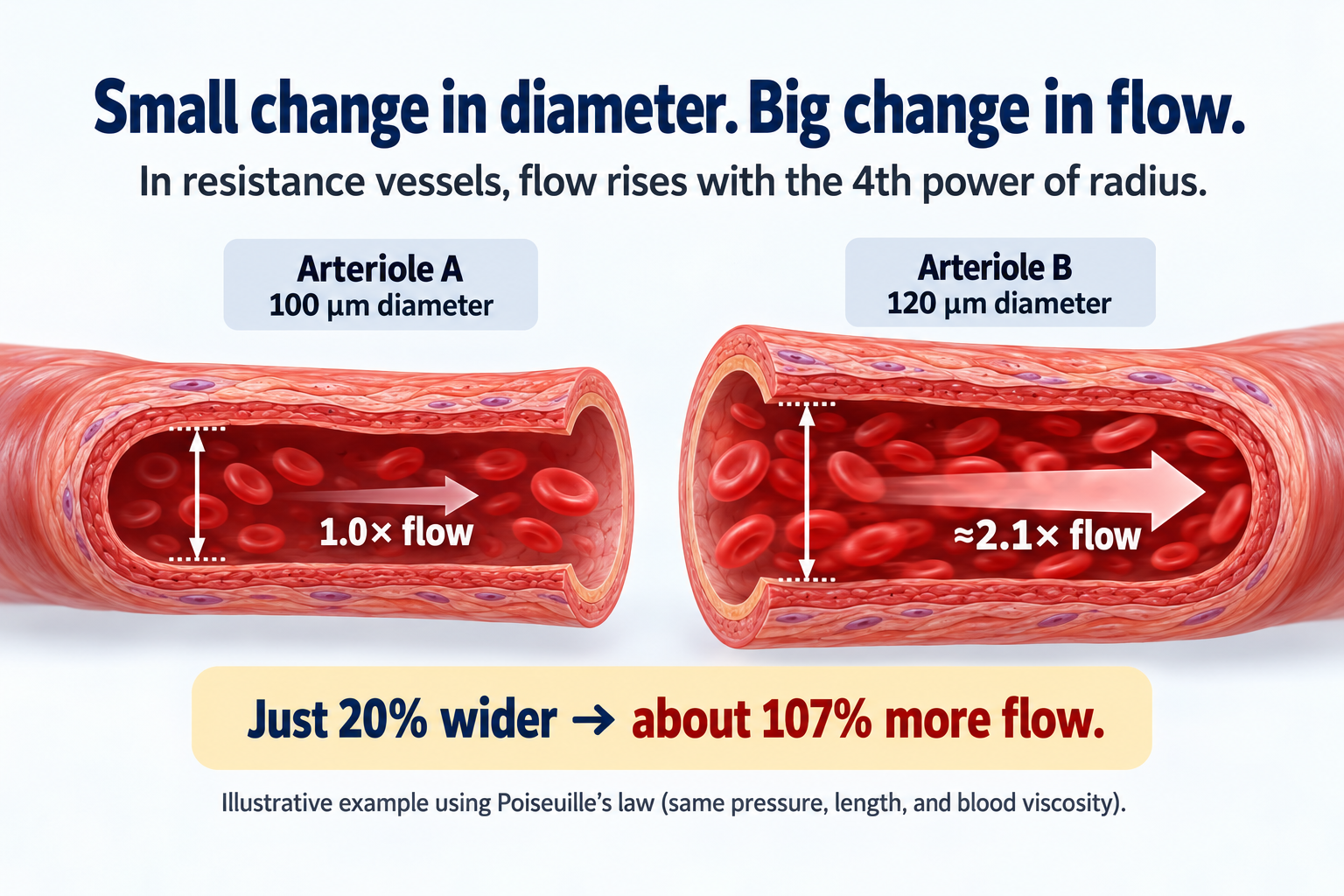
There is an abundance of research and meta analyses on slow breathing and vagal tone. As we follow this simple non-doing method, it initiates the release of Nitric Oxide from the paranasal sinuses, relaxing blood vessels, increasing blood flow. The long exhales increase vagal tone. Blood pressure begins to regulate. Anxiety softens. The chemistry of the body shifts, not just for a few minutes or an hour, but eventually all day long. The physical, mental, and emotional balancing effects are accumulative. The practice heals in an adaptogenic way.
We don’t “box the breath” or use ratios. If you like them go ahead, but they are not necessary. “Controlling the breath” is a short term practice. We are focused on the long practice, alternating sides.
This breathing practice is not about getting-you-high, or having the ultimate breath trip. This is not a hyperventilation breathwork workshop. There is no fast open mouth breathing here, stressing out the body with the dangers of cortisol, hyperventilation and hypoxia. There are no long, willful breath holds. It is not about the ego clenching the breath. Clenching and controlling the breath is pretty much the definition of anxiety. This daily practice is different from those flashy peak experience open mouth breathing workshops.
We are not chasing highs, but rather focus on feeling balanced, centered and relaxed, all through the day, everyday… even if the world is falling apart. This is where the gold is found.
It is not about breathing more and faster, but breathing with greater efficiency, stability and presence. Over time, one morning practice at a time, it adds up into something profound and simple. One becomes “sattvic.”
Eventually, over years, a person’s character changes. People report becoming more adaptable and flexible, working creatively rather than reacting to the stressors of life. We start living a more harmonious life, breath by breath.
This is the “long - slow” approach. This is about neuroplasticity, neurogenesis and rewiring the nervous system. There is preliminary research that breathing left and right creates new grey matter and greater left right connectivity. This connectivity becomes obvious to those who practice.
“The value of this left right breath will remain in doubt,
to those who have not yet practiced enough.” tom gillette
Ultimately breathing is a lifestyle. Gratefully follow the breath and rewire the thoughts. Put loving thoughts on the screen of your mind over and over and over, and the habit character of the mind shifts in a life affirming direction.
In many ways, Left Right Breathing is easier than mindfulness. We are not just “watching” the breath. We are touching it. The thumbs are the primary fingers to focus on left and right. Of course, we feel through all the fingers over time and study their qualitiies on different days and so come to know them.. The delicate tactile touch under the nose feeds back what is happening. Continuity of awareness begins to emerge, or what people sometimes call, being “in the flow.”
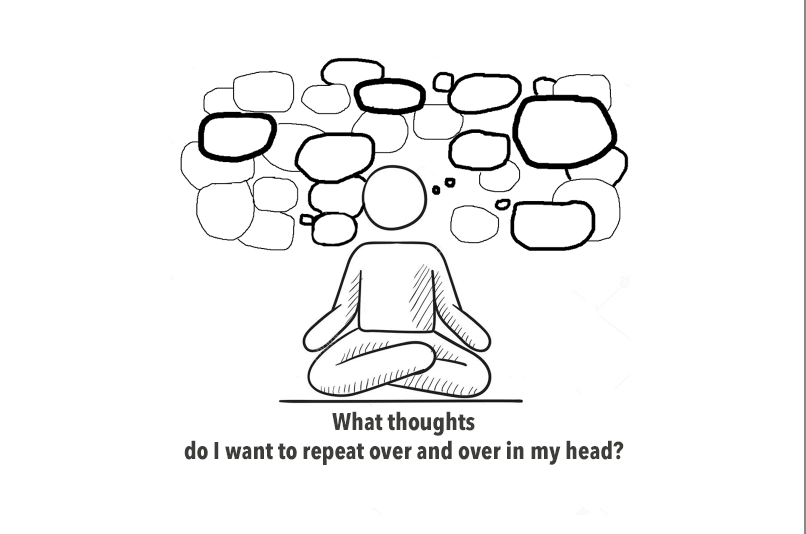
This breath introduces us to something deeper: the Witness. The part of us that observes our personality, observes our thinking/talking mind as it thinks. There is a quiet presence, behind the constant swirl of thoughts that usually captures our attention.
If you follow the breath to the end of the exhale, or the end of the inhale, the swirl of thoughts may become still, for a moment. And in that moment, clarity emerges. “Be still and know thyself,” - this is something that can be practiced. Everyone can go into a still place and indeed we already have experienced this stillness millions or trillions of times and not recognized it or rather lived inside of it. If the mindset is one of “controlling the breath” it is less likely to arise because there is an actor who thinks they are in charge. Stillness is there and it arises out of non personal effortlessness.
When the body is well-supported, this practice can be done for much longer with comfort. A long practice is enjoyable, instead of teeth grinding torture. The first threshold of dosage, a good goal to set when you start, is around 24 minutes every morning ( a unit of time in yoga.) Experience has shown that 10 or 15 minutes of Left Right Breath is not enough dosage for much of anything. 15 minutes of practice doesn’t have much depth to it.
If there is no depth to morning practice, there are no rewards. If there are no rewards, long term habit formation does not happen. With the elbows supported and the body at ease, the practice can become one of ongoing curiosity, a morning exploration into the interoceptive world.
You might need help to get going. That’s where we come in.
Learning Left Right Breath is not so different from learning to play an instrument. Piano, guitar, golf, tennis. It all comes down to loving your practice. The love has to be there in some way, or else you won’t practice long enough. Practicing all the time, you’ll make small incremental steps of interoceptive awareness each day. Love your practice, whatever you practice, over the long haul. The real value is not intensity, but rather consistently showing up every day, and going into a delightful place of balance and flexibility of mind.
Language matters
We don’t say “hold the breath” or “control the breath.” These tend to be judgmental phrases. A controlling mindset is tense, and not much fun to be around. Instead, we might say: float the breath. Listen to the breath. Follow the breath. Relax with each breath.
The phrase “Alternate Nostril Breath” misses the point. The nostrils are like the steering wheel on a car. The purpose of the activity is for all the parts of the car to come together and drive the car from one destination to another. The purpose of the practice is not just to sit in the car and turn the steering wheel. Turning the steering wheel is not the purpose. The purpose is to drive the car.
Yes, we focus on the nostrils for part of the practice, but many beginners falsely get the impression that the purpose has something to do with the nostrils, and that doesn’t make much sense. The practice is about awareness, balance, and the inner subjective experience of left and right, mind and body.
We have let go of many Sanskrit labels when necessary, keeping only essential polyvalent terms, words that don’t have equivalents in English. Not out of disrespect, but to avoid confusion, debate, and secondhand ideas.
The emphasis here is simple: practice. We have a bias towards action, not talk. To paraphrase TKV Desikachar: “Yoga is just a bunch of words, without practice (saadhana).”
We get the breathing and gratitude habit going every morning. And then, gradually, many years later, we become mindful all through the day.
You begin to notice, which side is dominant right now? When the left nostril is dominant, what state of mind comes with it? What are the thoughts and emotions that arise on the left side? What happens when the dominance shifts to the right side? What happens when left and right sides go into balance? We watch and notice. It is a long worthwhile process. It takes time and perseverance.
Left Right Breathing may be one of yoga’s most undervalued practices. In recent times, most yoga teachers have been told to only practice 10 or 15 minutes, a couple of days a week, here and there. Which is a shame.
“You have to go there, to know there.
If you don’t go there, you don’t know there.”
You can begin now, with this next breath you are taking right now.
If you used to practice Left Right Breath of some sort, and then lost the practice, well begin it again. Drop the guilt. It is cumulative and all the practice you did before will be a great help, because the nervous system will remember. that is what neuroplasticity is about.
We show up every day. There is a group of us that have explored daily 24 minutes, 48 minutes and more, for years.
A next stage of practice dawned in Dec 2024. The “Every Hour Practice” was the next stage of growth and not a beginning place.
You’re welcome to join us in what may be yoga’s most direct form of mindfulness.
Our aim is simple: build a life where the breath’s presence is not occasional, but continuous.

New Paradigm:
Amazing cardiovascular results, calm steady mind, great reduction of anxiety, improved attention, focus, and memory. When there is sustained left versus right mindfulness, there is a physiological, neuronal integration. Breath will spur your creativity, intellect, peacefulness, contentedness, one pointed-ness, gratitude, joy and love for life, and is just the beginning. “The First Rule: Love your practice.” If you don’t love your morning practice, whatever it is, you won‘t practice long enough for it to matter. The question becomes, “What breath practice can you realistically do long term?” This is something you should try for a few months, then decide. Significant “advanced practice” becomes accessible for ordinary people like you and me, by simply showing up.
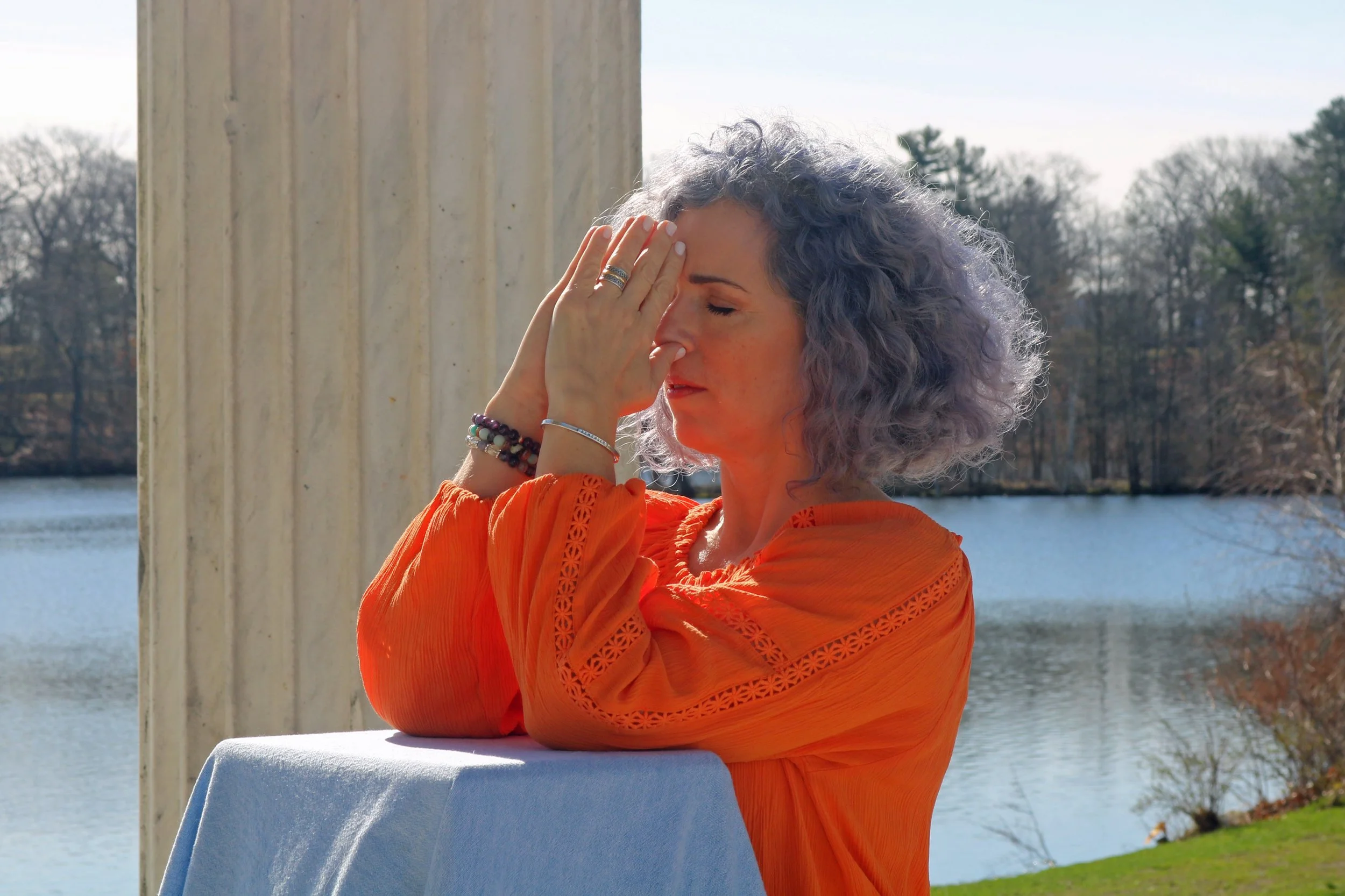
Fingers are the easiest way to develop Mindfulness of Breath.
Double Thumbs are the preferred method!
It all comes down to what you value in life. It is hard to value a practice like this, ahead of time, until much later when you see the compound effects over time and what the practice is doing for you.
The name of this yogic breath practice is Anuloma Viloma/Nadi Shodhana which means “purify/clean the nadis.” No one cares about “cleaning the nadis.”
After many years and thousands of hours of practice, as a side effect, we have found that daily Left Right Breath which releases a trickle charge of Nitric Oxide into the lungs and bloodstream, there is anecdotal evidence that it possibly helps repair and clean the plaque in the blood vessels to the brain, lungs and heart. When long term practitioners (over the course of years) are tested, there is some reports that they have minimal / no plaque in their arteries. This side effect has proven to be particularly valuable after open heart surgery.

It takes time, but cleaning the capillaries is invaluable to your health and wellbeing, as well as up leveling your meditation.

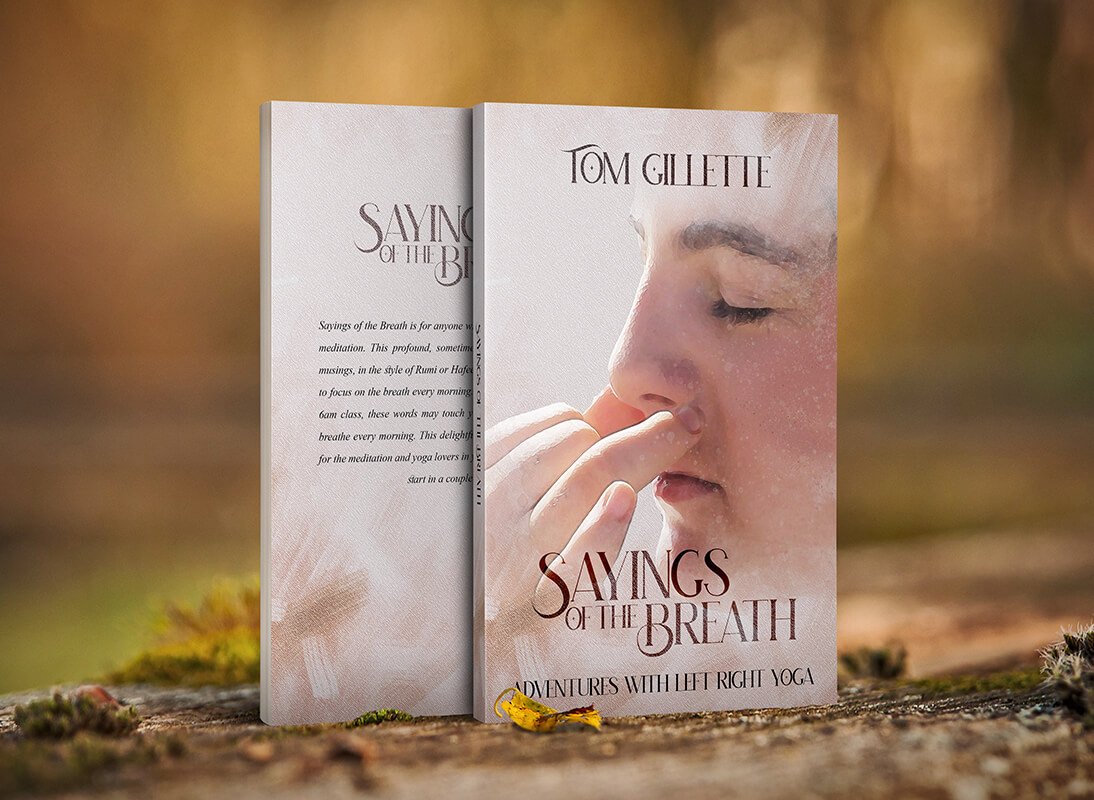
Tom Gillette has taught thousands and thousands of yoga classes most every day since 1988. He has discovered something very special studying the nasal cycle, something that has been overlooked in the yoga tradition, that could help you tremendously with anxiety and your meditation practice.
““Thank you for offering such amazing classes for so many years. I tell people all the time that you are the teacher I have learned the most from and continue to do so after 20 years of practice. Thank you for your wisdom, sense of humor. I feel blessed to know you.””
We make this groundbreaking, novel approach to traditional yogic breath practices available to everyone without regard to cost. These very unique, daily breath classes are “free by donation.” Join us every morning. Or hit the latest class replay button. Or go to the YouTube channel.