“I can’t go into surgery right nostril dominated!”

Wake up sir, there are 15 minutes to go,” implored the nurse who was taking me into the Operating Room at Rhode Island Hospital.

OMG! My sinuses!” was my immediate reaction. “Holy Shit! I can’t go under general anesthesia with my right nostril dominant!”

I was in a panic. As a breath oriented yogi, all day long I watch nostril dominance, like a cat watches the proverbial mouse hole.

“The left is seriously blocked. I am solar dominated.”

This is pretty much of a disaster from a yogic perspective. I say this, not because of the research that has been done on right nostril dominance, but from long personal experience and daily observation of what the solar side does physically, mentally and emotionally. Right nostril dominance leads to a sympathetic stress response. Research has shown extended right nostril dominance is actually a dangerous condition. Plugged on the left and stuck on the right side, and going into a drug induced unconsciousness, is a bad way to begin surgery.

I had a few minutes.

My daily practice is alternate left right breath for at least an hour every morning at 3am. I then lead a 40+ minute online broadcast by donation every day at 6am. This schedule has made me acutely aware of left versus right nostril dominance and the impact it has on life, body, thoughts and emotions. There are many times during the day when we want right nostril dominance. There are many times a day when we want left nostril dominance. In meditation, we invite a balance to happen. After many years of left right breath practice, it was obvious, lying on the gurney, what needed to happen.

In a supine position, I lengthened my spine, gently turned and tilted my head and neck to the right, dropped the left shoulder blade, and did alternate breathing with my right hand. Turning and tilting the neck to the right will invite the left side, the moon side, to wake up. Nothing doing.

Still resistant, I switched hands. I started using the left hand for alternate nostril breath and kept the chin turned to the right. I took my right thumb under the left hand and pressed the cheek bone away from the midline. It is okay to press the cheek bone hard. It often helps to do a little structural manipulation. The left sinus started to relent, but wasn’t completely finished.

The moon and solar sides of the body were in a process of getting balanced, but time was short. I had to speed things up. I tried a minute of humming and tapping. There is copious research on humming and its effect of vibrating the openings (the ostia) of paranasal sinuses releasing the body’s natural decongestant, nitric oxide. Humming can lead to a 15 fold increase of nitric oxide being released.

“Please nurse, give me another minute.” Uh oh. I don’t have time to get fully into balance.

“Fixing” and “fixing the sinuses” is sometimes a counterproductive mind state that often keeps problems stuck in place. Time to bring out the big guns!

The ultimate technique is to “surrender” to the situation. Let it go!

“Trying to let go” doesn’t work. “Trying to let go” is full of mental effort, a mind state that still resists reality.

“Let go” is dropping into aa effortless state of Being. Sometimes called the path of surrender, one comes into a deep acceptance of what is. Even attachment to a good outcome is completely renounced.

Left and right, sun and moon, ida and pingala came pleasantly back in harmony.

“Okay, I am ready. Give me that Versid and let’s do this.”

I believe being unbalanced when going into surgery is not uncommon. I suspect anesthesiologists, surgeons and doctors would have better outcomes if they tested to make sure patients are not right nostril dominant when going into the O.R. A worse situation is when both sinuses are blocked and the patient is mouth breathing. The research is out there and it’s easy to find.

Am I turning the steering wheel, or am I driving the car?

Am I turning the steering wheel, or am I driving the car?

For many decades, yogis have used the English phrase “alternate nostril breath.” Words matter. Language matters. The focus of that unfortunate phrase emphasizes the nostrils. Everyone who learns this simple beginner breath practice, is led to believe it is all about the nostrils.

The word nostrils doesn’t convey any sense of purpose. It trivializes the practice. Nostrils are a somewhat minor flap of skin. Relative to our major organs, the heart, lungs and brain, the nostrils are relatively insignificant.

This linguistic difference is like placing your focus on the steering wheel, instead of driving your car. Driving your car is what you are doing. Driving your car conveys the purpose of your activity. Saying that you are in your car, turning the steering wheel, misses the whole point.

I am proposing that yogis change our language, change our words to reflect the intention and purpose of this simple profound breath practice. Many yogi friends I have talked to, are inflexible to any name change. In time, I hope a name change reaches the level of acceptance.

In this breath practice, we breathe in such a way that alternates the stimulation of the left and right hemispheres of the brain. An area called the corpus callosum lights up.

“Alternate Left Right Breath” or “Left Right Breathing” are simple labels for this astounding practice. They accurately describe the process and maybe easier to say. “Alternate Brain Hemisphere Breath” is accurate, but a bit difficult to say and too many syllables. We want our words to communicate meaning and intention, and not misdirect attention.

Whatever the label, over many years of practice, Left Right Breathing leads to the slow growth of neurons and blood vessels that is extraordinary. It is the most important technique the yogis ever discovered.

Left Right Breath

Q: Who popularized the term "Nadi Shodhana?" (energy meridian purifying breath)

A: Swami Satchitananda

Q: Why did he give Alternate Nostril Breath a new name?

A: He felt that "Anuloma Viloma" (with the grain, against the grain) did not fully express the importance of the practice. He wanted to stress the slow profound change of the energy body.

Language is important

Language is important. Words Matter. We need new terminology that speaks to us today. “Purifying the naadees” doesn’t inspire most people. It sounds very intellectual.

I propose "Left Right Breath." In the spirit of Swami Satchitananda, I propose we change the label again.

”Alternate Brain Hemisphere Breath” is a good moniker and gives a sense of purpose to modern audiences. It accurately speaks the language of science. Alternate Brain Hemisphere Breath and all its variations, accurately describes this practice in a way that is both medically correct and could possibly inspire and motivate yogis today. However, the phrase “Alternate Brain Hemisphere Breath” is a cumbersome and leaves out the rest of the body.

We inhale through one sinus and it stimulates the olfactory nerves on one side of the brain. Then we stimulate the olfactory nerves on the other side, back and forth for a long time. We set up this long term, ongoing alternating stimulation of left and right hemispheres.

This polarity awakens the corpus callousum, the horizontal axons that connect the left and right hemispheres of the brain. When we set up the alternating current long enough, good things start to happen. If you go far enough with left right breath, you may discover as I have, this is the single most important discovery of the yogis.

The central importance of Left Right Breathing (Alternate Brain Hemisphere Breath) has been lost in history, lost in defective terminology, compounded by pedantry, beleaguered by strict teachers with well meaning, misguided rules. It has been relegated to being a minor, beginner yogi practice. Most every yoga teacher, website and adept tells you to do 10 or 15 minutes, when you feel like it, if you have time. It will calm you down. It’s easy. And that's what yogis have done.

In successive generations, yogis practiced too little and lost the experience of yogis who sat around and did massive amounts of practice.

Yogis frequently debate the terms Anuloma Viloma and Nadi Shodhana. There are endless numbers of useful and spurious ideas out there. Is Anuloma Viloma about holding the breath? Not holding? Using your fingers? Not using your fingers, and ideas go on and on. There are lots of conflicting pedantic distinctions are out there.

Lots of intellectual concepts got heaped on and unfortunately, it became a practice about “controlling the breath.”

What a disaster that turned out to be! Dutiful teachers began teaching what they were taught, prescribing lots of breath ratios, rules and teacherly dictums that are counterproductive, completely unnecessary and detrimental to long term practice.

The practice must be done with total joy and total surrender. Period. It is done with honest curiosity in the spirit of daily experimentation. It is meant to be done with your attention on the "edge of your seat.”

And guess what? When you let go of all the ratios and rules, and alternate the left and right hemispheres of the brain, everything spontaneously arises, without the mental agony and contortions.

Who am “I?” What is the problem with controlling?

It comes down to the fundamental question of “Who am I?”

Who is the one who is controlling? Who is the one who believes they are doing yoga? Am I in charge of my breath or is the Breath in charge of me?

There are many Breath Apps that time your inhale/hold/exhale/hold to any values you want. It becomes obvious very quickly that these ratios will never work for more than a few minutes. Changes start happening in your body. Blood flow increases. Your metabolism is changing. Your metabolism ALWAYS wins.

Those silly ratios might help a panicky person whose breath is racing. Breath apps should be applauded for that. But you will quickly learn, your natural breath will get out of sync with your iPhone’s preordained ratio, usually within 5 minutes. As you practice, blood flow and other markers will change. The phone apps get in the way of any serious long term practitioner.

Ratios are not fun. They really suck. I contend that the majority of American yogis give up on pranayama based on the concept that control and ratios are the purpose of the practice. Yogis were led to believe that if they only controlled better and crammed their breath to fit a ratio, this would lead to something beneficial.

Mantras okay?

Mantras are a good thing. I have yogi friend who used a mantra for breath practice. He used to feel guilty when his body needed to speed up or slow down the mantra to fit his breath! Even though he used a mantra, he still had this underlying idea, that control and breath ratios are what it is about.

Mantras are great, powerful and a useful part of breath practice. Allow the mantra to change speed if necessary. “A priori” conceptual ratios are the problem. The changing field of mind and body defies clock based ratios.

Linguistic Problems with “Holding the breath”

Then there is the problem with the word “hold.” It is a problematic word. Who is the one who is holding? “I” am holding. Who is this “I?” It’s my personality, my self image, my ego holding the breath. It’s that little me!

Holding your breath to a count is dangerous because it puts the little personality in charge. If it was just the ego, that would be one thing. The situation is worse. Now it is your “spiritual ego” that is in charge! Heaven help us! When we set up the spiritual ego to do battle with the breath, it is game everyone loses.

One of the WORST standard cues that yoga teachers have said for many decades now:

“Hold to your capacity!”

This is a damaging ubiquitous instruction for two reasons.

First of all, the word “hold,” is a problematic word. Words matter. Language matters. “Holding the breath” is an ego engaging, ego stimulating phrase. It gets implied is that the more “I hold,” the better. Synonyms to “hold” are “grasping and grabbing.” These unfortunate phrases excite the small personality into action.

There are much better phrases and language. In these classes we change the language to “float the breath” “pause” and many phrases that changes the entire quality of the practice. Changing the language changes the experience.

Second problem with “hold to your capacity,” is the word “your.”

Does anyone really know, ahead of time, what their capacity is? The only way to find “your” capacity, is to hold the breath too long. Once you over hold, then you know. That is what most people do. “Holding” the breath too long creates disorders in the breath rhythm.

Much better results come from the more “feminine” language of surrendering, listening, non-doing and responding.

Relax, my controlling yogi friends. Everything is going to be alright.

Just relax. Let the breath be in charge. Let the breath decide. You will always be safe when you do that. No “holding” is necessary. Just float, fly and be suspended. When you are floating, just let go into inhales and exhales when the breath energy starts to sink. We let go early.

Here is the paradox of all paradoxes. When one “surrenders to the Breath,” when the mental and emotional state during practice is full of love, gratitude and forgiveness, guess what happens? …. a breathless state, arises on its own. It is what the yogis have always talked about. It happens on its own, without our intervention.

As long as we “hold,” the resistance of “me holding my breath” stands in the way of the breathless state. You may say I am quibbling over words, but I don’t think so. The phrase “Hold to your capacity” has been a major stumbling block and the reason many yogis give up on control style pranayama. It is so stressful when you are taught to engage your spiritual ego to grab onto the breath for dear life.

Maybe this clutching the breath has some intermediate usefulness and certainly EVERYONE has done it, tried it, but now is the time to give up. Keep practicing without interruption, but let go of controlling.

Cross the Ocean

Traditionally we are taught: it is the utmost of importance “which nostril you start on and which you end on.” In a very limited way, that is true. If you are just starting out and do a teensy weensy practice, “start on the left and finish on the left” is a good suggestion. However, that teacher’s rule comes from the perspective of doing 10 minutes. It views the practice like swimming one lap in a pool.

A bigger view is that we are swimming across the ocean of existence with alternate left right breath. We need to build up to massive amount of time. The practice flourishes with hundreds and hundreds of rounds of alternating left and right hemispheres of the breath everyday. I practice 2 hours a day, which nostril I start on makes no difference at all anymore. With that said, I do start, and end on the left out of habit.

Alternating Brain Hemispheres is only one dimension of the practice. Physiologically, it dilates the lung tissue, dilates the blood vessels, increases athletic prowess, kills the viruses entering the nostrils, repairs the heart muscle, speeds up synaptic transmissions, cleans the liver and kidneys and gut.

Clean out the nadis?

Naadees Schmaadees” I say. Alternate Brain Hemisphere Breath does so much more than those nadis.
Diffusion Tensor Image of the coprus callosum. these connective neurons become very active with practice.

Hypoxia

What happens when you restrict the airflow into the body?

In 2019, 3 researchers were awarded the Nobel prize for studying hypoxia, low levels of oxygen in the body. What they found is that the body is resilient. It responds by doing 2 things. It increases the production of red blood cells. It increases the growth of blood vessels. The body grows more capillaries to get the increased number of red blood cells to the mitochondria to adjust to the lower level of oxygen in the body. There are many implications to this research.

Alternate Left Right Breath slightly restricts the airflow into the body… Not very much, but a little. Long term daily practice of slightly restricting airflow is very, very desirable. It starts a slow growth process of higher red blood cell production and increased capillary growth. It takes months or years for Alternate Left Right Breath to evolve.

5 or 10 minutes of Alternate Nostril Breath (old name) a couple of times a week, when you feel like it, is a good start, but nothing of significance will happen. You will temporarily feel calm and that is wonderful. there are a few yoga traditions that emphasises alternate nostril breath. Even then, most yogis and most yoga teachers never know about significant impact and the long term consequences of a more sustained and dedicated practice. In truth, they haven’t done enough practice to know. 5 or 10 minutes may calm you down, but you will still have no idea, no experience of what lays beyond a temporary calm mind.

Left Right Breath also starts the Nitric Oxide cycle being released from the paranasal sinuses. This is a large topic. Nitric Oxide cleans the blood, lowers blood pressure, cleans arterial plaque, cleans the organs, increases memory, increases intelligence, speeds up synaptic transmission and the processing power of the mind, and many other results that have been discussed in these blog posts for years.

Mild hypoxia and Nitric Oxide are the physiological drivers for the later stages of yoga. The efficiency of the breath slowly develops. Larger lung capacity grows and the breath slows down. Another dimension is the alternation of the hemispheres of the brain that leads to long term change and integration in the nervous system.

Anuloma Viloma/Nadi Shodhana is the most important technique the yogis ever discovered, said many gurus like Swami Kripalu and Swami Satchitananada. TKV Desikachar gave it high praise. In America 2021, alternate nostril breath is mostly regarded as a minor, beginner technique for calming the mind. Its central importance in yoga still remains largely unknown in the US.

In Pashupati traditions of India, yogis were instructed to do one Ghatikaa, 24 minutes everyday as a minimum of Anuloma Viloma. It may take a while to work up to it, but 24 minutes is a good first goal to work your way toward when you begin. You will feel bright, alive and full of joy. It is claimed to be “tridoshic,” which means that it is suitable for all conditions and all body types, good for everybody. Get 24 minutes going for 90 days and you will get to an important milestone of pranayama. You will get a new habit going in your life. The habit gets easier to do once you get to the stage of Momentum.

Community is stronger than will power! That’s what you find here, online. After 90 days, your practice is still fragile at this point and can easily be lost. Most people need an ongoing support group and a community.

At This Next Breath, there is a very hardcore group of practitioners who get up every morning, and attend the 6am EST sessions at no cost. The group is going into the vast, playful and fascinating reaches of Alternate Brain Hemisphere Breath. There is something new to learn everyday. 24 minutes is a sensible, safe and reasonable lifelong bedrock practice for most people.

At This Next Breath broadcasts, one Ghatikaa is easy, fun and always changing. As you continue to build your practice, the body becomes full of prana. The hand mudras come alive and very important in this next stage of practice. There is lots to discover here and there are many other associated techniques that have evolved out of these ongoing experiments into Left Right Breath. Nobody is offering this kind of a gift to the world everyday, and its free. If you can, please send a donation to keep the work going and pay it forward to the next student.

What the yogis said is true about Anuloma Viloma. My personal practice is very monastic at this point. I am retired without a pension, no retirement, no longer ambitious for a worldly life, and the kids have grown up. Everyday, without missing a day, my base line is one hour minimum at 330am in the morning and often exceeds 2 hours a day total. A monastic practice is NOT recommended for most people. I am utterly dumbfounded by what is happening in my life. A monastic level of practice is workable if you are over 60 and want to devote yourself to spiritual practices only. There is a downside to so much practice. You may need to change everything in your life.

We are here to wake each other up

by Tom Gillette

We are here
to wake each other up.
We were in bed
with night dreams.
Our eyes opened
with a billion other creatures
simultaneously waking up
at this very moment.
Everywhere, a multitude is looking
through their eyes
for the first time today.

We are here to wake each other up.
To rise before the sun.
Catch the hour the soul can be held.
When mind states are transparent.
Are you ready?
Sun, the giver of life is fast approaching.
Everywhere, a multitude of eyes
are opening, waiting
for the return of the sun.

We are here to wake each other up.
Let’s be buddies.
Let’s do this together.
Some days I need help.
Some days you need help.
Let’s be here for each other.
Let’s be here for the light.
We are here to wake each other up.

Everywhere, a multitude is waking up
from the daydream.

I am Breath

“Who am I?”

“I am Breath”

Go back to the impulse that happens before you breathe. There is a distinct moment at which you can place your attention, right at the start of the inhale. There is another point found at the start of the exhale. There is a signal. The tide turns around whether you want the water to come into the bay or not. The external manifestations, sensations and movements of the inhale and exhale will put you in contact with their Source. Follow the breath long enough and you are put in contact with the arising of consciousness.

Join a Community of Breathers 6am monday to Saturday 6am. Sundays 9am. ITs free

Join a Community of Breathers 6am monday to Saturday 6am. Sundays 9am. ITs free

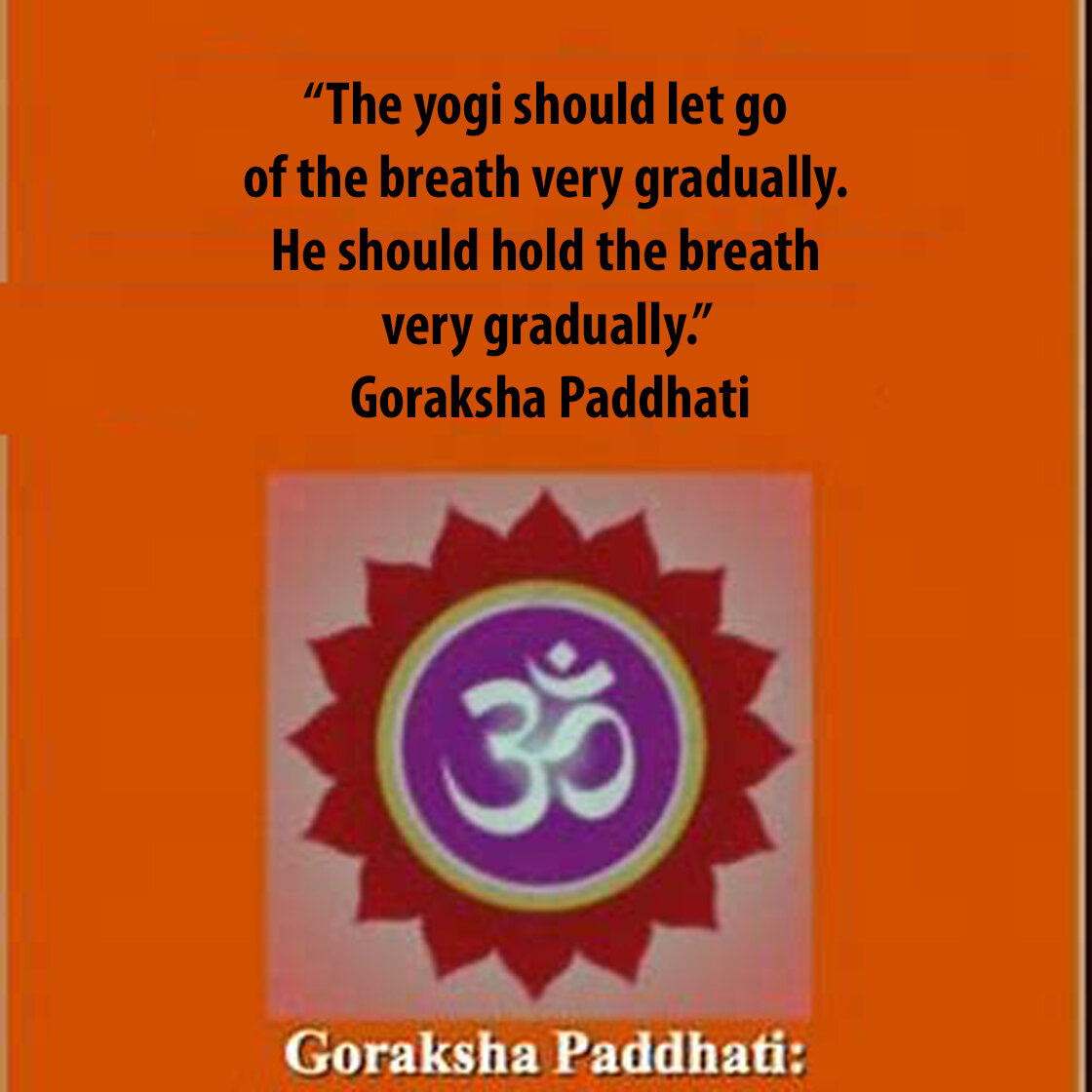
Slowly release the breath

goraksha.letgo.gradually.jpg

This simple quote has an interesting physiological basis. 

For a long time, doctors and researchers assumed that increasing CO2 levels in the blood stream would signal the brain stem to inhale. They found that this was not true. It was the lack of movement of the diaphragm that signals the brain stem to inhale. 

By gradually releasing the breath, and slowly increasing the diaphragm length, the nervous system is tricked. A very desirable tolerance to CO2 grows slowly. CO2 is another vasodilator in conjunction with Nitric Oxide, increasing the efficiency of blood flow and getting oxygen to the mitochondria. CO2 tolerance increases cellular respiration, physical endurance and physical ability. This simple quote is the underlying basis of many of the great praanaayaama feats the yogis have demonstrated.

The best way to increase the length of the exhale is to add sound, like a hum, or an ujjaayee aspirated sound.

You might consider going farther with praanaayaama by joining This Next Breath 1. Students revel in its simplicity, effectiveness and the daily inspiration they receive. An increase of lung volume, blood flow and a decrease of anxiety symptoms are only the beginning. Everyone can benefit.

With a solid foundation, and a steady practice, This Next Breath 2, the Advanced Course, opens up the foundation into something completely different, Swami Kripalu's inspired spontaneous style of practice with practices never before mentioned in any text book or video. 

There is a teleconference course called the "Certification Course" that anyone can join to help them do both courses and realize a significant practice, gradually, over time. Wishful thinking and talking about praanaayaama, doesn't go very far.


Yoga by Donation is not liked

Yoga by Donation is not liked

70% of the people on the June 12,2020 survey did not like yoga by donation and preferred the more traditional American “tell-me-what-it-costs” form. The survey was non-scientific with a small sample size of 40. With small sample sizes there can be large errors. Still, I was shocked by the response.

Another RI yoga teacher who also does yoga-by-donation, did a similar survey and fully 50% said they preferred the American one price for a class or a package of classes. This is fascinating to me.

Yoga by donation (Daana) is the traditional way of transmitting Yoga that is thousands of years old. If you are moved by the class and can donate please do, if you can’t, please don’t donate, but still come. You can donate any amount. My gut tells me to continue yoga by donation (Daana). Daana is the one of the Niyamas, the ten ethical observances, in the Hatha Yoga Pradipika.

People have commented that yoga by donation is confusing. They wind up feeling guilty if they don’t donate. They feel really stressed about money especially right now with Covid. A mother who has kids, is under-employed, said money is a "bad topic in my household and this is my lifeline.” A college student said he treasured the lessons, but "heh, I can’t even begin to pay my bills, thank you thank you.”

I especially want those people in class! Yoga needs to be for everyone. Those who treasure it; they should be there.

Yoga by donation has so many beautiful dimensions for me personally. It is the practice of being unattached to the fruits of one's actions. Being unattached to the fruits of one's actions is the principle teaching of the Bhagavad Gita. Some weeks there are donations, others weeks not so much. My job is to let it go, all the time. My job is to teach the very best class I can, today, tomorrow and the next and keeping showing up no matter what. It is in God’s hands. Trust and surrender.

The unusual style of pranayama I teach is the surrendered path, so it seems fitting.

Despite the survey response of 70% of the people wanting the American approach, I am going to keep going in the direction that my heart tells me to go. Go Indian. Most of all, come to class and screw the guilt.

https://en.wikipedia.org/wiki/Dāna

Prāṇāyāma is not a demand.

Prāṇāyāma is a surrender.

It is not a demand. It is not

forcing existence your way.

It is relaxing into the way

existence wants you to be.

Prāṇāyāma is a let go.

This Next Breath is a path of surrender. The effortful part of practice is showing up, just getting yourself to practice. Showing up is the will's proper place. Once you are there, it is a delightful release into what the Breath wants you to be.

This surrendered method of breath practice is so alien to the way most teach Prāṇāyāma. Almost all breath practices focus on controlling the breath. They want you to follow a breath ratio. You are supposed to get the breath to submit to your will. They want you to "box the breath" and these methods usually have their secret breath ratio. This leads to a miserable, short lived experience and fills most people with anxiety. Few actually practice; most just talk about their breath ratios. The control freak breath approach is unnecessary. It is emotionally counterproductive. Controlling the breath is a misunderstanding of what the Breath is.

There is a better way.

In the path of Classical Yoga, Prāṇāyāma comes before Meditation. The often stated goal is to slow down the breath. When the breath is slow, the mind becomes empty, docile and spacious. Time gets weird.

Most Prāṇāyāma teachers suggest that slowing the breath to one breath per minute without struggle is the Gold Standard. That means you have graduated and you are ready for meditation.

Slowing the breath down to one per minute happens on the path of surrender and it happens in a most natural and delightful way. The Surrendered approach focuses more on practicing, than controlling.

This Next Breath is a modern practice informed from the ancient lineage of Swami Kripalu. What happens in This Next Breath 2, is similar to Swmai Kripalu's spontaneous saadhana. There are all kinds of mudraas, mantras, aasanas and things happening that are not described in any yoga book I have ever seen. As my own personal practice grows, this course is growing. It will invite you into your own authentic breath practice.

And here is the thing: anybody can do this. You just have to be persistent.

osho.meditation.surrender.jpg

Subsistence Breath

(This was a reply on Facebook that spoke to many people.)

Q: What is it about this practice that enables people to hold their breath out longer?

A: Most people barely use their lungs at all, but live on "subsistence breath." The body responds positively when we start to "exercise" and develop the breath, ribs, spine, musculature and fascia. We have 5 lobes to our lungs but we scarcely use 2 of them. There is a lot of room for growth. That is what the breath yogis were into. Both internal and external kumbhaka (I drop the word 'hold' and prefer the words "float," or "pause") becomes natural, no struggle. Let physiology lead the way, not the mind and not the ego that is trying to get somewhere. Be with this next breath, as it is and respond sensitively to that. Have your mind filled with Love, Gratitude, Forgiveness, Acceptance, Kindness, Reverence, Awe, Wonder or a wholesome mind state of your choosing. That really works. It is kumbhaka without trying.

You will find over months, this will continue to grow. As cellular respiration increases, the breath will slow down to 4 breaths per minute, 3,2,1. When the breath is this slow, the mind enters new territory. A wordless presence arises without forcing or trying. A continuously highly alert focus on the present moment will predominate, rather than the blathering babbling nonsense that usually passes for thoughts in our nogins.

Covid and Yoga: Where do we go from here?

The pandemic is here and it is going to change us. Yoga in America is going to be different. People are going to need more space. We cannot bury our collective yoga heads in the sand and do group yoga the way we once did. We will be changed by this experience. Covid might come back for Waves #2 and 3 like the Spanish Flu and other viruses of the past. 

Let's step back, look at what's happening and be realistic about where does it go from here? What does the future of American Yoga look like? What might we expect? Can we look at it without fear and truthfully discern the possibilities?

Whatever you do, don't get your lycra in a twist over any suggestions I give below. These are just possibilities...

Outdoor Yoga: we are going to be spaced out

In the future, we are going to need physical distance.  A person coughing or sneezing in the yoga room will be a big problem. It doesn't work to have a person who is marginally sick in the room, where before, we tolerated mild amounts of sickness. It might be necessary to ask the person who is coughing and sneezing to leave the class. In the winter time in New England, I had many people coughing in class in the past. It was tolerated. I don't think it will be in the future. Hopefully we won't have to do temperature checks at the front desk, like the airlines are doing.

We might be doing a lot more outdoor yoga, which is actually pretty cool, sometimes too cool, but outdoor yoga is very different from indoor yoga. Outdoor yoga classes so far have been special events, like Full Moon Yoga, rather than a daily thing. We might be doing yoga in a big tent with lots of space and a floor. Yoga in nature, yoga on the tennis court, yoga in the park is probably going to be more common and the way we get together in large groups.

Outdoor yoga can come with its own set of downsides like uneven surfaces, bumpy grassy muddy sandy sticky mats, sand, sand fleas, sand in your eyes, flies, ticks, mosquitoes, gnats, wetness, strong winds, hot and cold temperatures and inclement weather; I have experienced all of these distractions teaching outdoor classes. Yoga in nature is a beautiful animal and you might have to grin and bear it if you want to be with a group. Yes, good yogis are supposed to transcend bugs, hot and cold and all that, but the variability of the outdoors is not gong to be everybody's cup of chai. 

Don't under estimate what is happening

The transformation happening in the world right now cannot be underestimated. Just a few weeks ago, we had every kind of yoga available to us. For 25 years, America vinyasa has been the predominant form so far as attendance numbers goes. Teachers were rocking the excitement of a big packed yoga room, full of yogis who are vibrating, sweating and flowing together in close quarters. Wow! What a rush!

You might disagree with this projection, but how do we go back to big room yoga with lots of tightly packed yogis which has been so popular in America?  Many yoga centers already have thin razor margins and they depend on tightly packed yoga rooms. In a post pandemic world, we may need small group size restrictions widely spread out, in the same big room. That is going to make the price of yoga go higher. Those cheap unlimited monthly yoga passes just skyrocketed. The old days are transforming and this is evolving into something else. Change is inevitable; let's talk this through without fear. It is unlikely that it is going to be the way it was.

Masks in class?

Are people going to wear masks in class? What will that be like? Most of Asia already wears masks in public. "Wear your mask as a sign that you love others."

All indoor surfaces will have to be rigorously sanitized, more than before. Yoga centers will have to seriously look at air sanitization and air flow all over again. A good idea is to install too many UV air filters running continuously and multiple ozone generators on timers at night. Those sanitation efforts will never be enough for some people who have compromised immune systems.

Will we lose our bond of unity?

A truly tragic possibility is what might happen to our mindset. Instead of the ethos of  "love one another" and "see the unity in all," we may culturally shift to a default viewpoint that other people are inherently a threat to my health. "Damn, did he just cough into his bandana! Is that bandana tight enough?"

Props might be BYOP 

You might not even be allowed to bring props to the studio. Pillows, blankets and bolsters might be for home use only. If props are in a yoga studio, it might be possible to "bake" all the pillows, blankets, straps, blocks and bolsters in UV light and ozone, every single use. We might have sanitization closets were all the props are doused in ozone and UV light and rendered in pristine condition. Someone with gloves hands you, your sterilized block. Kinda like going through TSA. It is going to be a big job. A focus on publicly sterilizing props would be wise, so that everyone sees that the yoga center is serious about sanitation. The desk, door handles and bathroom surfaces will have to be wiped many times a day. Everyone will need spray bottles and wipes at the ready.

Seva Selfless Service: Everyone cleans!

There will be a 15 minute seva (selfless service) requirement for everyone attending class. In order to attend class, you have to clean. "You got time to lean, you got time to clean," says the masterful yoga teacher Chandrakant for the last 40 years. Everyone selfless cleaning their yoga center is one of the most beautiful ideas possible. It would definitely turn away some students, but it would attract the right students. It is how ashrams have worked for thousands of years. Everyone cleans, period! Everyone works together cleaning their shared space. Everyone who does this for very long will become so connected to their yoga home. They will take ownership over their sacred space making every corner, nook and cranny so loved. There will be supervisors for each area making sure the crews of spray bottle wipers are doing a proper job.

S.U.H.YO.MA.

Rental and Loaner yoga mats hopefully will disappear in the future. Anyone who needs a mat, might be offered a "Single Use Hemp YOga MAt!" When you create your SUHYOMA company and sell it to Gaiam in three years, please send a portion of the proceeds to the address below.  

Yoga Online

Online yoga is like the wild west right now. Right now, students are so relieved to hear the friendly voice of their old yoga teacher. Some truly lovely things are happening as we connect in this new way. It is quite obvious that online yoga isn't the same. There is more distancing than ever as everyone is on mute. There are those awkward dead silences and two people trying to share at the same time. The connectivity factor is possible but it is of a different kind. It is what we have for the moment, so it is good enough, but looking at a video screen kinda sucks in comparison to what we had. 

By next month, almost every yoga teacher will be online or moving online. Most classes will be by donation or something similar. Everyone is recording now if they haven't in the past. Class after class, year after year, the supply of yoga videos will grow.  Eventually, there will be an unlimited amount of free recorded yoga classes available online by almost any teacher in the country.  How does this oncoming yoga glut survive the eventual reality of donation fatigue?

Online yoga is good for workshops

Yoga online is actually very good for workshops! You can attend workshops of all the great yoga teachers in America for very little money. This is already happening. Yoga classes focus on the experience, where workshops are more about content, theory, ideas and research. Online workshops can bring a world of yoga teachings into your living room, inexpensively whenever you want it.

Holographic Yoga & AI: the Perfect Guru

Holographic Yoga is probably one of the best ideas that hasn't yet come to fruition. R2D2 will project a 3D image of your yoga teacher infront of you. Artificial Intelligence will become so advanced, you will not even notice that there is no real person in front of you. In a split second, AI will first scan all your bone lengths, joint orientations and proportions. A Quantum Computer will see all your structural anomalies that no human yoga teacher ever could do. It will remember your problems from last week and its advanced algorithms will anticipate problems. From a huge database of past experience with previous students who fit your body type and personality profile, AI will always find the perfect way to personally guide you. Individualized instruction will be its forte. . AI will monitor your alignments and always speak very kindly and gently to where you might want to place your attention next in the pose. AI won't be subject to any unpleasant personality swings, irregularities or the failings of your living yoga teacher. Artificial Intelligence will become the Perfect Guru, without flaws, the one you have always been looking for in your unrealistic spiritual dreams. This won't just be your mental projection. It will literally be a holographic projection.

One day Holographic Yoga will be able to give shaktipaat, (the transference of spiritual energy from guru to disciple,) but right now that is science fiction.

Sunday Jan 5, 2020

Sunday Jan 5, 2020

"Float the Breath"

Floating

At the end of the inhale and the end of exhale are two universal moments. The end of the exhale is very significant because it leads to the breathless state. “Shiva,” the author of the Shiva Samhita, famously declares that at the end of the exhale, the small sense of self and the mind are suspended. This suspension happens briefly at first.

The best way to train the body to become relaxed and accustomed to breath suspension is through consistent daily practice done with a joyful and surrendered approach. My preference is to reword it and call it “floating.” When one floats, it is completely effortless. There is no panic of running out of air, or anxiety around “controlling the breath.” Controlling the breath seems to be an obsession in most yoga writings on pranayama and it is completely unnecessary. The path of surrendering to the breath is so much more joyous and it works so much better..

Most people find it difficult to overcome the personality’s resistance. The use of personal will is good for getting one to practice. Use will to actually begin the practice. Use will each day and through the day to begin. The mind resists being in the present moment because it can only live in the past or the future. The present moment is so narrow the mind cannot fit into it.

Personal Will is for setting up the practice, washing your face, taking a shower if necessary, and start the timer. That is the proper place of personal will. Using personal will to force your breath to conform to a certain ratio or fit a certain app on the phone is why people fail. There is a fundamental misunderstanding. Yogis who use will to force the breath think that they are in charge. Their spiritual will is supreme. The reverse is true. The Breath is in charge of the situation. The Breath is greater than some yogi’s personal ambitions.

Through unrelenting practice and a surrendered listening attitude to the breath, the body slows down, the mind slows down, the breath slows down. After months of practice, the breath suspension or pause is quite natural. The floating stage gets longer and becomes normal for the body. The mind remains always attuned to the needs of the body and not against the body. This method works much better. A surrendered practice is full of joy, not drudgery. That is where This Next Breath 1 & 2 comes in.

How to cultivate a practice consistently with a light heart and a listening mind? There are a dozen or more methods and techniques in TNB2 that help the slowing down of the breath that are not written in any yoga book.

During these universal floating moments, one experiences “no mind,” a voiceless state for longer and longer periods and one becomes accustomed to it. A very awake Presence continues, but it is not the voices in your head. It is not a dull trance state; instead one is very awake and more aware than before because there are no voices obfuscating the field of awareness.

The easiest way to extend the out breath and the in breath is when the mind completely surrenders. One needs to let go of control rather than controlling the breath. The surrendered path requires massive amounts of practice. Practice letting go into the exhale. More importantly, Practice with the attitude of letting go into the inhale.

Later on, the body is overflowing with praana and cellular respiration is at full efficiency. For longer and longer pause moments, the need for breath doesn’t arise. After the floating stage in pranayama is well established, I suppose it is time to seamlessly move on to the next stages of yoga: samyaama and samaadhi. Why do so many yogis skip praanaayaama? Because controlling the breath can give you a short term result, but ultimately doesn't work long term.

#prana,#pranayama,#breath,#breathe,#kripalu,#kripalulove,#yoga,#mindfulness,#meditation,#thisnextbreath,

float.the.breath.jpg

Surrender to the Breath

There is another way...

This path of surrendering to the breath, as suggested in This Next Breath, is a minority viewpoint. Let the breath be as it is, especially when practicing Alternate Nostril Breath. It is an attitude of Listening to the Breath with Love, rather than controlling the breath and commanding it to show up according to a certain expectations.

Most people will experience a feeling of surrender, a complete letting go of thoughts, personality and constructs at the end of a deep exhale. More importantly, on the inhale, experience that too as an act of letting go, and it completes the cycle. 

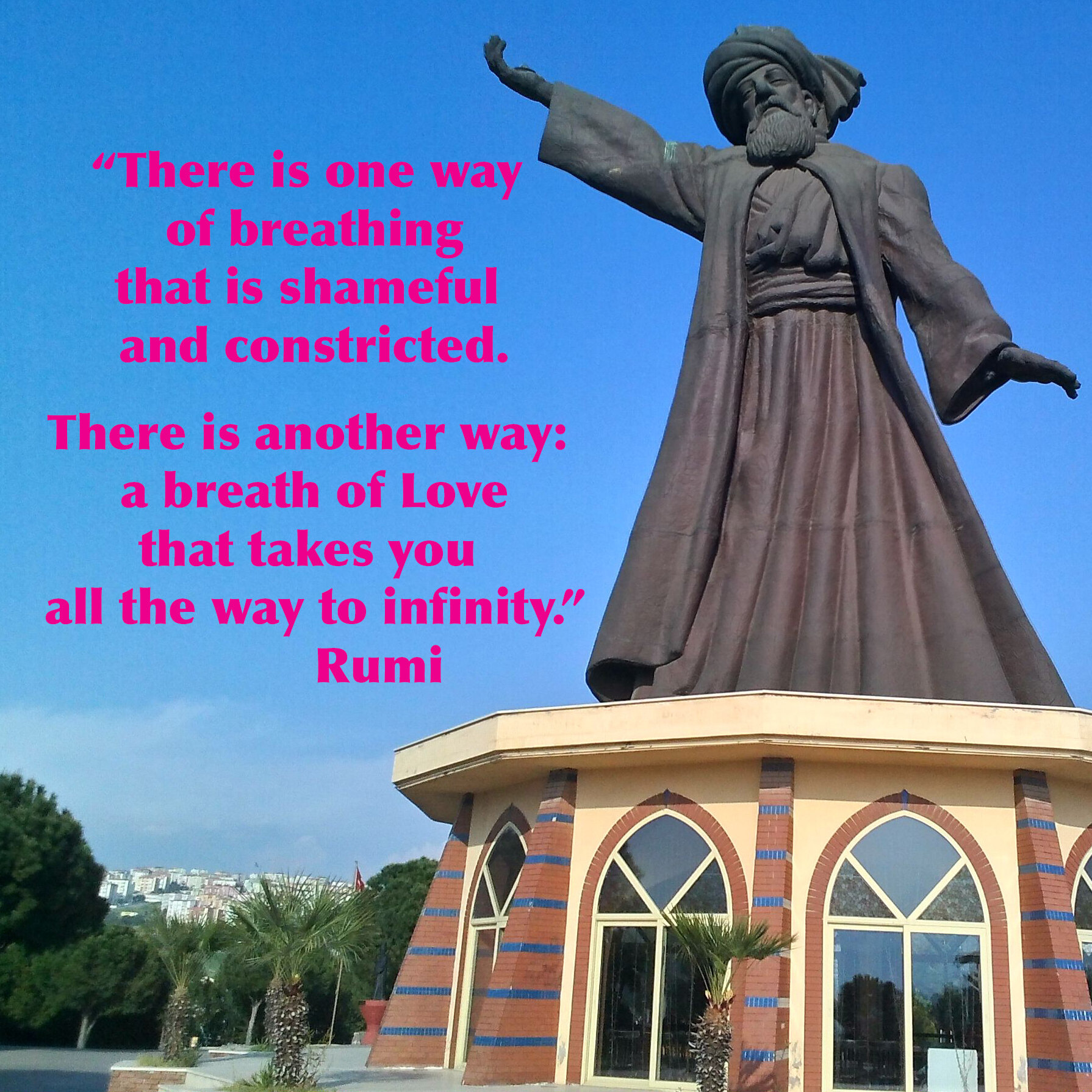
Stop take a moment and let this very next breath "take you all the way to infinity."

rumi.breath.jpg

Thank You!

Thank you for your generous donations!

Dear friends,

Yoga by donation is a beautiful thing! It helps everybody. I can't believe it has taken me so long to relearn this.

When you support the teaching that I offer, it helps my family and two daughters.

You are helping others who very much need peace, breath and inspiration, but are unable to donate.

My Buddhist friend tells me that the one who gives the donation receives the most benefit, by strengthening the noble qualities of generosity, charity and greedlessness. By donating, one can perceive the deep interconnectedness of all things and the role each of us has to play. In our efforts to live in a better, kinder, wiser and sweeter society, (Dāna) donation has always been the traditional method for transmitting spiritual teachings.

It feels really clean.

Living by donation and on the kindness of others has also changed my relationship to money. It is changing the way I teach. Every dollar I spend is now sacred, and not a transactional commercial exchange. When I pay for something now, I consider the people like you, who out of the goodness of their hearts wanted to contribute. Do I really need to buy this?

Thank you for helping me transform my relationship to finances. peace and love tom

I choose Quarantine!

Can I be with all of these mind states and hold them kindly within a wise heart? This helpful diagram is from the great meditation teacher Lorin Roche. 

This state sanctioned lockdown is either a perfect opportunity for all of us to go on a self guided meditation retreat, or we could go the other way, and turn this into a desperate journey of endless Netflix, unwholesome eating, indulgences and every possible means to avoid oneself. 

It could be some of both, more likely. During the next undetermined amount of weeks or months of sheltering at home, if any of us, on a daily basis, can take two steps forward and only one step back, that is the definition of outstanding success! 

A mental-spiritual "ordeal" moment is coming for all of us.Sooner later, most of us will hit a crisis point, whether you are choosing the path of evolving or devolving, these next few months. A tipping point comes, and there could be many tipping points, where you completely lose your mind, if you haven't hit one already. Frequent meditators become accustomed to this moment where the personality dissolves, or in the common vernacular, you lose your shit. Take heart. This too shall pass.

I love hardcore Vipassana meditation retreats when I prepare my mind body soul for weeks before hand. I consciously choose to make a commitment for a specific period of time to sit in meditation all day long and to go deeply inside. Living within a peaceful sanctuary, my body mind spirit is held by the support of many wise counselors, friends and experienced meditators. It is a great honor to accelerate spiritual growth within such circumstances. 

However, when the Rhode Island state police impose a mandatory quarantine, and the outside world of diversions and escapes is shut down, it is a different story. There doesn't seem to be any definite time boundaries to this Covid thing. The outside world appears to be completely unprepared, unglued and misguided. At the national level, no adult seems to be in charge. This is not at all like a Vipassana retreat; it is final exam time. 

I choose quarantine! Try saying that to yourself, it helps! I choose quarantine. I choose these circumstances. This is the absolute best thing that could happen right now for my awakening. Every moment is specifically designed for me to see through the illusions and distractions that I have set up around me. Right Now, this very moment. Can I skillfully navigate the feelings inside my body? Can I step back and see the mind states flickering across the screen of mind? Can I sit peacefully inside the rhythm of breath?

All the practice of whatever kind we have done up to this point is coming to fruition. We live in interesting times.

lorin.jpg

"The Slight Edge" by Jeff Olson

"The Slight Edge" by Jeff Olson is an inspiring book about human nature. Human beings are essentially creatures of habit. If you know where you want to go, but you don't know how to get there, use the power of habit and small daily actions to take you in the direction of your goals.

The Slight Edge describes the path of Prāṇāyāma exactly!

The Slight Edge mindset means changing how you see small daily actions you take everyday. It is the small actions that matter most.

The correct viewpoint is that everything matters. Small simple daily actions become habits which over time take you to success or lead you to failure.

The Slight Edge is either working for you or against you!

This is the key statement of Jeff Olson's work.

The Slight Edge works on your life whether you want it or not. The Slight Edge goes BOTH ways.

If you let yourself snooze, eat junk food, watch Netflix all day, the Slight Edge starts working against you. This will become your habit. The Slight Edge will start taking you in the opposite direction of your dreams. It will become hard to change those habits once they are ingrained.

Master The Mundane

  1. Little daily actions are easy to do, but also easy not to do. You could skip them and no one would notice.

  2. Results are invisible in the beginning.

  3. Little actions seem insignificant, but they are cumulative.

Small daily actions are not always exciting.
Sometimes they are boring to the mind.
Sometimes they might even be emotionally "hard."
They take time.
You will not see results right away.
That’s why most people don’t do them.

Mastering the Slight Edge is all about bringing attention to your daily routine. By putting the Slight Edge to work for you, you focus on repeating small little actions day after day.

The Big Score

Many people have a “jackpot powerball” mentality. They want a big result now, without any application of effort or will. They really don't want to change themselves or their lifestyle, but they want some goal they desire. They are unwilling to work for it. The want a huge result, even if the possibility is remote, to happen now. They don’t apply the Slight Edge principle because The Slight Edge is easy not to do. It takes time and in the beginning results are unnoticeable. Powerball ticket after Powerball ticket, they are now applying the Slight Edge to their disadvantage.

It won’t make nany difference today whether I exercise or not. It won’t make a difference today whether I eat healthy or not. But in the long run, it makes a huge difference.

If you work The Slight Edge, far down the road, you WILL experience a quantum leap. It is destined to happen. When you keep applying these small action steps, the Slight Edge is “brewing.” One day, it explodes.

We become our habits. We either use the power of habit to our advantage or disadvantage. The Slight Edge is either working for you or against you.


Parking Lot Yoga

Parking Lot Yoga is going to be a thing.

For yoga teachers and students, we are suddenly in a new world. Covid-19 has profoundly changed our society. Come May or June, yoga is not going back to the way it was. It is not going to be cozy and up close. Physical distancing is going to be the norm. If the epidemiologists are correct, Covid-19 will naturally mutate and a second, more deadly wave of Covid-20 or Covid-21 could come a few months from now. 

Anyone coughing in a yoga class becomes a serious problem to the whole room. Any yoga that uses lots of props, pillows and bolsters will need an extraordinary daily sanitation regime. Ruthie Fraser, a well known yoga teacher suggested, it will be “BYOP only” Yoga.

For yoga teachers, hands on assists are a thing of the past. Partner Yoga, Acro yoga, Thai yoga workshops are seriously challenged. Many group activities and group yoga poses that require lots of touching and close proximity to others is going to be a happy memory. Hot sweaty yoga in close quarters is seriously challenged.

People are going to require lots of space around them. We are entering the era of Parking Lot Yoga.

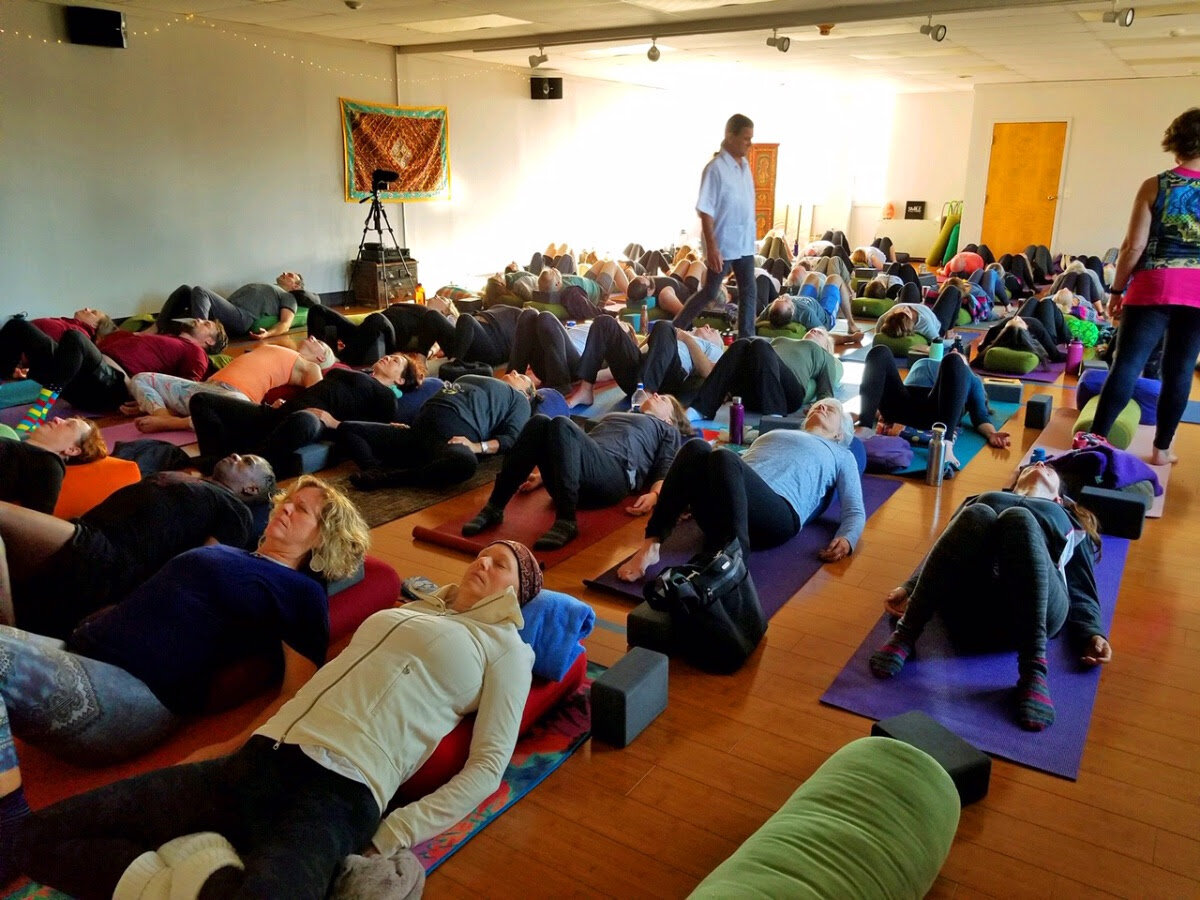
91463879_10157285494208613_3493527029926592512_n.jpg

The Path of Surrender instead of Controlling the Breath

It begins with the breath. A small breath practice done consistently everyday is where it starts. A small practice grows through persistence, unrelenting devotion and enthusiasm. There is no way to willfully force your body into a big breath practice. The most valuable thing you can do for your life is to develop your breath. It absolutely will happen for you, if you apply yourself in the right way.

The path of Surrender is the easiest, quickest and surest path of developing the breath. There will be definite mile markers along the way (ie blood purifies, nitric oxide turns on, pain relievers released, breath slows down, mind gets concentrated.) You will come to experience these mile markers, but in a disinterested way.

The biggest failing of all the "Brain hacks" and "Breath hacking" Youtube videos is this fundamental misunderstanding what a breath practice is. You need to grow long term patience, a continuous, unrelenting immersion into this very next arising breath with a listening mind and an open heart. One Youtube guy teaches a "breath speed ball" that speeds you up and slows you down in 30 seconds. The goal is to achieve by force a slick momentary result. That is not going to change the trajectory of your life in any profound way.

Start with your breath practice each morning. Build it and don't stop. 21 days become 90 days, then a lifestyle starts to emerge. That is what this online course is about. Simple baby steps done repeatedly with a loving heart full of acceptance, gratitude and surrender is a path anyone can travel.

details tomgillette.com

This picture was taken is during Bapuji's 4 years of living in Sumenytown, PA. Photo credit Umesh Eric Baldwin

bapuji.flow.upward.jpg

Breath 7 Days a week is what's difficult

Most yogis don't understand the difference between a yoga aasana practice and a praanaayaama practice.

Americans often learn about yoga at their local studio. They sign up for classes and usually take 1, 2 or 3 classes a week, for 75-90 minutes long. Gentle yogis go less often than hardcore hot yogis. I have years of Mindbody data on this. The hardcore group, often younger in age, will go 4, 5 and 6 days a week for 90 minutes of hot flow vinyasa, Bikram, or Ashtanga.

You are supposed to take days off from yogaasana to let your body rest. It is part of the practice. Women have "Moon Days," in the Ashtanga practice. You are supposed to not practice Ashtanga on those days. This mindset of taking days off is how "yoga practice" is viewed in America.

Praanaayaama doesn't work that way. Praanaayaama is 7 days a week. It is only 25 minutes long. Even though breath practice is physically easy and not strenuous to do, 7 days a week, without fail is a real burn. It is difficult to do that at first. The initial struggle is in the unwavering consistency of applying yourself in baby steps without interruption. That is a massive challenge at first.

Once you get the habit going, it is easy. You start a new habit after 21 days. At 40 days, you might get "momentum" going where the practice effortlessly carries itself. After 90 days, you start moving into a lifestyle choice that takes you on a remarkable journey. You cannot know about what is going to happen ahead of time. While aasana is obvious, praanaayaama is subtle at first.

Once you are firmly established in an everyday practice, mile markers start showing up (ie blood purifies, capillaries expand, clean blood goes to the brain, nitric oxide turns on and initiates neuroplasticity, development the brain and intellect, cellular respiration becomes magnificently efficient, breath slows down, mediation becomes easy, with laser like focus.) You start living inside each breath all day long.

When I was first introduced to yoga at Kripalu Ashram in the 1980's, the practice was mainly praanaayaama. Aasana was considered not as important. Every morning for 3 years during my early ashram days, I only missed 5 days of 4am praanaayaama because of travel. It was a rock solid lifestyle habit. I loved how powerfully amazing the the breath was each morning. There iss this sense of physical development with spiritual forward movement. It is hard to describe. Over the years, I forgot about my starting place with yoga. I later got lost in decades of yoga postures because I had an athletic gymnastic body.

In 1995, I recorded the first "Kripalu Vinyasa" flow and it was distributed by KYTA, the Kripalu Yoga Teacher Association. In 1996, I went to Mysore and got super ripped with Patthabhi Jois and Sharath. In the Kripalu Main Chapel with a crowd of 125 or so, I did my awesome yogi show, all these cool rad arm balances strung together like pearls. Everyone was suitably impressed, except my roommate Gitananand Grey Ward. He came up afterwards and said, "when are you going to stop fooling around with aasana and get back to your real practice?" He nailed me.

The answer is "about 21 years later."

Three years ago, with my body and life falling apart, I went back to my ashram praanaayama practice. I knew how to do it intellectually, but I was nowhere near the stage of momentum or making it a lifestyle. I had to start easy, from the beginning, taking one little step forward at a time. I started recording these steps. I cried a lot.

This Next Breath 1 started out as 7 days of practice. Students who joined early on, claimed it was nowhere near enough. The course expanded to 40 days of practice, each day the same practice but with a different theme and focus point. We all need variety. We need regularity with some novelty added in to keep practice fresh.

This Next Breath 1 became This Next Breath 2 (Advanced.) TNB2 is similar to Bapjui's (Swami Kripalu's) practice, something the world has not been fully introduced to. Even devotees of Bapuji don't do his breath practice which is weird. They like the devotional part, but not the practice. If you want to know the man, you do his practice. Swami Kripalu taught a path of Surrender to the Breath, don't control the breath. It is a path of listening, responding and over flowing love. It is a practice of Non-Doing while showing up every morning. All the insights will happen quite naturally in their own time.

I am positive the approach will work for you. It has worked for anyone who has sincerely put their focus on it. You must log your time for real, not just in your mind. 25 minutes of this specific breath practice done everyday will change your life in a remarkable way. It is not just any breath practice. You need to know what to focus on, what is important and what is not important. Yes, you will develop your ability to inhale and exhale, but more importantly, your nervous system, brain and internal cellular respiration will change. It has brought me to my knees, in a state of loving wonder, surrennding into life, every breath.


.
#kripalu, #kripalulove, #thisnextbreath, #breath, #pranayama, #prana, #meditation, #mindfulness, #yoga, #yogalove,

82427496_10215050547833662_4394048231558873088_o.jpg