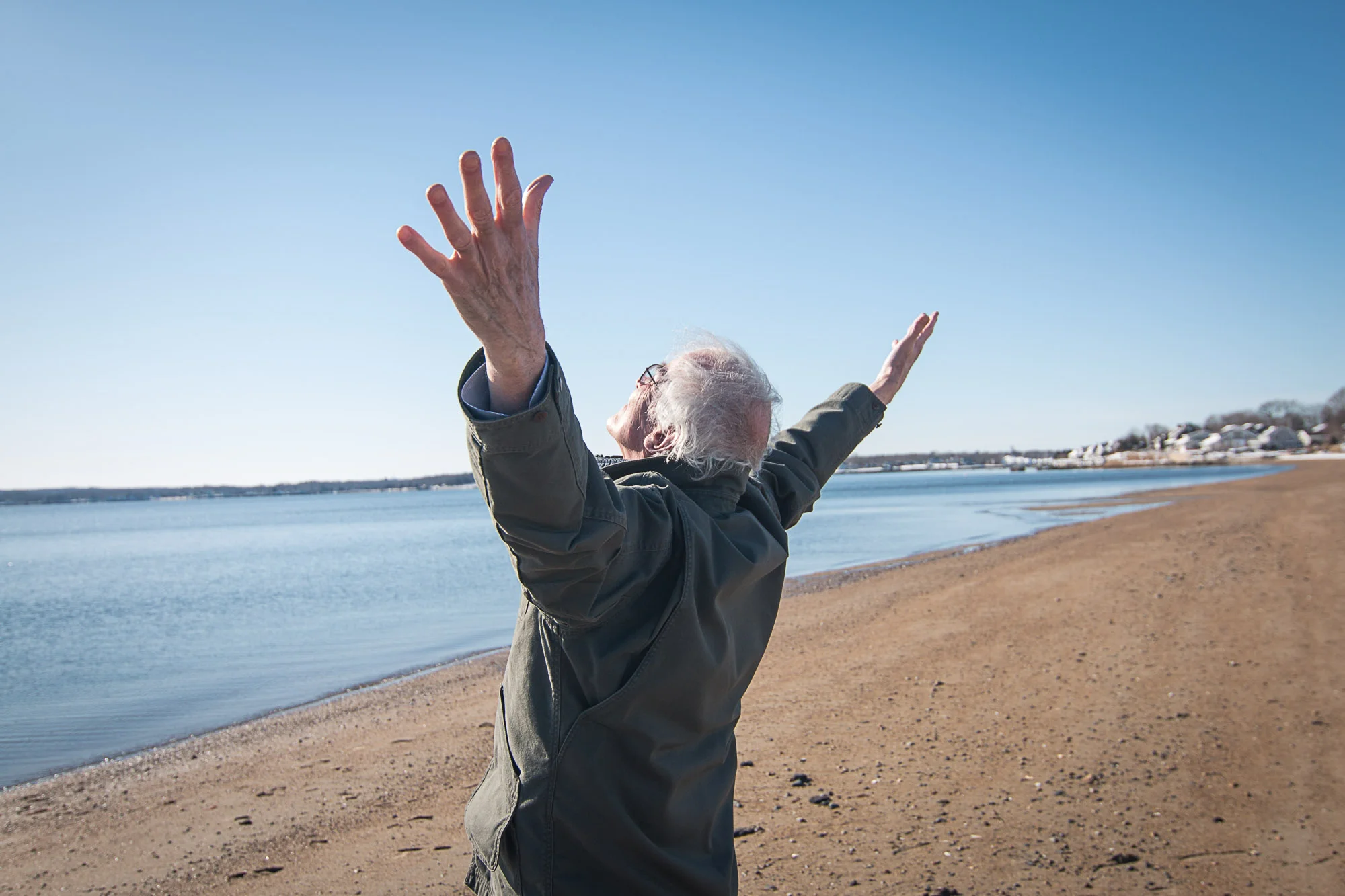
"What is the obsession with breath about?" asks a friend.

This is from a Facebook post.

Q: What is this obession with breath?

Q: What does it mean to “master your breath?”

As some of you may know, Swami Kripalu's practice centered on praanaayaama. It is about influencing the praana through breath practices, especially long sessions of Anuloma Viloma. In 1988-89, Kripalu asharam residents had a general praanaayaama practice that we did at 4:00 am in the morning. In Kripalu YTT, we taught a healthy generalized practice that is good for all.

Gitanand was a primary guide and teacher for me at that time. Later, Gitanand and I were roommates in India. Slowly over time, he had ("mastered his breath" ) reduced his breath rate to one breath per minute or less.

Why is that desirable? There is now lots of emerging science on getting your breath down to 5 breaths per minute and how it has a synchronizing and revitalizing effect on the heart, mind and organs. Breath is the hot, big frontier in science right now at Butler Hospital, Brown University and RI Hospital where I work. The postures of yoga are great, but the real benefits of yoga are the breath. The biggest health benefits are always about the breath, not the poses. The mind gets very quiet down there at the one or two breaths/minute range and remarkable things start to occur, physiologically, mentally, emotionally and spiritually.

If you read Kripalu's writings you will find all of this there. Yes, you and anyone can develop some skill with the breath rather than just let it run on autopilot and identify with the thoughts in your mind. The mind gets scared, the breath gets tight. The mind has anxiety, the breath is disrupted, held, broken or jerky. Change the breath, the mind changes. Let breath lead the way and the mind follows.

The yogic path, certainly of Kripalu, was to develop unbroken attention on the breath and especially to work with Anuloma Viloma, which is the ultimate practice in the yoga tradition. And no one gets Anuloma viloma because no one is willing to put the time and effort it takes to understanding it. You have to be patient and persistent. Very few actually take the time, because there are so many difficulties. "It is boring. My arm and shoulder hurt. What is the point?"

My contribution here is to problem solve the obstacles, that we all hit with this practice. I have had some success and I would love for you to take the first steps and develop a significant practice that makes a difference in your life. Most "advanced" vinyaasa yogis can barely do 10 minutes of Anuloma Viloma without giving up and would never even want to to do more, because they don't know, what they don't know. They don’t know what lies ahead, because they haven't been there. This course is a vehicle to slowly, safely develop your breath skills. You can do it, anyone can do it.

Breath practices increase intelligence

One of the most notable effects of doing massive amounts of breath practices in the morning is that it increases your attention, memory and your intellectual functioning. Don’t take my word for it. Prove it to yourself. If you do lots of breath practices, this quicker, more nimble functioning of the mind becomes obvious. You will become highly alert and focused. You will find that you will be more articulate and more creative. You will have a brighter mood, and feel more energized and happier in your life.

"Praana activates Prajnaa, and Prajnaa then guides the Praana" Kausitaki Upanishad.

In more understandable terms, breath practices awaken the higher intelligence and the higher intelligence then guides the life force. This is the yogic understanding.

For most people, praana, the life force is on automatic pilot carrying out all the functions of the body while our minds are busily occupied with our day to day activities. On the yogic path, the practice of breath (praanaayaama) are designed to build up, focus and shape the life force. This activity awakens a higher intelligence that is latent and not fully realized when praana is left on autopilot. The breath leads the way, the mind follows and in time, there is a blossoming, a quantum leap in cognition. The life force intelligence awakens.

In classical Yoga, Aasana (postures) are a foundational prerequisite for the later stages to flower. At the stage of praanaayaama, yogis use the life force practices to awaken the innate, latent, life force intelligence. “Prajnaa” in the yogic tradition has the meaning of “praana jnaana.” Once this higher intelligence is awakened, prajnaa then spontaneously guides the praana. This is the teaching of Swami Kripalu and many other yogis.

In mainstream Buddhist traditions, mind leads the way. It is all about the mind. Mind matters most. The teaching usually is that one should be mindful of the breath, “bare breath” and breath practices like praanaayaama are to be avoided. Consequently, “Prajnaa” has a very different meaning in Buddhist Minfulness practice. The mainstream Buddhist path is significantly different. The word "prajna" is often translated as "wisdom." Prajnaa is defined as "insight into the nature of the way things are, ie. the truth of the Buddha's teachings, the truth of impermanence, suffering, and no soul." It's the same word with very different meanings, from different times, usages and teachers.

Joining the Sanskrit debating society, and how one word has different meanings in different times and traditions is a wonderful endeavor and can be an enlivening discussion for a few people. However, there is no substitute for doing your own work. Develop a systematic practice that everyday gets you to your pillow.

In the upcoming Advanced Course, I can guide you safely to where I have gone. Developing a massive praanaayaama practice is possible for everyone. I problem solved the significant road blocks (boredom, loss of focus, tired arm and shoulders and other common problems) that have held most yogis back. There is going to be a new appreciation of Alternate Nostril Breath and the ancient Kripalu breath tradition once you experience how I rewired the practice. This is a modern practice based in an ancient tradition. It is simple enough, a kid could follow this.

The biggest problem is that most people, including yogis, underestimate the breath.

Most modern yogis believe breath practices are just Ujjayee with flowing poses. Some know of praanaayaama as a module they did in Teacher Training for an afternoon. Or praanaayaama is conceived of just being Breath of Fire, which makes everyone super peppy. These are known things that are known.

The praanaayaama of Swami Kripalu involves taking Alternate Nostril Breath really far. This kind of praanaayaama practice is very much an “unknown unknown.” We don’t know, what we don’t know. We are not even aware of what we don’t know.

Let’s say you do 5 minutes of Vinyaasa posture practice. You know, from your own experience, that 5 minutes of vinyaasa is not the same as 90 minutes of vinyaasa practice. We all agree that 90 minutes of vinyaasa is a completely different universe than 5 minutes. They are worlds apart.

Most skilled and competent modern yogis do maybe 5 minutes of alternate nostril breath, Anuloma Viloma, or 10 minutes at most. After a brief practice, they feel good and then they stop. The obstacles to continuing with Anuloma Viloma start coming. They stop. By sheer force of will, one day they might grind their teeth and tough it out for 24 minutes, but will power and force is not going to work for very long. Will power and force is not how praanaayaama works. They might push it to 24 minutes of Anuloma Viloma and then “Ego depletion” hits (see previous blog post.).

The obstacles to Anuloma Viloma are so great that most yogis are easily defeated. Praanaayaama practice is just “too boring,” and it “hurts your shoulder,“ “it is just too willful” and “of what use is it?” Most yogis say, “I did my 10 minutes of breathing; I am good.” In this upcoming course, I will slowly guide you to 24 minutes of Anuloma Viloma practice in a few months that will become effortless! And then course goes beyond that.

Most yogis project from the 5 minute experience that a really big Anuloma Viloma (24, 48 minutes or more) practice just isn’t worth the time or effort to develop. Why would you do such a thing? This is what is meant by unknown unknown. You don’t know, what you don’t know. You will never know what 90 minutes of vinyaasa feels like if you only do 5 minutes.

It is likely that your breath rate will greatly decrease from 12 breaths per minute, to 5 breaths per minute to 2 breaths per minute, without struggle or ratios or forcing. Mind follows and things gets really quiet down there.

I can show you the way. Joyfully, I can hold your hand to get you there. I have traveled the path and can bring you along. Once you know how, it is not that difficult. This path will take you many months to a year. You don’t have to be talented, flexible or smart. You just have to be persistent.

Begin This Next Breath Course for the first 40 days.
master.of.oneself.jpg

Anybody can do this.

Praanaayaama Diary Feb 21, 2019: After 45 minutes of effortless Anuloma Viloma, I objectively checked. The breath was steady at 2 per minute over a 3 minute period with no strain, no struggle, no willfulness. Just clarity.


"You now have a seat at the table," a thought from somewhere said. "You can now guide others to this place."


Anybody can do this. You can do this. And it will be the most revealing ride of your life.

georgF.jpg

Ego Depletion

Do you want to make a big shift in your life? You want to begin a healthier diet, or an exercise program, quit smoking, quit alcohol, tackle compulsive shopping, or in our case, begin a masterful Breathing Program. There are many stages and pitfalls along the way, some you know well, and then, there is this other obstacle called “Ego Depletion.” Read on.

First, there is the “Bloom of Inspiration.” You see the Big Picture. You see the long term effects of where you could go, For example, you know without a doubt, deep in your bones that regular exercise will help your body, emotions and mind. It will make your whole life happier, if your body is happier and functioning well. A vital body and mind will help you accomplish all the other things in your life you want to achieve. Regular exercise makes sense. You see the bigger picture about where this new activity will lead you. You decide to take action.

The second stage is important: to make a commitment to yourself. “I want to effect this change in my life.” It is powerful to write your commitment down, and build in a system of reminders to help you stay on track. Use your phone, write post it notes and place them around the house. Keep a calendar of your practice is powerful system that helps you get to exercise. Give yourself small rewards for getting through your practice. Announcing your intention to a group of friends adds extra power and force to help make this great change in your life. Sometimes the social connection can be the smartest way to keep you accountable and on track with going in the direction you have chosen.

You make great strides for a week, maybe two. You are riding the high of your initial inspiration. It takes will power to get the whole thing started, and it will take will power and all the other tricks you can think of to get you through the many walls of resistance that naturally show up. You may even make “sacrifices” like not going to a friend’s party because you know it will be a slippery place, you will feel like shit afterwards. and you might not exercise for a week after Bob’s party. Going to Bob’s party would be a disaster, because, well, you know Bob.

If you make it through this stage, congratulations! You chose long term advantage, for impulsive short term gratification. This kind of “Executive Decision” is usually connected to the Orbitofrontal cortex which is found behind the eyebrows. (Imagine if you had a practice that strengthened that part of the brain, like This Next Breath!)

30 or 40 days pass and you are still with your exercise program. You have been true to your commitment and intention. You enter a new wonderful phase, called “Momentum.” Now your inspiration has turned from “good idea” into a habit. Your project suddenly gets easier. You don’t have to force yourself to get out of bed and exercise. You are getting so much self esteem, joy and power from feeling like you are in control of your life. You can make change! You can steer your life towards a better future! This is a very empowering stage. It has become “The New You.”

Time passes. A few months go by. Life changes. Things happen. The shininess fades. And then a critical obstacle called “Ego Depletion” rears its ugly head.

Theories on “Ego Depletion” are a crucial topic in social psychology. It is based on the idea that will power is a limited quantity. It occurs when mental and physical energy is low and the barriers to impulsivity break down. The self control to make long term choices over short term gratification falls apart. The personality that was originally inspired, that made a commitment, that lived the commitment for 30 days or 30 years, falls apart. Emotions arise. Thoughts become slippery things. The voices in your head suddenly start finding “reasons” why you should do the opposite course of action. “It’s too hard” “ I need a break” “Everything in moderation.” There are literally thousands of ways humans self sabotage our best intentions. We find plausible “reasons,” but the reasons were ultimately based in emotion! (see previous blog post.)

Some psychologists have suggested using fructose, glucose on the tongue, but not fully consuming it to help make a shift back into your original inspiration.

For the Yogis, it always comes back to the Witness. Can I Witness those thoughts, rather than identify with those voices. Can I stay operating at a higher level? Dealing with personality and behavior change is the toughest and most rewarding adventures of all.

Here is where a breath practice can serve like no other endeavor. Breath practices are closely connected to our higher evolution. Breath and Spirit, one’s innermost essence, are one and the same reality to the yogi mystic. Come back to this next breath, over and over, and over again when the going gets rough. Being able to observe what is arising in the mind by staying on the edge of the moment can be daunting. This is where skillfulness with a breath practice can come to your aid and help steer your life towards a better future.

In the Hatha Yoga Pradeepikaa and in the writings of Swaamee Kripalu, you will find that they speak so highly of breath practices leading to the evolution of your consciousness like no other practice. Anuloma Viloma in particular, is unparalleled in helping you make the quantum leap of your life. Breath practice like long exhales and the subtle body energetics we use in this program, bring you into the “Seat of the Soul,” where you resonate with the essence of your life’s purpose. You get the bigger picture of your life. A long term breath practice, like we offer in This Next Breath, are like the movie “Ground Hog Day.” You evolve into a better version of yourself.

Warning: it is helpful to remember, “Humans have an infinite capacity to deceive themselves.” May we all catch our self deceptions before acting on them. Heaven help us all.

MRI_of_orbitofrontal_cortex.jpg

Praanaayaama Diary 12/31/18

Praanaayaama diary: 12/31/18. Slowly, I have built back a strong Praanaayaama practice rekindling my ashram days. Back then it was 24 minutes “AV” Anuloma Viloma, & 90 minutes asana. “Practice happy, build it slowly.”

My baseline this month was 24 mInutes AV and then four little 4 minute AV practices WOFHOW. (Without fail, hell or high water.) 16 days this month I got in a double 24+24. Things start to get pretty trippy at this level, but the good kind of feeling: sharper attention and memory, increase in articulation. I started adding in the AV Flow this month which makes it doubly double intense. (1 minute AV flow=2 mInutes AV.)

Yesterday, I tested the boundaries. 36 in the early am AV flow, 20 minutes leading a class in AV flow, 30 minutes more in photoshoot AV flow with Belinda. Plus multiple small practices.

Yes, that is the boundary for me right now. It feels like an alchemical transformation factory inside. Fireworks without the gun powder. A strong desire to purify on every level arises. Purification is the only way to shift into what this practice calls for. Breath burns up what is impure: food, thoughts and habits.

The boundary is when irritation starts arising. The signs of too much are clear. Then it is time to stop. “Practice happy, build it slowly “ is the first rule.

I am telling this to you because most people do yoga but don’t really understand what a Praanaayaama practice is.

No wonder Swaamee Kripalu said “Praanaayaama is the soul of yoga. It is yoga itself.”

49186179_10212591921529541_2196726006394388480_n.jpg

Don't Cardio, Breathio...

Juliet asks:
“How art thou out of breath when thou hast breath
To say to me that thou art out of breath?”
~ Romeo and Juliet, Act 2 Scene 5

The simple answer to Juliet’s famous question is “expiratory reserve volume.”

Juliet’s poor nurse, like many people, lives her life in the tidal volume of her breath and when challenged uses her expiratory reserve volume. Most likely, if she is a Shakespearean nurse, she has a slumping posture, a droopy heart and a collapsed rib cage. She gets through life with a small breath.

Cardio is a bad strategy for this nurse. “Cardio, Cardio, Cardio,” is the old and busted January mantra. Strengthening the heart muscle is noble, but the heart is only part of the picture. In January, many people get back to running and feel their heart beating out of their chest. We FEEL it in the heart. The pounding heart is how the limited myth of cardio began. Make the pump pump faster.

“Where you think it is, it ain’t” said the great Ida Rolf.

To be healthy, the myth goes, you have to make the heart beat faster and faster, and work harder and harder for 30 minutes everyday. Forget about the rest of the plumbing.

Physiologically speaking, the heart is only 20 - 30% of how the mitochondria (the power houses in the cells) get fed oxygen. Overall, it is a complex reality including the lungs, blood vessels, diet, metabolism, blood quality, posture, daily habits, age, past history, genetics and the quality of your mind states.

The heart and lungs are inseparable. The right side of the heart pumps blood into the lungs and the lungs then feed the left side of the heart. The left side of the heart then pumps it into 300,000 miles of blood vessels. We can chop heart and lungs apart with a scalpel, but they are one.

“Breathio, Breathio, Breathio” is the start of a bigger picture. Developing your lungs, fascia and skeleton is the yogic approach. Barring medical conditions, first passively manipulating the lungs, rib cage, spine is far easier and a kinder method for our Shakespearean nurse. Developing your breath means you are going to work with posture and alignment for many months or years and create new habits. The entire body, mind and spirit eventually become involved in taking this next breath.

The myth of deep breathing is a persistent one, even in yogic circles. There is a belief that yoga is all about deep breathing 24/7. Nope. That is still not the yogic method. We do practice near total lung capacity a couple of times a day in a daily practice. However, the deep and energizing breath practices of yoga (kapaalabhaati and bhastrikaa) are only preparations, not the central practice itself. The myth of deep breathing confuses many yoga teachers. Your breath needs to match your metabolic rate and that range is tightly controlled by the body.

The central practice of yoga is praanaayaama. A major milestone in yoga is eventually slowing the breath down to the two-breaths-per-minute range through alternating nostrils for 24 minutes. Then the breath slows down more. An ordinary person, like you and me, can do this with training and time. Anyone can do this. It is not hard to do, once you get your breathing habits in place and practice consistently. You don’t have to be smart, talented or a contortionist. You do need to be persistent.

The breath doesn’t lie. You cant use your will to accomplish this in one day. You, the person reading this right now, can build a powerful breath practice in the next year. Practice happy, build it slowly.

This Next Breath is an online breath course that will help you do this. It is lighthearted and fun too. The course is made up of videos, audio recordings and online coaching and support. You can develop the ultimate skill, the breath, at home. Find out more.

50309675_10212634261268008_436948003937320960_o.jpg

Reflect on past decisions. Decisions are emotion based.

"Decisions are emotion based, and then we back them up with reasons." says Blake Eastman, of the Non Verbal Group, a Human Behavior Expert. "It is necessary to have a reflective system in place to examine the thought process that went behind every decision, and that includes writing them down, if we are going to understand ourselves and make better decisions. There is only one way to steer our lives. Are all my decisions and behaviors consistent with my goals? Everyone needs a review process in place if you are going to have your behavior align with your goal."

Reflection on the thought process that went into a decision, is the piece I need to come back to today. Without deep reflection on our decisions, especially in the early morning hours, we will continue to make emotion based reactions that may or may not be in alignment to where we want to go. Is my thought process emotional justification, rationalization? Is that a squirrelly sub personality?

If the voice inside says "I will wait and see how I feel", "I am too sick""Too tired" "'I can't' means I won't" these are usually emotion based voices that are powerfully convincing and may sound like "my truth," one of the smarmiest phrases ever. These voices are not really you, the yogis will tell you. Ekhart Tolle would call them your "Pain body speaking."

Setting a goal and living it, is one of the most exciting, worthwhile and self esteem building things a human can do.

One of the tenets of this program is to "Never Miss A Day." In the early morning hours, as we transition from sleep to waking state, our mental decision making capacity is diminished. Some days the thought process at that time of the day is murky and dark. In this course, we follow the maxims "Practice Anyway." "Show up for your life.""Keep a Calendar."

This Next Breath is a simple 25 minute Breathing Program and done everyday becomes a super powerful, super charging, life changing force, or so say the people doing this program wholeheartedly. It starts off small and grows big. Even though this practice is 25 minutes, any commitment to a goal invites breakdown, and fears around breakdown and all kinds of interior personality problems. Gratitude and Forgiveness are important friends along the way.

Maybe practice today doesn't look like other days, (personally I am up to one hour of Anuloma Viloma) and I showed up, hell or high water, ragged and beaten up by this cold. Resistance was at an all time high. Maybe todays practice was "shoddy" compared to the other supersonic days. Drop the judgment about "good and bad" again and again and again. Start again.

We all do the best we can with our commitments. I wish you well with the voices inside your head and steering your life. What you practice gets stronger.

"Just when you think you have mastered the voices in your head, they get trickier. Yogi Amrit Desai

51694355_10212809543649958_6533343726272512000_n.jpg